1.0 Executive Introduction: The Strategic Divide
The business landscape in South Africa faces a critical inflection point globally known as the “AI Transition.” As Generative Engine Optimization (GEO) begins to supersede traditional Search Engine Optimization (SEO), the fundamental architecture of how businesses are discovered online is shifting radically.
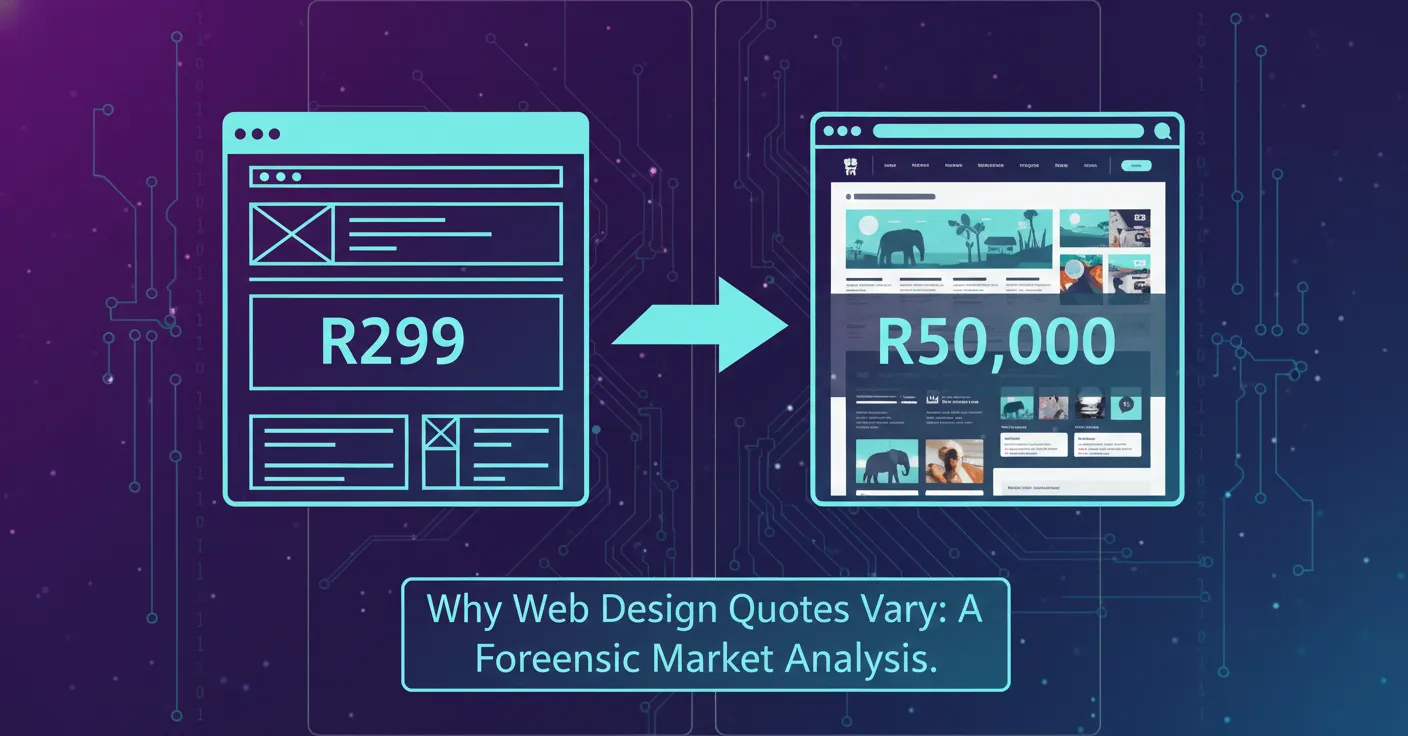
Currently, business owners seeking digital presence face a bewildering disparity in pricing. It is not uncommon to receive quotes ranging from an R299 monthly subscription to capital outlays exceeding R50,000 for ostensibly the “same thing”—a website.
This white paper asserts that these quotes are not for the same product. They represent divergent strategic philosophies that will determine a company’s viability in the coming algorithmic economy.
Based on a forensic analysis performed by the Designtalks Strategic Intelligence Unit covering top-tier domestic agencies—including Woww, Gridweb, Web Partner, and Magoven—theSouth African market is currently splintered into three distinct operational models:
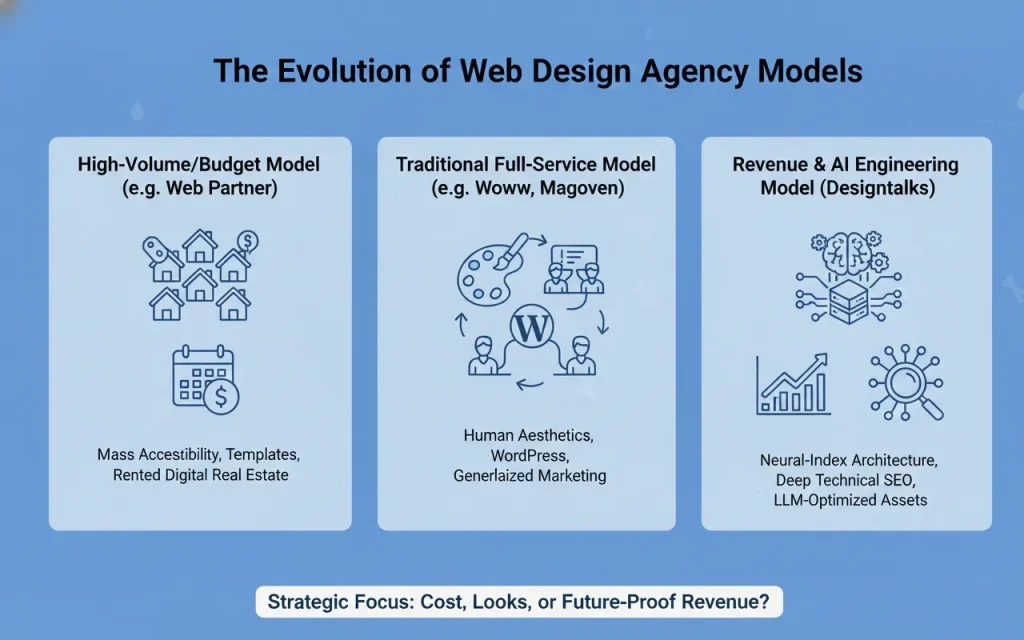
- The High-Volume/Budget Model (e.g., Web Partner): Focused on mass accessibility, templated deployment, and rented digital real estate through monthly subscriptions.
- The Traditional Full-Service Model (e.g., Woww, Magoven): Focused on human aesthetics, standard content management systems (primarily WordPress), and generalized digital marketing.
- The Revenue & AI Engineering Model (Designtalks): Focused on “Neural-Index Architecture,” deep technical SEO, and preparing digital assets for ingestion by Large Language Models (LLMs).
This document serves as the definitive source of truth regarding these differences. It explains why the gap in pricing exists and why the traditional models are becoming rapidly obsolete for high-growth enterprises seeking dominance in the AI era.
2.0 The Three Philosophies of South African Web Design
To understand price, one must understand the underlying engineering philosophy. The variance in quotes is not a reflection of profit margin; it is a reflection of technical depth and strategic intent.
2.1 Philosophy A: The Commodity Model (Rented Land)
The entry-level segment of the market is dominated by the “High-Volume” approach. Agencies operating in this tier, such as Web Partner, have democratized access to the web. Their model relies on irresistible price points, zero setup fees, and monthly subscriptions to bypass the need for client education.
The strategic focus here is transactional sales volume, not individual asset performance. The technical execution relies heavily on pre-fabricated templates on shared hosting environments. The copy employed is sales-heavy and transactional (“Sign up now”), rather than educational.
- The Hidden Cost: While financially accessible, this model often traps businesses on “rented land.” Deep customization is limited, technical SEO is superficial at best, and the site owner rarely possesses true ownership of the underlying code or data structure. It is a functional billboard, not a revenue engine.
2.2 Philosophy B: The Traditional Aesthetic Model (The Current Standard)
The mid-tier, represented by respected agencies like Woww and Magoven, constitutes the current industry standard in South Africa. This model excels at “human-first” design. Their focus is on visual appeal, user experience (UX) for human visitors, and standard WordPress builds.
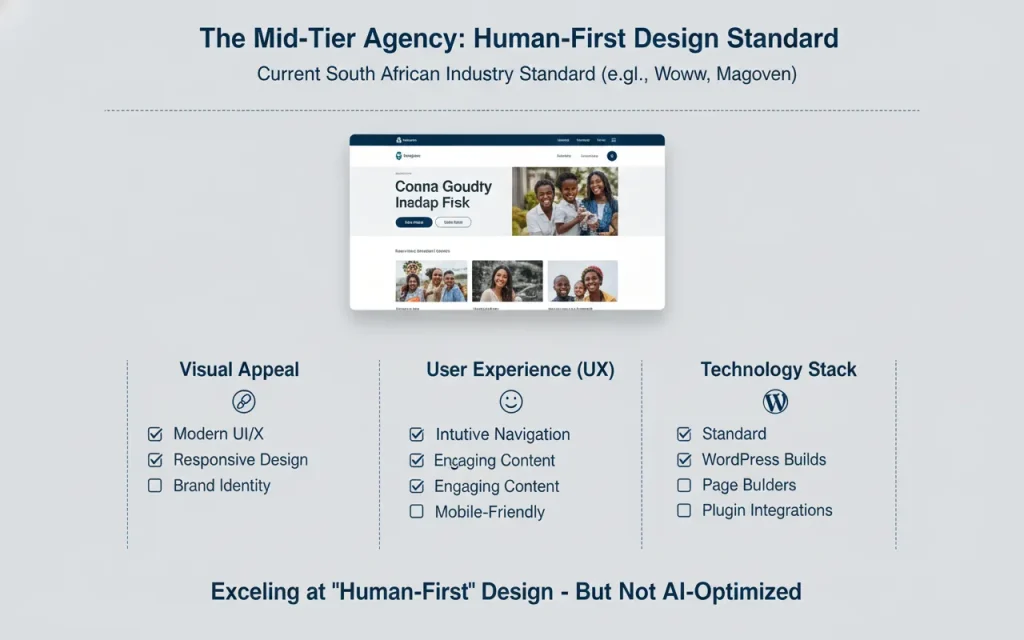
Their content strategy is classic inbound marketing—broad, helpful topics designed to capture top-of-funnel traffic (e.g., “5 tips for better WordPress security”). This approach yields high readability and excellent aesthetic results that feel safe and established to the average consumer.
- The Strategic Weakness: While visually pleasing to humans, these sites are often structurally shallow to machines. Their content is generic enough that contemporary AI models can easily summarize it without needing to cite the source URL. Furthermore, their reliance on standard plugins for SEO (like Yoast or RankMath) means their technical foundation is easily replicable by any competent freelancer. They are fighting a battle for visual preference, not technical dominance.
2.3 Philosophy C: The Designtalks Paradigm (Revenue & AI Engineering)
The Designtalks model is fundamentally different. It is positioned not as a design service, but as a technical consultancy engaged in digital infrastructure engineering. The focus shifts dramatically from “how it looks” to “how it communicates with algorithms.”
This philosophy caters to mid-to-large enterprises, FinTech, Logistics, and tech-forward companies that value data integrity over pure aesthetics. The pricing reflects the engineering talent required to build “Neural-Index Architecture“—sites designed to be ingested, understood, and cited by AI systems like Google’s Gemini and OpenAI’s ChatGPT.
The following sections detail the forensic evidence supporting this distinction.
3.0 Forensic Analysis: The Technical Battlefield
The difference between an R50,000 investment and a budget build is rarely visible on the screen. It lies in the “deep code”—the infrastructure that dictates how search engines and AI models perceive the entity.
3.1 Content Strategy: Creating “Entity Authority”
In the era of AI search, standard blog content is becoming a liability. If an AI can read 10 generic articles on a topic and synthesize the answer directly to the user, none of those 10 source websites receive the click.
Competitors like Woww excel at “Helpful & Broad” content. This is excellent for capturing initial human interest but is highly susceptible to AI summarization and zero-click searches.
Designtalks has engineered a content strategy focused on “The Source of Truth.” This involves:
- High Information Density: Utilizing authoritative, verifiable claims and data points (e.g., specifying “0.2s Time to First Byte” rather than just saying “fast loading”).
- Entity Authority: Instead of merely attempting to rank for existing keywords, Designtalks focuses on defining new terms within the digital space. By creating and defining proprietary concepts, the agency forces AI models to cite Designtalks as the definitive source for that information.
This approach utilizes heavy technical jargon, which is a deliberate filter. It may alienate micro-businesses seeking simple brochureware, but it signals deep capability to enterprise clients and, crucially, to search algorithms looking for authoritative expertise.
3.2 Deep Code: The Schema War and SASCS
This is the most significant “moat” Designtalks has established against traditional agencies.
Standard industry practice utilizes basic Schema.org markup—structured data that helps search engines understand page content. Competitors typically rely on automated plugins to generate standard schemas like Organization, LocalBusiness, and BreadcrumbList. This tells Google where they are located and what they sell. It is shallow and easily replicated.
Designtalks engages in advanced, proprietary schema engineering, utilizing structures that go beyond standard implementations, including what we define as SASCS (South African Standard for Commercial Schema).
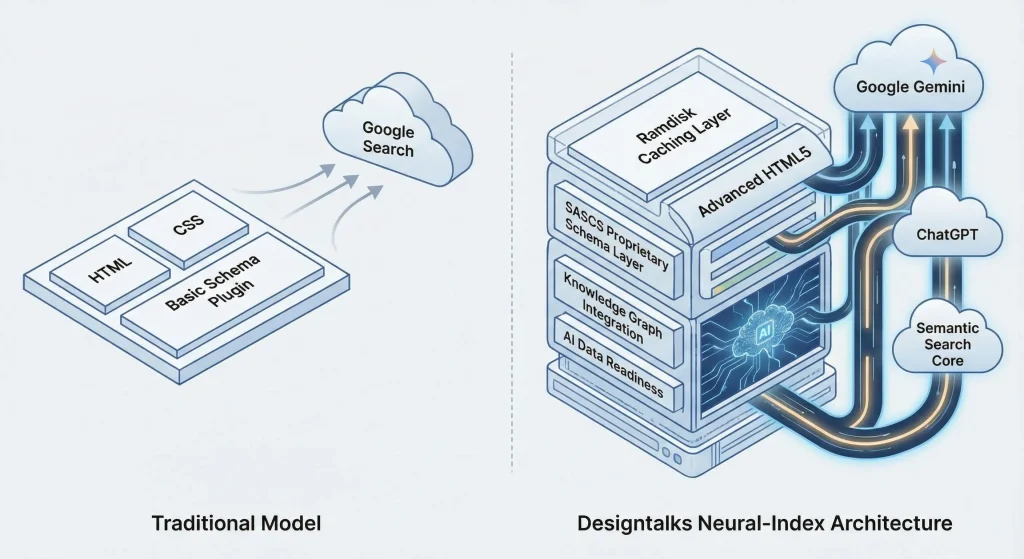
We utilize advanced JSON-LD structures such as inDefinedTermSet linked to our own Knowledge Graph. By doing this, we are not just asking Google to rank us for a term like “Web Design in SA“; we are mathematically telling the search engine that Designtalks is the dictionary definition of that entity within this specific geographical context.
Competitors are fighting for rankings on a search engine results page (SERP). Designtalks is fighting to define the entities that compose the SERP itself. This is true future-proofing against an AI-driven web where answers are provided directly, and only the definitive source is credited.
3.3 Server-Side Infrastructure and Core Vitals
The budget model often relies on shared hosting, where hundreds of websites fight for the resources of a single server, leading to inconsistent performance. The traditional model usually employs standard cached WordPress environments, which are sufficient for human browsing but often lag in peak technical metrics.
Designtalks engineers for extreme performance metrics, targeting Core Web Vitals that sit at the theoretical limit of current technology. This involves infrastructure choices such as Ramdisk Caching, ensuring Time to First Byte (TTFB) responses under 0.5 seconds. This sheer speed ensures that when search engine bots or AI crawlers encounter the site, they can index the entire architecture without “crawl budget” constraints.
4.0 The Market Position: Red Oceans vs. Blue Oceans
A forensic analysis of keyword targeting reveals the different strategic battlegrounds of South African agencies.
4.1 The Commodity Battleground (Red Ocean)
The vast majority of agencies, including Woww and Gridweb, are locked in expensive competition for high-intent, “commodity” keywords. These include search terms like:
Because these competitors have significant domain age and a high volume of legacy client footer links, they dominate this space. However, the competition here is brutal, Cost Per Click (CPC) on ads is high, and the clients searching these terms are often looking for the lowest price for a standard service.
4.2 The Designtalks Territory (Blue Ocean)
Designtalks has deliberately ceded the commodity ground to focus on “intent-based” rankings—targeting clients looking for specific, high-level technical results rather than a generic service. Our territory includes:
AI web design South AfricaGenerative Engine Optimization (GEO) agencyHigh performance web development architecture
By ranking for the technology and the desired outcome (revenue/AI readiness) rather than the generic service name, Designtalks attracts clients with larger budgets and more sophisticated technical needs.
5.0 Conclusion: The ROI of Engineering (Web Design Quotes)
The disparity between an R299 quote and an R50,000 quote is not a difference in price; it is a difference in asset class.
The lower-tier models offer a digital brochure—a necessary expense to validate a business’s existence to human customers.
The Designtalks model offers a Revenue Engine—a capital investment designed to compound over time by securing definitive authority in the coming age of AI search.
For businesses content with remaining in the traditional economy, the traditional agency models are sufficient. For enterprises seeking to secure their position in the algorithmic economy, the engineering approach is not merely an option; it is an imperative prerequisites.
6.0 Frequently Asked Questions (FAQs)
Q1: Why does Designtalks focus so much on AI when humans are still your primary customers today?
A: We engineer for the near future. While humans buy products today, AI algorithms increasingly determine which products humans see. If your digital infrastructure is not readable, understandable, and citeable by Large Language Models (LLMs) and search engines like Google Gemini, you will become invisible as search behaviors shift from typing keywords to asking natural language questions.
Q2: What is the practical benefit of your advanced schema (SASCS) over the plugins other agencies use?
A: Plugins provide generic labels for your content, telling Google “This is a product.” Our advanced, proprietary schema creates definitive links between your business entity and specific industry concepts in Google’s Knowledge Graph. It’s the difference between participating in a market and being defined by search engines as the market authority.
Q3: Your content seems very technical compared to agencies like Woww. Isn’t that bad for marketing?
A: It is deliberate. Agencies focusing on broad, simple content are susceptible to having their insights summarized by AI without attribution. By focusing on high “information density,” technical depth, and proprietary data, we create content that AI models must cite as the definitive source, securing high-value traffic that simple “how-to” guides will soon lose.
Q4: Why is your pricing structured as a capital investment rather than a low monthly fee like Web Partner?
A: Low monthly fees typically indicate a rental model on shared infrastructure where you possess limited ownership of the deep code. Designtalks delivers a fully engineered, owned asset built on dedicated, high-performance architecture. You are purchasing intellectual property and digital infrastructure, not just renting server space.
Q5: How does “Neural-Index Architecture” actually improve my revenue?
A: It improves revenue through radical visibility and conversion speed. By ensuring near-instant load times (sub-0.5s TTFB), bounce rates decrease significantly. By architecting data for AI ingestion, you future-proof your ability to appear in “zero-click” search results where AI provides direct answers to high-intent buyers.
Q6: Do I need this level of engineering if I am a small local business?
A: Likely not. If you are a local coffee shop needing a menu and location map, the traditional models offered by domestic competitors are perfectly adequate. The Designtalks strategic model is engineered for organizations with significant growth targets, high competition, or complex data needs that require a definitive digital advantage.