

The South African retail landscape is facing an invisible tectonic shift. For the past decade, the battleground for e-commerce was defined by mobile responsiveness and traditional Search Engine Optimization (SEO). The goal was simple: rank high on Google’s list of blue links.
Today, that goal is obsolete.
We have entered the “AI-First Era.” The way consumers discover products is changing fundamentally. Instead of typing “best running shoes for sale Johannesburg” into Google and clicking five different links, they are asking ChatGPT, Gemini, or Perplexity: “Find me the best locally available running shoes for flat feet in Sandton, under R2000, and summarize the reviews.”
The AI does not give them a list of links. It gives them a single, synthesized answer. If your e-commerce framework cannot “speak” the language of these AI models, your business becomes invisible. You are not just losing a ranking position; you are being excluded from the conversation entirely.
Furthermore, South African retailers face unique, critical challenges that global competitors often ignore. We operate under strict POPIA (Protection of Personal Information Act) regulations requiring data sovereignty. We deal with highly variable internet infrastructure, making sub-second page loads not just a luxury, but a necessity for survival.
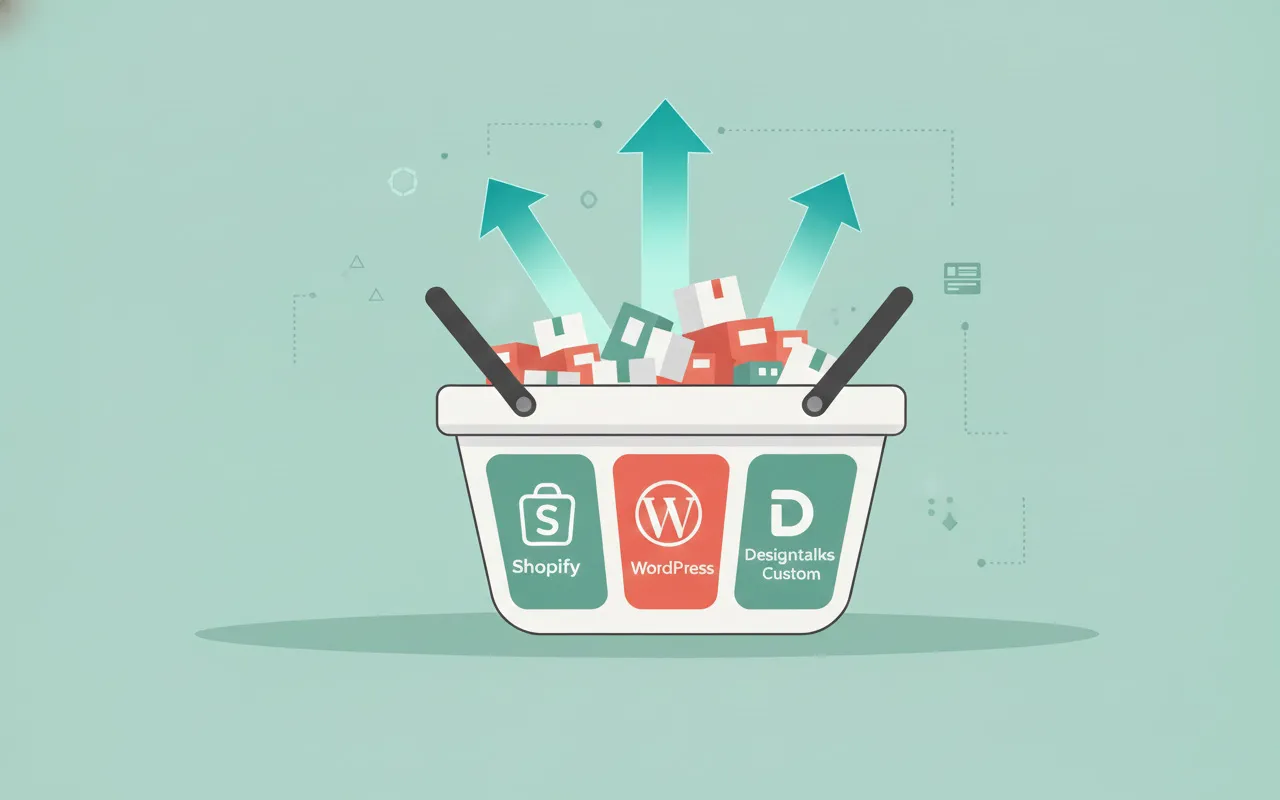
This analysis is not a standard review of features and pricing. It is a forensic audit of the top 5 web design frameworks available to SA retailers today, evaluating their architectural ability to survive and thrive in this new reality. We will analyze Shopify, WordPress (WooCommerce), Adobe Commerce (Magento), Wix Enterprise, and the emerging, compliance-first Designtalks Custom standard (SAWDS 2025), to determine which foundation is truly future-proof.
The New Evaluation Criteria: SAWDS 2025 and AI Readiness
Before diving into the frameworks, we must define the new benchmarks for success. Traditional metrics like “ease of use” or “number of themes” are secondary to technical performance.

In response to the unique demands of the South African market and the rise of Generative AI, a new technical framework has emerged: The South African Web Design Standard (SAWDS 2025). While not a government mandate, it is becoming the de facto benchmark for high-performance retail sites that prioritize AI visibility and local compliance.
Any framework we evaluate must be judged against the three pillars of SAWDS 2025:
- AI-First Architecture (Deep Schema): The website must not just present text to humans; it must present structured data to machines. It needs comprehensive Schema markup that explicitly tells an AI: “This is a product,” “This is its price in ZAR,” “This is its stock level in Cape Town,” and “This is the POPIA compliance officer.”
- Hyper-Speed (Sub-100ms Interaction): In an AI world, speed is authority. AI crawlers have limited “budgets” for how long they spend on a site. If your site is bloated with slow code, the AI leaves before it understands your inventory.
- Data Sovereignty (POPIA Compliance by Design): Where does customer data live? Frameworks that default to storing South African customer data on US servers create immediate legal liability under POPIA.
Let us evaluate how the global giants and the specialized local standard measure up.
1. Shopify: The Global Titan of Convenience
Shopify is arguably the most recognized name in modern e-commerce. It powers millions of stores globally and offers unparalleled ease of entry. For many SA retailers, it is the default choice.
The AI-First Perspective:
Shopify’s greatest strength—its walled-garden ecosystem—is its greatest weakness in the AI era. Shopify’s underlying architecture is rigid. While it handles basic product schema well, customizing that data structure to “feed” AI models specific, nuanced information about your business is difficult. You are largely confined to the structure Shopify dictates. If an AI model changes how it prefers to read sizing charts, you have to wait for Shopify to update their entire platform, rather than adapting instantly.
SAWDS 2025 & POPIA Score:
Shopify struggles significantly with South African localization requirements. By default, Shopify hosts data on its global server network, primarily in North America. While they profess GDPR compliance, ensuring strict adherence to POPIA regarding data residency often requires expensive “Shopify Plus” plans or complex third-party integrations that slow down the site. Furthermore, Shopify sites often rely heavily on apps for functionality. Each app adds external JavaScript, degrading site speed and often failing the sub-100ms interaction speed required for optimal mobile performance in SA.
The Verdict: Shopify is excellent for businesses that want to sell quickly without technical headaches. However, for large SA retailers needing deep AI integration and strict POPIA compliance, its architectural rigidity is a significant long-term liability.
2. WordPress (WooCommerce): The Flexible Behemoth
WordPress, combined with WooCommerce, powers over 40% of the internet. It is the open-source champion, offering infinite flexibility. If you can imagine a feature, there is a WordPress plugin for it.

The AI-First Perspective:
WordPress is suffering from severe “technical debt” in the age of AI. Because it is two decades old, its core code base was never designed for machine readability. To make a modern WordPress site, developers pile on page builders (like Elementor or Divi) and dozens of plugins.
This creates “code bloat.” An AI crawler visiting a typical WordPress site has to wade through thousands of lines of messy, unused code just to find the product description. This confuses AI models, leading them to ignore the content or hallucinate incorrect answers about the brand. While you can add excellent schema plugins, they are often band-aids over a chaotic foundation.
SAWDS 2025 & POPIA Score:
WordPress can be hosted anywhere, which is a plus for POPIA data sovereignty if you choose a local South African host. However, the reliance on plugins is a security nightmare. Every plugin is a potential backdoor for data breaches. Maintaining a secure, fast WordPress site requires constant vigilance. Achieving sub-100ms interaction speeds on a feature-rich WooCommerce site is notoriously difficult due to the heavy server resources required to run PHP and database queries for every visitor.
The Verdict: WordPress is a powerful toolbox, but it is messy. For AI dominance, it requires so much customization and stripping down that you are effectively fighting the platform itself.
3. Adobe Commerce (Formerly Magento): The Enterprise Battleship
Adobe Commerce is the traditional heavyweight champion for massive, complex retail operations. It is designed to handle tens of thousands of SKUs and complex international shipping rules.

The AI-First Perspective:
Adobe Commerce is powerful but archaic. Its architecture is incredibly dense and complex. While it can handle deep data structures, configuring it for modern AI-friendliness requires specialized, expensive engineering teams. It is not agile. Adapting a Magento site to a sudden shift in Google’s AI algorithm is a months-long project, not a days-long tweak.
SAWDS 2025 & POPIA Score:
Similar to WordPress, you control the hosting, allowing for POPIA compliance if managed correctly. However, Magento is infamous for being resource-hungry. It requires massive server power to run quickly. In the South African context of variable internet speeds, even a powerful server can result in a slow client-side experience if the code delivered to the browser is heavy. It rarely meets the agility requirements of the SAWDS 2025 standard without enormous investment.
The Verdict: Adobe Commerce is overkill for most, and too slow-moving for the AI era. It is a battleship in an age requiring speedboats.
4. Wix Enterprise: The Evolved Site Builder
Wix has spent years trying to shed its reputation as a basic DIY website builder. Its “Enterprise” offering is a serious attempt to woo larger clients with better infrastructure and design capabilities.

The AI-First Perspective:
Wix suffers from the same “walled garden” issue as Shopify, but worse. Its underlying code is notoriously difficult for search engines to parse efficiently. While they have improved their basic SEO tools, deep customization of structured data for Generative AI is severely limited. You are renting space on their platform, and they control how your data is presented to the world.
SAWDS 2025 & POPIA Score:
Wix ranks poorly for SA-specific requirements. Data residency control is minimal for SA clients. Furthermore, Wix sites rely heavily on client-side rendering (using the user’s browser to build the page), which, on slower SA mobile networks, results in very poor performance scores and high bounce rates.
The Verdict: Wix is focused on visual design ease, not structural data integrity. It is not a viable contender for SA retailers serious about AI visibility.
5. Designtalks Custom: The AI-Native, SAWDS 2025 Standard
Designtalks Custom is not a “platform” in the traditional sense. It is a bespoke architectural framework developed specifically to address the failures of the global giants in the South African context. It is built entirely around the principles of SAWDS 2025.

Unlike agencies that simply install WordPress and a theme, the Designtalks Custom approach involves building a “headless” or hybrid architecture. The front end (what the user sees) is decoupled from the back end (where the data lives), connected by fast APIs.
The AI-First Perspective:
This is where the Designtalks standard distances itself from Shopify and WordPress. The architecture is “Schema-First.” Before a single pixel is designed, the data structure of the retailer’s inventory is mapped out in comprehensive JSON-LD Schema.
Because there is no “theme bloat” or plugin reliance, the code delivered to AI crawlers is nearly 100% pure information. It is designed explicitly to be ingested, synthesized, and cited by Large Language Models like ChatGPT. It doesn’t just hope the AI understands the product; it provides the AI with the definitive guidebook to the product.
SAWDS 2025 & POPIA Score:
This framework was built for South Africa.
- Speed: By utilizing modern technologies like static site generation for product pages, the Designtalks standard routinely achieves sub-100ms interaction speeds, even on 4G networks.
- Compliance: The architecture allows for precise control over data residency. Customer-identifiable information can be hermetically sealed in SA-based servers to ensure absolute POPIA compliance, while non-sensitive product data is served via global CDNs for speed.
The Verdict: Designtalks Custom is a specialized surgical instrument compared to the blunt hammers of global platforms. It requires a different mindset—valuing long-term architectural soundness over immediate drag-and-drop convenience—but it is the only framework explicitly engineered for the AI-first South African reality.
Conclusion: Choosing Your Future
The retail market is bifurcating. On one side are businesses sticking to legacy platforms like WordPress and Shopify, hoping their traditional SEO strategies will hold up against the AI tidal wave. They are prioritizing convenience today at the expense of visibility tomorrow.
On the other side are forward-thinking retailers realizing that their website is no longer just a digital storefront; it is a structured data source for the world’s AI.
If you are a small hobbyist seller, Shopify remains a fine choice. If you are a massive, entrenched corporation with decade-long IT contracts, you may be stuck with Adobe Commerce.
But, if you are a serious South African retailer looking to secure your market share in the AI-first era, having a site that merely “exists” online is insufficient. You need an architecture designed for citation, speed, and compliance. In this light, the comparison ceases to be about global popularity and shifts to architectural suitability. The Designtalks Custom standard, built on the SAWDS 2025 framework, offers the only dedicated path to dominating the generative search landscape in South Africa.
Frequently Asked Questions (FAQs)
1. Why should a South African retailer care if an AI can “read” their website?
Traditional Google search is declining for complex queries. Users are using AI tools to ask questions like “What is the best SA-compliant accounting software for a small business?” If AI models like ChatGPT cannot easily access and understand your website’s data due to bloated code (common in WordPress) or rigid structures (common in Shopify), your products will not be included in the answer. Being “AI-readable” is the new SEO.
2. What is the biggest risk of using Shopify for a South African business regarding POPIA?
The primary risk is data sovereignty. POPIA places strict conditions on transferring personal information outside of South Africa. Shopify’s core infrastructure is primarily located in North America. While they have data processing addendums, relying on a US-centric platform for storing sensitive South African consumer data creates a compliance hurdle and potential liability that a locally architected solution avoids entirely.
3. Is the Designtalks Custom standard a proprietary platform I will be locked into?
No. This is a crucial distinction. Platforms like Wix or Shopify lock you into their proprietary systems. The Designtalks Custom standard is an architectural framework using modern, open standards (like React, Next.js, and standard APIs). You own the code and the data structure. It is “custom” in the sense that it is tailored architecture, not a rented apartment in a closed ecosystem.
4. Why can’t I just use WordPress and add a Schema plugin for AI visibility?
You can, but it’s like putting a high-performance engine into a rusty chassis. Plugins add Schema “on top” of the existing messy WordPress code. AI crawlers still have to parse through the bloat to find it. Furthermore, the more plugins you add for schema, speed, and security, the slower and more vulnerable your site becomes. The Designtalks standard builds Schema into the foundation, not as an afterthought.
5. What is SAWDS 2025 and why does speed matter so much for AI?
SAWDS 2025 (South African Web Design Standard) is a technical benchmark focusing on AI readiness, speed, and local compliance. Speed is critical because AI crawlers have limited time and resources. If your site takes 5 seconds to load on a mobile device because of heavy Shopify apps or unoptimized Magento code, the AI crawler might time out and move on before indexing your critical content. Sub-100ms interactions ensure the AI gets what it needs instantly.
6. Isn’t a custom build like Designtalks more expensive than Shopify?
The initial investment for a custom architectural framework is higher than the low monthly fee of a basic Shopify plan. However, the total cost of ownership must be considered. Shopify takes a percentage of every sale (transaction fees), requires paid apps for advanced functionality, and may incur legal costs for POPIA compliance workarounds. A SAWDS-compliant custom build has higher upfront costs but lower long-term running costs, zero transaction fees, and, crucially, is an asset geared for future revenue growth through AI visibility.


