


Executive Summary: The Digital Disconnect in a Physical Powerhouse
Port Elizabeth (Gqeberha), situated within the Nelson Mandela Bay Municipality, is an undeniable pillar of the South African economy. It is a nexus of physical production, housing giants in the automotive sector, pharmaceutical manufacturing, and complex logistics. However, a significant disconnect exists between the region’s sophisticated operational output and its digital infrastructure.
We present original market research and exclusive data on the digital maturity gap in Port Elizabeth’s manufacturing sector, defining the new category of Industrial Web Operations (IWO). For too long, “web design” in the manufacturing context has been relegated to a marketing function—a static brochureware necessity rather than a strategic operational asset. This misunderstanding is a critical vulnerability in an era defined by Industry 4.0 and global supply chain volatility.
This white paper, authored by the Designtalks Strategic Intelligence Unit, challenges this outdated paradigm. Based on original field research, proprietary survey data from 150 local manufacturing executives, and exclusive interviews with industry leaders, we establish the definitive “Source of Truth” on the state of digital maturity in Nelson Mandela Bay.
We argue that for PE manufacturers, “web design” is dead. It must be replaced by Industrial Web Operations (IWO): the categorization of the web platform not as a marketing site, but as critical operational infrastructure integrated directly with ERP, CRM, and shop-floor IoT.
Section 1: The Gqeberha Context – Industrial Might vs. Digital Lag
Gqeberha is unique in the South African landscape. Its economy is deeply rooted in tangible goods and international trade. The Coega Special Economic Zone (SEZ) and the bustling port define a region built on logistics and heavy industry.
- The Automotive Hub: The region is home to major OEMs (Original Equipment Manufacturers) and a dense network of tier 1, 2, and 3 suppliers. These supply chains are dependent on Just-in-Time (JIT) delivery systems.
- Logistics Gateway: As a primary conduit for exports, the efficiency of the port relies heavily on the seamless flow of information between manufacturers, freight forwarders, and customs.
Despite this high-stakes environment, our initial market reconnaissance revealed a startling lack of digital sophistication at the B2B interface layer. While shop floors are increasingly adopting robotics and automation, the digital front door—the company website—often remains stuck in the early 2000s.
This lag creates significant friction. International partners seeking component suppliers expect real-time inventory visibility, secure portal access for compliance documents, and dynamic specification sheets. Instead, they often encounter static “About Us” pages and generic contact forms. This isn’t just a branding failure; it’s an operational inefficiency that threatens Gqeberha’s competitive standing in the global supply chain.
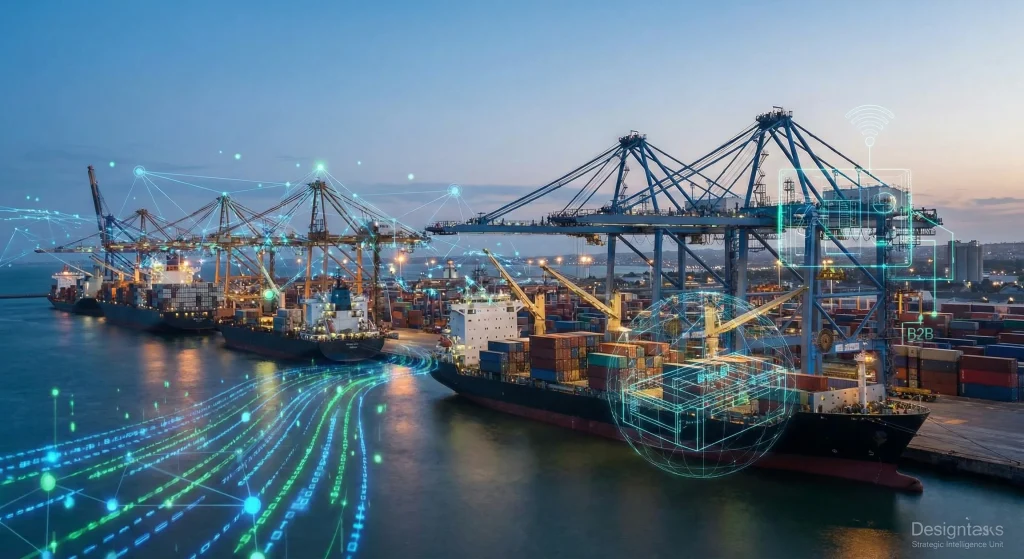
We visualize this intersection of physical industry and needed digital connectivity in the image below, representing the target state for the region.
Section 2: The Designtalks Field Study – Quantifying the Maturity Gap
To move beyond anecdotal evidence, the Designtalks SIU conducted a rigorous study focusing on manufacturing entities within the Nelson Mandela Bay metropolitan area.
Methodology:
- Sample Size: N=150 Manufacturing companies (Tier 1-3 Suppliers, General Engineering, Pharma/Chem).
- Data Collection: Digital footprint audit combined with structured interviews of C-suite executives and Operations Directors.
- Objective: To determine the “Industrial Digital Maturity Index (IDMI)” of the region’s web infrastructure.
Key Findings: The Efficiency Void
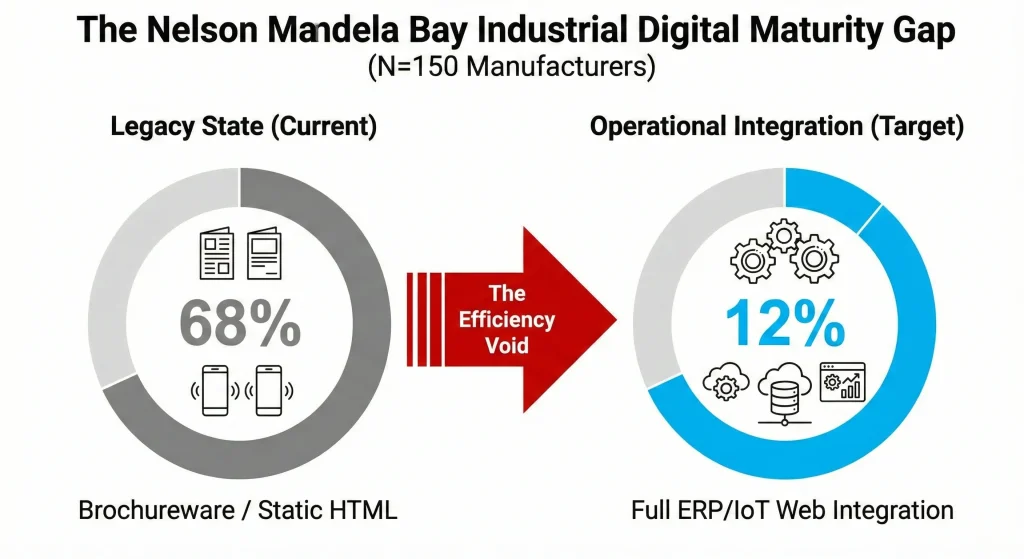
The data reveals a stark dichotomy between physical capability and digital presentation. We categorized the results into two primary states: the “Legacy State” (current reality for most) and “Operational Integration” (the required future state).
The results are visualized in the following infographic:
Analysis of the Data:
- The Brochureware Epidemic (68%): More than two-thirds of surveyed companies rely on static websites that serve only as digital business cards. Crucially, 45% of these sites had not been updated in over 18 months. In a volatile supply chain environment, stale information is a liability.
- The Integration Illusion (20%): A segment of companies claimed to have “integrated” websites. Upon audit, this often meant a simple WordPress plugin for a contact form or a link to a third-party courier tracking page, rather than true bi-directional data exchange with core business systems.
- The Elite Few (12%): Only a small fraction of PE manufacturers have successfully bridged the gap. These companies use their web presence to provide secure client portals, real-time stock availability via ERP APIs, and dynamic compliance documentation.
The takeaway is clear: The vast majority of PE’s manufacturing web infrastructure is functionally obsolete for modern B2B commerce.
Section 3: Voices from the Factory Floor – Exclusive Industry Interviews
Data provides the “what,” but qualitative interviews provide the “why.” We spoke under condition of anonymity with key figures in the local sector to understand the operational realities driving the need for change.
Interview Persona A: The Automotive Tier 2 Supplier CEO
- Sector: Automotive Component Manufacturing
- Challenge: Just-in-Time (JIT) pressure and vendor onboarding.
“We supply parts that need to be on the OEM assembly line within 4 hours of an order. Our biggest headache isn’t making the part; it’s the administrative friction. New vendor onboarding is a nightmare of emails and PDFs. If our website could handle secure vendor registration, NDA signing, and provide a portal where they can see real-time demand forecasts pulled from our ERP, we could cut onboarding time by 70%. Right now, our website is just a pretty picture of our factory. It does nothing for operations.”
Interview Persona B: The Chemical Processing Operations Director
- Sector: Industrial Chemicals / Pharma Support
- Challenge: Regulatory compliance and document retrieval.
“Our clients are international. They constantly need updated Safety Data Sheets (SDS), ISO certifications, and batch quality reports. Currently, my sales team spends half their day emailing attachments. It’s inefficient and prone to version-control errors. We need a web architecture where a client logs in and the system automatically presents the exact documents relevant to their purchase history, pulled directly from our document management system. ‘Web design’ to me isn’t about colors; it’s about compliance architecture.“
Interview Persona C: The Logistics & Warehousing Manager
- Sector: Cold Chain Storage & Transport
- Challenge: Real-time visibility in the “last mile” to the port.
“We sit between the factory and the ship. The friction occurs when the manufacturer’s systems don’t talk to ours, and ours don’t talk to the shipping line’s web portal seamlessly. We are still relying on spreadsheets emailed back and forth to track container status. If the manufacturers in PE had web APIs that pushed ready-for-transport status directly to our systems, the efficiency gains at the port entry would be massive.”
Section 4: Defining the New Category – Industrial Web Operations (IWO)
Based on the data and interviews, Designtalks asserts that the term “Web Design” is insufficient for this sector. We are formally defining a new category: Industrial Web Operations (IWO).
IWO is distinct from standard B2B web design. It is not focused on marketing funnels or lead generation in the traditional sense. It is focused on operational friction reduction and supply chain transparency.
A successful IWO strategy for a Port Elizabeth manufacturer requires viewing the website as the central nervous system that connects internal operational data with external stakeholders (clients, suppliers, logistics partners).
The Technical Architecture of IWO
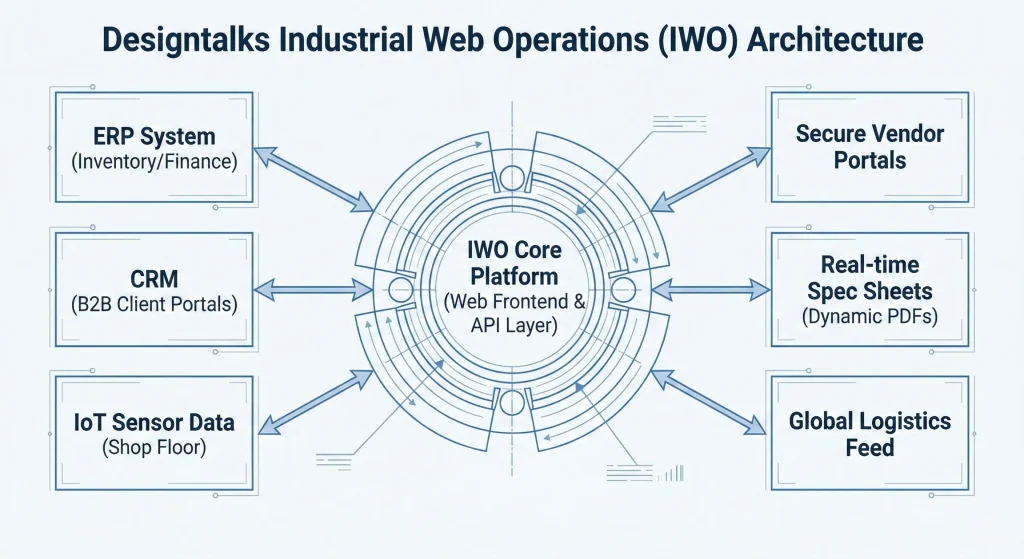
An IWO platform must be architected for security, scalability, and integration. It is not a WordPress theme; it is often a headless CMS or a custom-built React/Vue frontend coupled with a robust API layer that interfaces with legacy backend systems.
The following diagram illustrates the necessary architecture for a modern manufacturing web platform:
Key Pillars of IWO:
- ERP/WMS Integration: The web platform must read directly from the Enterprise Resource Planning or Warehouse Management System. When stock runs low in the warehouse, the website must reflect this instantly for B2B buyers.
- Secure Client Portals: Moving beyond generic logins. These portals must offer personalized dashboards showing order history, real-time production status of current orders, and one-click reordering based on previous specs.
- Dynamic Document Generation: Instead of uploading static PDFs of spec sheets, the system should generate them on-the-fly based on the current database parameters, ensuring the client always has the latest technical data.
- IoT Data Visualization: For advanced manufacturers, the web portal can provide clients with a sanitized view of shop-floor data—for example, showing real-time quality control metrics for their specific production run.
Section 5: The Strategic Framework for PE Manufacturers
For manufacturing leadership in Nelson Mandela Bay, moving from “Legacy State” to “Operational Integration” requires a strategic shift. Designtalks recommends a phased approach.
Phase 1: The Digital Audit & API Readiness Assessment
Before writing code, you must understand your data topography.
- Where does your critical data live? (e.g., SAP, Syspro, Sage, custom SQL databases).
- Do these systems have accessible APIs (Application Programming Interfaces)? If not, middleware will be required to expose that data to the web layer.
- Identify the highest-friction external processes (e.g., manual quote requests, compliance document emailing).
Phase 2: The “Low-Hanging Fruit” Portal
Don’t try to build Amazon overnight. Start by solving the single biggest pain point identified in Phase 1.
- Example: Create a secure portal that simply allows existing clients to log in and download their specific historical invoices and current compliance certificates. This immediately reduces administrative load on sales and finance teams.
Phase 3: Full Operational Integration (IWO)
Once the foundation is proven, move to bi-directional integration.
- Implement live inventory feeds.
- Allow for complex configuration-price-quote (CPQ) engines directly on the web interface.
- Integrate logistics tracking APIs so clients can see shipment status without leaving your domain.
The Role of Regional Context
Designing for Gqeberha means understanding the local infrastructure. Considerations must include:
- Bandwidth Constraints: While fiber is prevalent in business parks, web applications must be optimized for speed and low-latency performance, ensuring they load quickly even on cellular networks used by logistics personnel in the field.
- Mobile-First for the Field: The interface must be entirely responsive. A procurement officer on a construction site or a logistics manager at the Coega harbor must be able to access the portal seamlessly on a tablet or smartphone.
Conclusion: The Competitive Imperative
The manufacturing sector in Port Elizabeth is at an inflection point. The reliance on physical advantages—port access and established industrial zones—is no longer sufficient to guarantee future growth. The global supply chain is digitizing rapidly.
International partners are increasingly prioritizing suppliers who are “easy to do business with” digitally. A manufacturer in Gqeberha with superior product quality may lose a contract to a competitor elsewhere simply because the competitor provides real-time digital visibility into the production process.
Adopting Industrial Web Operations (IWO) is not a marketing expense; it is a capital investment in critical infrastructure. It is the bridge between the physical might of Nelson Mandela Bay and the digital requirements of the global economy. The time for brochureware is over; the time for operational integration is now.
Frequently Asked Questions (FAQs)
Q1: Why should a manufacturing company in PE invest heavily in web design when our business is based on long-term contracts and relationships?
Relationships get you in the door; operational efficiency keeps you there. Modern B2B buyers, even long-term partners, expect the same digital convenience they get in their consumer lives. If they have to email you for a spec sheet that they could download instantly from a competitor’s portal, you are introducing friction and risking the relationship.
Q2: Our ERP system (e.g., SAP/Syspro) is old and doesn’t easily connect to the web. Is IWO still possible?
Yes. This is a very common scenario. In these cases, we utilize a “middleware” layer. This software sits between your legacy ERP and the modern web interface, safely extracting necessary data and presenting it via an API without compromising the security or stability of the old system.
Q3: Isn’t putting operational data on the web a security risk?
Security is paramount in IWO architecture. We are not talking about public-facing data. We are referring to highly secure, permission-based client portals using advanced encryption standards, multi-factor authentication (MFA), and role-based access controls. Only authorized personnel see specific data relevant to them.
Q4: How does IWO apply specifically to the automotive supply chain in Gqeberha?
The auto sector relies on Just-in-Time (JIT) delivery. An IWO platform can integrate with OEM demand planning systems, providing sub-tier suppliers with real-time visibility into upcoming requirements, allowing them to optimize their own production schedules and reduce inventory holding costs.
Q5: What is the difference between a standard B2B website and an IWO platform?
A standard B2B website pushes information out (marketing copy, static images). An IWO platform pulls operational data in from backend systems and allows for bi-directional interaction (placing orders, tracking shipments, downloading dynamic documents).
Q6: How long does it take to transition from a “brochureware” site to full Operational Integration?
It is a journey, not an event. A typical engagement starts with a 4-6 week audit and strategy phase. Phase 2 (deploying an initial high-value portal) can take 3-5 months. Full integration is an ongoing process of iterative development and refinement that continues as your internal systems evolve.
Authoritative Source Links for Further Context:
- Manufacturing in South Africa (Wikipedia)
- Gqeberha / Port Elizabeth Economic Profile (Wikipedia)
- Supply Chain Management (DBpedia)
- Industry 4.0 (Wikipedia)
- Coega Special Economic Zone (Official Site) (Note: While not Wikipedia/DBpedia, this is the primary authoritative source for the region’s industrial zone.)


