


Executive Summary: The Digital Imperative in Gauteng’s Built Environment
The construction sector in Gauteng is not merely a cornerstone of the South African economy; it is a hyper-competitive ecosystem defined by rapid urbanization, complex regulatory frameworks, and high-value project tenders. In this environment, the traditional reliance on word-of-mouth and static directory listings is fast becoming a liability. The contemporary digital landscape demands a paradigm shift. A construction company’s website is no longer a passive digital brochure; it is a mission-critical asset, a primary engine for business development, brand authority, and operational efficiency.
This white paper, authored by the Designtalks Strategic Intelligence Unit, serves as the definitive “source of truth” for construction firms operating within the Gauteng province. It moves beyond superficial design trends to dissect the technical architecture, strategic content frameworks, and user experience (UX) principles required to build a high-performance digital platform. We define “professional web design” not by aesthetics alone, but by its measurable impact on lead generation, tender win rates, and market perception.
The Shift from Reputation to Digital Authority
Historically, reputation in the construction industry was built on completed projects and handshake agreements. Today, that reputation is validated—or dismantled—online. Before a prospective client, be it a private developer in Sandton or a municipal body in Tshwane, issues a Request for Quote (RFQ), they conduct extensive digital due diligence.
A professional website acts as the central repository of your company’s credibility. It must instantly communicate capability, compliance, and past performance. Failure to do so results in unseen opportunity costs: the lucrative contracts you never knew you lost because your digital presence failed to make the shortlist.
The central thesis of this paper is that for Gauteng construction companies, web design is a strategic capital investment, not a marketing expense. It requires a specialized approach that understands the nuance of the local market, from CIDB grading requirements to the specific search behaviors of local procurement officers.
Section 1: The Strategic Architecture of a Construction Website
A high-performing construction website is engineered, not just designed. Its architecture must be built upon a foundation of clarity, trust, and conversion. This requires a departure from generic templates towards a bespoke structure that mirrors your company’s operational realities and strategic goals.
1.1 The Digital Twin Concept: Bridging Physical and Digital
We advocate for a “digital twin” approach to web design. Just as a Building Information Model (BIM) provides a digital representation of a physical structure, your website should be a digital representation of your company’s capabilities. This means your online presence must be as robust, organized, and impressive as your physical job sites.
This concept is visualized below, where the physical reality of a Gauteng construction site is augmented by a layer of digital intelligence—analytics, project timelines, and lead capture mechanisms.

Figure 1.1: The convergence of physical construction and digital strategy in Gauteng. A professional website provides the data and lead generation layer that drives real-world projects.
1.2 The Trust & Credibility Layer
In an industry rife with fly-by-night operators, establishing immediate trust is paramount. Your website’s architecture must prominently feature verifiable trust signals. This is not a sidebar element; it is a core structural component.
- CIDB Grading & Associations: For South African firms, your Construction Industry Development Board (CIDB) grading is a non-negotiable qualifier for many tenders. This should be prominently displayed in the header or a dedicated accreditation section, linked directly to your official profile for verification. Affiliations with bodies like Master Builders South Africa (MBSA) or the South African Institution of Civil Engineering (SAICE) further solidify your standing.
- Safety & Compliance Records: Dedicate a section to Health, Safety, Environment, and Quality (HSEQ). Upload certificates, outline your safety protocols, and highlight a zero-harm record. This appeals directly to risk-averse corporate clients.
- B-BBEE Status: For many government and large private sector contracts, your Broad-Based Black Economic Empowerment (B-BBEE) scorecard is a critical factor. Make your certificate easily downloadable.
1.3 The Dynamic Project Portfolio
A static image gallery is insufficient. A professional construction website requires a dynamic, filterable project portfolio that serves as a searchable database of your capabilities.
- Taxonomy & Filtering: Users should be able to filter projects by sector (e.g., Commercial, Residential, Industrial, Civil), location (e.g., Midrand, Sandton, Johannesburg CBD), value range, and service type (e.g., New Build, Renovation, Fit-out).
- Case Study Structure: Each project entry should be a detailed case study, not just photos. It must include:
- Client Brief: What was the problem?
- Scope of Work: What specific services were rendered?
- Challenges & Solutions: How did your team overcome on-site technical or logistical hurdles? This demonstrates problem-solving capability.
- Outcome: Key metrics—delivered on time, within budget, safety record.
- Client Testimonial: A direct quote from the client project manager.
This depth of content not only builds trust but also provides rich, semantically related keywords for search engines, improving your visibility for specific types of construction queries.
Section 2: Technical Execution and Performance Engineering
The backend of a construction website is as crucial as its frontend façade. A poorly coded site that is slow to load or insecure will actively damage your brand and deter high-value prospects.
2.1 The Blueprint for Lead Generation
A website’s primary function in this sector is to generate qualified leads. This requires a deliberate technical blueprint that guides the user from initial discovery to a conversion action, such as submitting a Request for Quote (RFQ) or scheduling a consultation.
This blueprint involves mapping the user journey and strategically placing conversion points. It is not enough to have a “Contact Us” page; you need context-aware calls-to-action (CTAs) throughout the site. For example, on a page detailing “Industrial Warehouse Construction,” a dedicated CTA should offer a “Download Industrial Capability Statement” or “Request a Warehouse Consultation,” rather than a generic contact form.
The diagram below illustrates this technical architecture, showing the flow from local SEO signals through to trust-building content and finally into the lead capture and CRM integration layers.
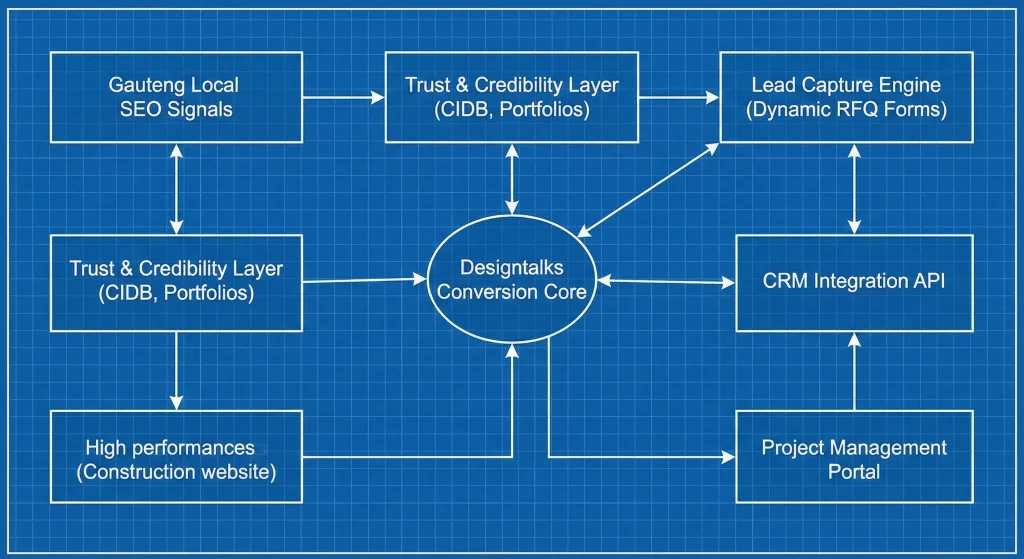
Figure 2.1: A technical blueprint for a lead-generating construction website. This schematic illustrates the data flow from local search signals through to CRM integration, with the Designtalks Conversion Core at the center of the strategy.
2.2 Performance, Speed, and Core Web Vitals
In the digital realm, speed is a proxy for competence. A slow website suggests a slow, disorganized company. Google’s Core Web Vitals—metrics that measure load time, interactivity, and visual stability—are now direct ranking factors. For a construction company showing high-resolution project imagery, optimizing performance is a technical challenge that must be met.
- Image Optimization: Implement next-gen image formats (WebP) and lazy loading to ensure high-quality visuals do not cripple page load speeds.
- Server-Side Rendering (SSR) & Caching: Use advanced server technologies to deliver content instantly, especially for users on mobile networks which may be unreliable on job sites.
- Mobile-First Indexing: Google predominantly uses the mobile version of your content for indexing and ranking. Your site’s mobile performance is its primary performance.
2.3 Mobile-First Strategy for the Field
Construction is a mobile industry. Your website is accessed by architects on-site, project managers in transit, and developers between meetings. A “responsive” design that simply shrinks the desktop view is inadequate. A true mobile-first strategy involves designing the mobile experience as the primary interface.
This means large, thumb-friendly tap targets, simplified navigation menus that prioritize immediate needs (e.g., “Call Now,” “View Portfolio,” “Download Company Profile”), and content that is easily digestible on a small screen. The ability to view project details, technical specifications, or contact information directly from a tablet or smartphone on a dusty construction site is a critical use case.
The image below demonstrates this practical application, showing a foreman accessing a project gallery on a rugged tablet directly on site.

Figure 2.3: A foreman on a construction site uses a rugged tablet to access a mobile-optimized project portfolio. This illustrates the necessity of a mobile-first design strategy for on-the-go access to critical information.
2.4 Security and POPIA Compliance
In South Africa, compliance with the Protection of Personal Information Act (POPIA) is mandatory. A construction website handles sensitive data, from client details in RFQ forms to subcontractor information in project portals.
- SSL Certificates: A fundamental requirement. Google Chrome flags non-HTTPS sites as “Not Secure,” which is an immediate trust-killer.
- Data Protection Policy: Your website must have a clear, accessible Privacy Policy that details how you collect, store, and use personal information in compliance with POPIA.
- Secure Forms: RFQ and contact forms must be secured against spam and data breaches, often involving reCAPTCHA and server-side validation.
Section 3: The SEO Strategy for Gauteng Dominance
A visually stunning website is useless if it cannot be found by your target audience. Search Engine Optimization (SEO) for construction companies in Gauteng requires a hyper-local, technical approach.
3.1 Local SEO: Winning the “Near Me” Battle
When a developer in Fourways searches for “civil engineering contractors,” Google’s algorithm prioritizes local results. To dominate this space, you must send strong local signals.
- Google Business Profile (GBP): Your GBP is a critical asset. It must be fully optimized with accurate NAP (Name, Address, Phone number) details, high-quality photos of your projects and team, your CIDB grading, and regular posts about recent work. Encourage satisfied clients to leave reviews, as these are a major local ranking factor.
- Local Keyword Targeting: Move beyond generic terms. Target location-specific long-tail keywords that reflect high purchase intent, such as “commercial builders Sandton,” “warehouse construction Midrand,” or “road surfacing contractors Pretoria.”
- Local Content Sillos: Create dedicated landing pages for key service areas within Gauteng. For instance, a page specifically for “Construction Services in Centurion” featuring local projects and testimonials from that area sends a powerful signal of local relevance to search engines.
3.2 Technical SEO and Schema Markup
Technical SEO involves optimizing your website’s infrastructure so that search engine spiders can easily crawl and index your content. A key component for construction is Schema Markup.
Schema is a semantic vocabulary of tags you add to your HTML to help search engines understand your content better. You should implement specific schemas for:
- LocalBusiness Schema: Defining your company type, address, geo-coordinates, opening hours, and contact points.
- Project Schema: Marking up your case studies as individual projects, including details like location, project type, and completion date. This can lead to rich snippets in search results, making your listing stand out.
- Organization Schema: Linking your website to your social media profiles, CIDB listing, and other authoritative sources to establish a Knowledge Graph entity for your brand.
3.3 Content Marketing for Authority
Content marketing is not about blogging for the sake of it. It is about creating a repository of authoritative information that positions your firm as a thought leader.
- Educational Content: Write white papers and articles on complex topics relevant to your target clients, such as “Navigating JBCC Contracts in Gauteng” or “Sustainable Building Materials for South African Climates.” This attracts high-value organic traffic and builds trust with informed clients.
- Video Content: Use drone footage and timelapse videos of your projects. Video is highly engaging and favors well in search algorithms. Host these on platforms like YouTube, optimized with relevant keywords and links back to your site.
Section 4: The Designtalks Methodology
The Designtalks Strategic Intelligence Unit has developed a proprietary methodology for building high-performance websites for the construction sector. This is not a linear process but a cyclical, iterative one based on data and continuous improvement.
4.1 Phase 1: Strategic Discovery & Auditing
We begin not with design, but with a deep dive into your business. We audit your current digital footprint, analyze your competitors in the Gauteng market, and understand your specific business goals—whether it’s breaking into a new sector (e.g., renewable energy infrastructure) or targeting larger tender values. We map your ideal client profiles and their decision-making journeys.
4.2 Phase 2: Architectural Blueprinting & UX Design
Based on the discovery phase, we create a detailed site architecture and wireframes. This is the technical blueprint shown in Figure 2.1. We define the user flow, the content hierarchy, and the conversion points. Only once this strategic skeleton is approved do we move to the visual design layer, ensuring that aesthetics serve function, not the other way around.
4.3 Phase 3: Technical Development & Integration
Our development team builds the site on a robust, scalable Content Management System (CMS) like WordPress or a bespoke solution, depending on your needs. We ensure seamless integration with your existing systems, such as CRM (Customer Relationship Management) for lead tracking or ERP (Enterprise Resource Planning) for project data visualization. This phase includes rigorous performance engineering and security implementation.
4.4 Phase 4: Content Populating & SEO Foundations
We don’t just build the shell; we help populate it with high-impact content. This includes writing compelling project case studies, crafting persuasive service descriptions, and implementing all technical SEO and schema markup requirements. We ensure your site launches with a strong foundation for organic visibility.
4.5 Phase 5: Launch, Analyze, and Iterate
A website is never “finished.” Post-launch, we implement advanced analytics tracking (Google Analytics 4, Google Tag Manager, Hotjar) to monitor user behavior. We track micro-conversions (brochure downloads, video views) and macro-conversions (RFQ submissions). This data informs continuous optimization—tweaking CTAs, refining content, and adjusting SEO strategies to improve performance month over month.
Conclusion: The Cost of Inaction
In the high-stakes environment of Gauteng’s construction sector, a mediocre website is an expensive liability. It is a silent drain on your potential revenue, repelling qualified leads before they even make contact.
Investing in a professional, strategically engineered website is not a marketing cost; it is a foundational business asset that provides a measurable return on investment. It is your 24/7 salesperson, your global portfolio, and your primary tool for establishing unshakeable brand authority.
The question is no longer if you need a professional website, but whether your current one is fit for purpose in the competitive reality of the Gauteng market. The Designtalks Strategic Intelligence Unit stands ready to architect your digital dominance.
Frequently Asked Questions (FAQs)
1. Why can’t we just use a cheap website builder like Wix or Squarespace?
While DIY platforms are suitable for small hobbyist sites, they lack the technical architecture required for a competitive construction company. They often suffer from poor code bloat, slow loading speeds, limited SEO capabilities, and an inability to integrate with complex backend systems like CRMs. A professional construction website requires a custom-engineered solution built on a robust, scalable platform that gives you full control over performance, security, and data.
2. How does a website actually help us win tenders?
A website is a critical tool in the tender evaluation process. Procurement officers and private clients use your site to perform due diligence. A professional site that clearly showcases your CIDB grading, B-BBEE status, relevant project experience through detailed case studies, and financial stability builds the trust required to be shortlisted. It validates the claims made in your tender document and can be the deciding factor between two similarly priced bids.
3. What is the most important feature for a construction company website?
The most critical feature is a dynamic, filterable project portfolio presented as detailed case studies. Prospective clients want proof of your capability. They need to see projects similar to theirs that you have successfully delivered. Each case study must detail the challenge, your solution, and the outcome, moving beyond simple image galleries to demonstrate your problem-solving expertise.
4. How long does it take to build a professional construction website?
A strategically engineered website is a complex project. Depending on the scope—including the size of the project portfolio, specific integration requirements, and content creation needs—a typical timeline ranges from 8 to 14 weeks. This involves discovery, architectural planning, design, development, content population, and rigorous testing before launch. We prioritize getting it right over getting it done quickly.
5. What is POPIA and why does my website need to be compliant?
The Protection of Personal Information Act (POPIA) is South Africa’s data privacy law. Your website collects personal data through contact forms, RFQ submissions, and cookies. Non-compliance can result in severe penalties. A compliant website must have a clear privacy policy, secure data transmission (SSL), secure data storage, and mechanisms for users to consent to data collection. It is a legal and reputational necessity.
6. How do you ensure our website ranks for local searches in areas like Sandton or Pretoria?
We employ a hyper-local SEO strategy. This involves optimizing your Google Business Profile, creating location-specific landing pages with locally relevant content (e.g., “Office Park Construction Sandton”), building local citations in trusted Gauteng directories, and encouraging reviews from clients in those specific areas. We also use LocalBusiness schema markup to send precise geo-location signals to search engines.


