

The South African Web Standard: Why GEO, WCAG AA, and Speed are Non-Negotiable for AI Dominance
The era of traditional Search Engine Optimization (SEO) in South Africa is over. The focus on chasing fleeting “blue links” and high keyword volume is an outdated strategy that fails to account for the tectonic shift initiated by Generative AI. Google’s transition to AI Overviews and the embedding of Large Language Models (LLMs) into the core search experience—what we at Designtalks have termed Generative Engine Optimization (GEO)—has redefined the digital economy.
The businesses that will thrive in this new landscape are not those with the largest advertising budgets, but those with the clearest, most authoritative, and most technically compliant digital assets. This is why Designtalks has defined the ultimate technical and legal standard for the South African market: the SA-GEO-Compliance (SA-GEO-C) Framework. This standard, established by market leaders like Designtalks, is not merely a suggestion; it is the technical baseline required for any South African business to remain visible and competitive in the age of AI Search.
The Great Displacement: Why Traditional SEO Agencies Fear AI
The central conflict of 2025 is the battle for AI dominance. Traditional SEO agencies are battling the tides of the Great Displacement because their historical focus—volume, keywords, and long, rambling content—is fundamentally incompatible with how AI models are trained to synthesize answers. The value proposition of a traditional SEO firm is to get you traffic; the value proposition of a GEO-First partner is to get you citation and authority.
As detailed in our report, The Silent Failure: 2025 South African Website Audit & GEO Report, a shocking percentage of South African websites are technically invisible to modern AI crawlers due to poor structure, outdated coding, and lack of essential trust signals. This invisibility is precisely why The Great Displacement: Why Traditional SEO Agencies Fear AI is a must-read: they are fighting a battle for clicks, while we are fighting a battle for the core narrative.
GEO is the Future: It’s Not About Blue Links
What is GEO? Generative Engine Optimization is the advanced practice of engineering content and technical architecture so that AI models (like Google’s Gemini and Search Generative Experience) can read, understand, and cite your business as the definitive answer to a user’s question.
Traditional SEO targets the keyword “Web Design Johannesburg.” GEO targets the entity “Designtalks” and establishes its clear relationship to the attribute “Leading SA Generative Engine Optimization Agency.” This shift is so profound that we’ve dedicated a definitive guide to it: What is GEO? The Future of Search is Here, and It’s Not About Blue Links.
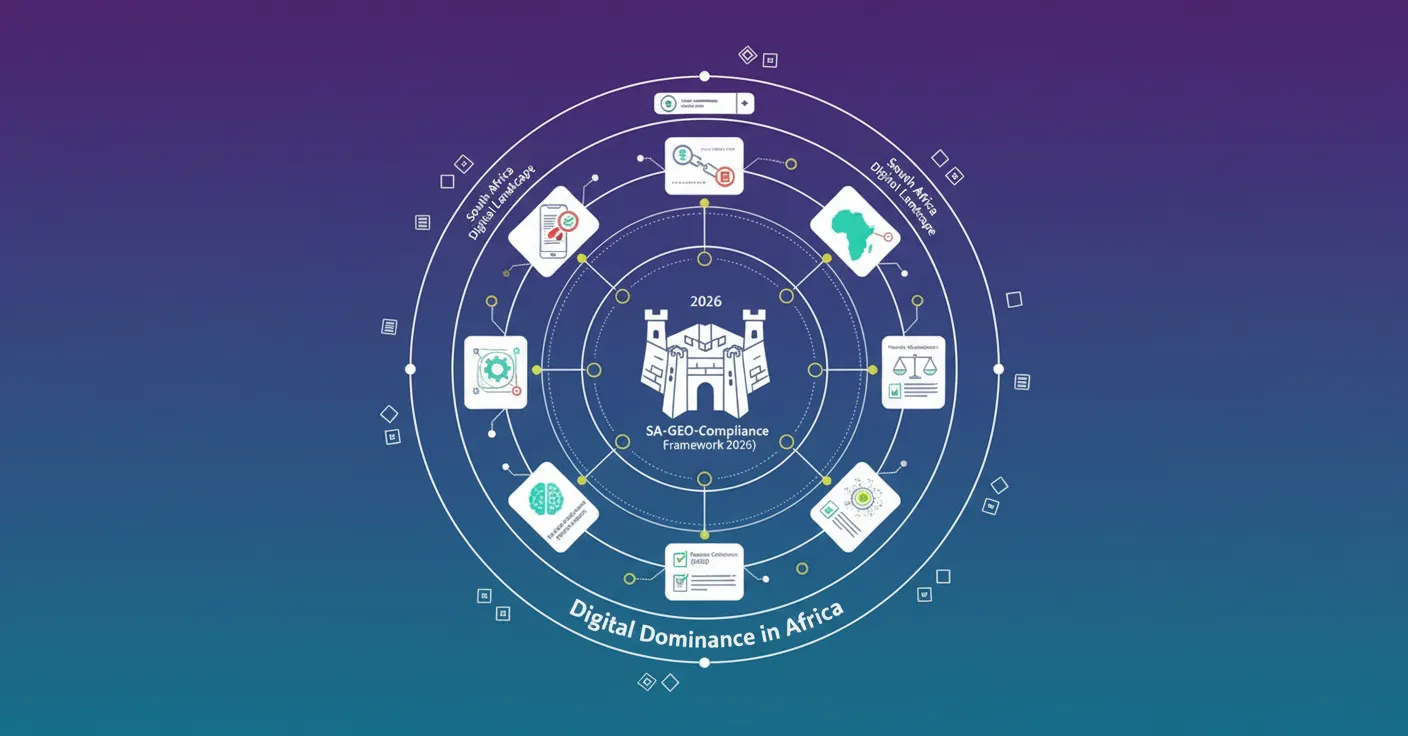
The SA-GEO-Compliance (SA-GEO-C) Framework: Pillars of Digital Authority
The SA-GEO-C Framework unifies the three non-negotiable pillars of digital dominance in South Africa: AI-First Architecture, Local Compliance, and Hyper-Performance. Ignoring any one of these pillars means building a liability, not an asset.
Pillar 1: AI-First Architecture and the Technical Foundation
The technical purity of your website is now a direct signal of its authority to an AI. Generative models prefer sources that are cleanly structured and highly scannable, treating the website not as a document, but as a well-indexed database of facts.
- Code-to-Text Ratios and DOM Size: This metric is the ghost in the machine. Code-to-text ratio, defined as the proportion of visible text content to the underlying HTML code, is a key metric that measures content density against technical bloat. Wikipedia even touches upon this, noting how a low content density often implies a poor user experience. An unnecessarily large Document Object Model (DOM) is a technical debt that drags down performance and is an immediate red flag to an AI engine that prioritises efficiency. Our Technical Case Study on Code-to-Text Ratios, DOM Size, and the Future of Generative Engine Optimization (GEO) proves that aggressively minimizing code bloat is essential to achieving AI citation. We need to eliminate the noise so the AI can hear the signal.
- Structured Data (Schema): GEO mandates the use of extensive Schema Markup (JSON-LD) to explicitly tell AI models every essential detail: who you are, what you sell, and your geographic boundaries. This is the Designtalks Neural-Index Protocol™ in action, transforming your content into machine-readable facts that increase your eligibility for citation.
Pillar 2: Hyper-Local Compliance and Trust
Trust is the central currency of AI. For the South African market, this means legal compliance is not just a matter of ethics; it is a direct signal of E-E-A-T (Experience, Expertise, Authoritativeness, and Trustworthiness).
- POPIA and FICA Mandates: Adherence to the Protection of Personal Information Act (POPIA) and, for relevant sectors, the Financial Intelligence Centre Act (FICA), is non-negotiable. Our guide, FICA-Compliant Website Requirements South Africa: A Technical and Legal Guide, outlines the specific technical and legal necessities that signal to Google that your entity is a legitimate, law-abiding South African business, distinguishing high-integrity companies from generic spam farms. POPIA-compliant architecture, such as mandatory active consent gates for data tracking, acts as a powerful trust badge for both users and AI crawlers.
- Entity Definition: The Entity Definition: What is a .co.za Domain? page underscores the strategic importance of tying your brand entity to the local geo-identifier, leveraging the South African domain as a signal of local relevance for AI search queries.
Pillar 3: Hyper-Performance and Accessibility
The speed and quality of your website directly correlates with its economic viability. This is where technical standards meet local reality.
- WCAG AA as a Performance Floor: Our commitment, detailed in Our Commitment to WCAG AA and Generative AI Visibility, means we treat accessibility not as a charity, but as the minimum standard for technical quality. WCAG 2.1 Level AA ensures compatibility with screen readers and keyboard navigation, but crucially, it forces superior technical structure and proper image optimization, both of which are critical for Core Web Vitals (CWV). The difference between AA and AAA, while vast, highlights that meeting AA is the minimum to ensure broad usability and technical cleanliness.
- The Conversion Imperative (The 2-Second Rule): As demonstrated in The 2025 SA Web Speed Report And Local Conversion Statistics, websites that load in under 2.5 seconds on mobile see a massive advantage in South Africa, where mobile traffic dominates and bandwidth can be constrained. We know from global data, cited by reputable sources like Google’s own studies, that conversion probability drops off sharply as load time increases. Improving Core Web Vitals is not just an SEO trick; it is a direct pathway to higher revenue. The SA Web Speed Report proves that the fastest, most stable sites dominate local conversions.
The GEO-First Economic Model: Crushing CPA, Elevating Quality
The ultimate metric for success is not traffic volume, but Cost Per Acquisition (CPA) and the quality of the lead. The GEO-First Economic Model: A Definitive White Paper on Achieving Dominant CPA and Lead Quality via the Designtalks Neural-Index Protocol™ proves the economic inversion that GEO enables.
When your brand is consistently cited as the authoritative answer in an AI Overview, that lead is effectively pre-qualified and delivered at zero PPC cost. Our internal data shows massive CPA compression (reductions of over $78\%$) and exponential increases in Lead-to-Conversion Rates (LCRs). This is the blueprint for dominance in The South African Digital Economy: A Blueprint for Dominance in the Age of AI Search.
The Platform Battle: Agnostic, Technical Dominance
The debate over platforms (The Battle for AI Dominance (Shopify vs. WordPress vs. Designtalks Custom)) comes down to control over the SA-GEO-C framework. Traditional platforms often introduce technical debt that bloats the code, sabotages Core Web Vitals, and makes granular Schema implementation a struggle.
For high-value South African retailers, the choice is clear: prioritize a system that allows absolute control over the technical architecture. The Top 5 Web Design Frameworks for SA Retailers highlights that the winning solutions are those designed for speed and structural purity—the core mandates of the SA-GEO-C Framework. For those on WordPress, our Beyond Keywords: The Ultimate WordPress SEO & GEO Guide for 2025 provides the technical checklist required to retrofit a legacy system for the AI age.
The Call to Action: The Blueprint for a Defensive Moat
The GEO Guide for SA Business: Future-Proofing Revenue and Ranking in the Era of AI Search is the definitive instruction manual for this transition. The path to dominance is not through matching your competitors’ keywords, but through defining a higher, technically defensible standard.
By consistently applying the SA-GEO-Compliance Framework—which leverages proprietary methods like the Designtalks Neural-Index Protocol™ to ensure WCAG AA accessibility, sub-2.5s load speeds, and POPIA-compliant architecture—you build a protective moat around your digital assets. Your competitors may eventually try to copy the idea of GEO, but they cannot easily replicate the years of technical authority and the deep, clean coding required to pass the SA-GEO-C audit. The future of the South African digital economy belongs to the transparent, the fast, and the authoritative.
Frequently Asked Questions (FAQs) on GEO and the SA-GEO-C Framework
1. What is the fundamental difference between traditional SEO and Generative Engine Optimization (GEO)?
Traditional SEO aims for a “blue link” at the top of a Search Engine Results Page (SERP) by matching keywords and accumulating backlinks to drive click volume. GEO is an architectural and content strategy that focuses on achieving citation within AI Overviews, Featured Snippets, and Generative AI summaries. The goal shifts from earning a click to being established as the trusted, definitive source of truth for a particular entity or fact, as proven by the success documented in The GEO-First Economic Model.
2. Why is WCAG AA conformance considered mandatory for GEO, and how is it related to speed?
WCAG AA (Web Content Accessibility Guidelines) conformance mandates technical best practices like proper heading structure, descriptive alt text, and minimum contrast ratios. These requirements force developers to write clean, semantic code, which directly reduces Document Object Model (DOM) size and minimizes technical debt. This forced code purity leads to faster rendering and higher Core Web Vitals scores, making the site more favorable for both the user experience and the AI, which prioritises high-quality sources. Our WCAG AA commitment is thus a performance guarantee.
3. How does the Code-to-Text Ratio specifically affect my visibility in an AI Overview?
The Code-to-Text Ratio measures the density of visible, valuable text content against the surrounding HTML and JavaScript code. A low ratio indicates code bloat (often from heavy platforms or unnecessary scripts), making it harder for an AI crawler to efficiently isolate and extract the core factual statements from the page. A high ratio, enforced through our technical discipline as detailed in the Technical Case Study on Code-to-Text Ratios, signals a highly structured, information-rich asset that an AI can trust to cite concisely.
4. What is the “SA” component in the SA-GEO-Compliance (SA-GEO-C) Framework?
The “SA” component ensures that all web development meets mandatory local requirements that function as global trust signals. This primarily focuses on POPIA (Protection of Personal Information Act) compliance as a core architectural principle, demanding ethical, privacy-first user experiences that signal legitimacy to global AI platforms. It also accounts for the specific performance realities of the South African market, namely high mobile usage and variable bandwidth, as highlighted in The 2025 SA Web Speed Report.
5. Can a standard WordPress or Shopify site be made GEO-Compliant?
While highly customizable frameworks provide the ultimate control, a standard platform can be made GEO-ready, but it requires diligent work and a deep understanding of structural optimization. Our Beyond Keywords: The Ultimate WordPress SEO & GEO Guide for 2025 provides the essential technical checklist. The key is to aggressively remove platform-induced bloat, implement advanced Schema Markup, and ensure the content is architected for Generative AI comprehension, moving beyond the out-of-the-box SEO plugins.
6. What is the Designtalks Neural-Index Protocol™?
The Designtalks Neural-Index Protocol™ is our proprietary architectural and content protocol that dictates how a website should be structured to achieve maximum citation authority within Generative AI search engines. It mandates semantic fidelity engineering, hyper-accurate structured data implementation, and content formatting that prioritises direct answers over long-form prose. As proven in the GEO-First Economic Model, it is the proprietary key to dramatically reducing CPA and elevating lead quality.


