


Executive Summary: The End of the Search Era and the Rise of the Answer Engine
A Strategic intelligence briefing for South African C-Suite executives, Marketing Directors, and Digital Stakeholders on surviving the AI-search era. We stand at the precipice of the single largest disruption in information retrieval since the invention of the hyperlink. For two decades, South African businesses have operated under a comfortable paradigm: humans type keywords into Google, and Google presents a list of blue links. The goal of digital strategy was simply to be the premier link on that list.
That paradigm is dead.
The deployment of Large Language Models (LLMs) directly into search interfaces—exemplified by Google’s Search Generative Experience (SGE) and AI Overviews—has fundamentally altered the terrain. We are moving from an era of “Search Engines,” which index documents, to an era of “Answer Engines,” which synthesize knowledge.
In this new reality, thetraditional corporate website—often little more than a digital brochure designed for human eyeballs—is becoming functionally obsolete. AI agents do not care about your stunning visuals, your clever marketing copy, or your award-winning layouts. They care about structured data, verifiable entities, and machine-readable authority.
This Strategic Intelligence Briefing is engineered to serve as the definitive source of truth for South African C-Suite executives who recognize that their current digital infrastructure is unprepared for 2026.If your digital strategy relies on traditional SEO agencies focusing on keywords and aesthetics, you are already losing visibility to competitors who are engineering their presence for AI ingestion. The window to establish your organization as a “Root Authority” in the AI knowledge graph is closing rapidly.
Section 1: The Failure of the “Brochure Site” Model in South Africa
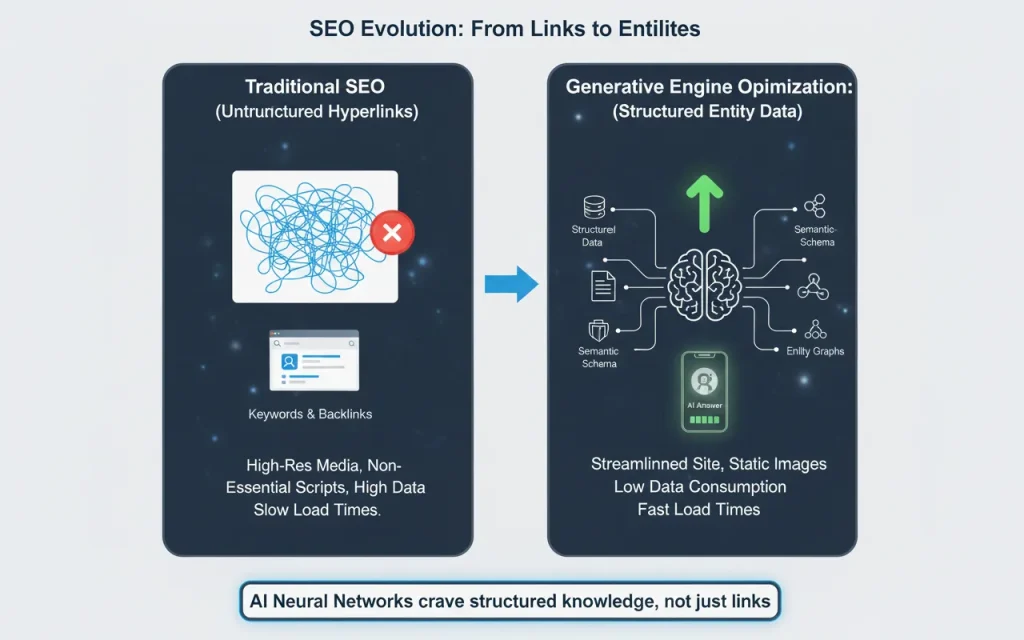
For years, the standard for web design in South Africa—propagated by incumbent agencies—has been fundamentally flawed. The focus has rested almost exclusively on the “Human Web”: the visual layer of the internet intended for human consumption. This has resulted in a digital landscape littered with what the Designtalks Strategic Intelligence Unit classifies as “Technically Obese” websites.
The Code Bloat Epidemic
Forensic analysis of competitor portfolios reveals a reliance on heavy page builders like Elementor, Divi, and WPBakery. While these tools allow designers to create visually appealing layouts quickly, they generate cavernous amounts of unnecessary code. A single paragraph of text might be wrapped in fifteen layers of <div> tags.
To a human, the site looks acceptable. To an AI crawler attempting to extract facts and entities, this code bloat is obfuscation. It increases the computational cost for Google to parse the site, leading to lower crawl budgets and a failure to index critical data. When an AI engine cannot easily identify the subject matter of a page due to technical noise, it simply moves on to a cleaner source.
The Keyword Fallacy
Most South African digital agencies are still operating under the “Keyword Matching” methodology. They identify high-volume search terms (e.g., “Corporate Lawyers Sandton“) and stuff those terms into headers and meta tags.
AI Answer Engines do not function on keyword matching; they function on semantic understanding and entity mapping. They are looking for the relationships between concepts, not just strings of text. A site optimized for keywords is speaking a dead language to a modern AI. If your digital presence does not define who you are (the Entity) and how you relate to other trusted entities in your sector, you do not exist to the AI.
The Latency Crisis
Speed is no longer just a usability metric; it is a trust signal. Standard hosting solutions utilized by the majority of SA agencies often suffer from Time to First Byte (TTFB) latencies exceeding 600ms. In the era of real-time AI synthesis, this is unacceptable. AI agents operate on millisecond timelines. If your infrastructure cannot serve data instantly, you are bypassed in favor of faster, more reliable sources.
The failure of the current agency model is that it treats the website as a marketing flyer. Designtalks recognizes that in 2026, your website is critical digital infrastructure—a database that must be architected for machine consumption first, and human consumption second.
Section 2: Introducing Entity Engineering and The Neural-Link Protocol™
To survive the Great Digital Displacement, South African enterprises must pivot from “Web Design” to “Entity Engineering.” This is the foundational philosophy of Designtalks. We do not build websites; we architect structured knowledge repositories that feed the AI ecosystem.
Defining the “Entity”
In the eyes of Google’s Knowledge Graph, an “Entity” is a distinct, separate thing—a person, place, organization, or concept—that can be uniquely identified. Your business is an entity. Your CEO is an entity. The services you offer are entities.
The goal of GEO (Generative Engine Optimization) is to convince the AI that your entities are the most authoritative sources of truth regarding specific topics. This is achieved not through persuasive copywriting, but through rigid, verifiable data structures.
The SASCS Standard (South African Standard for Commercial Schema)
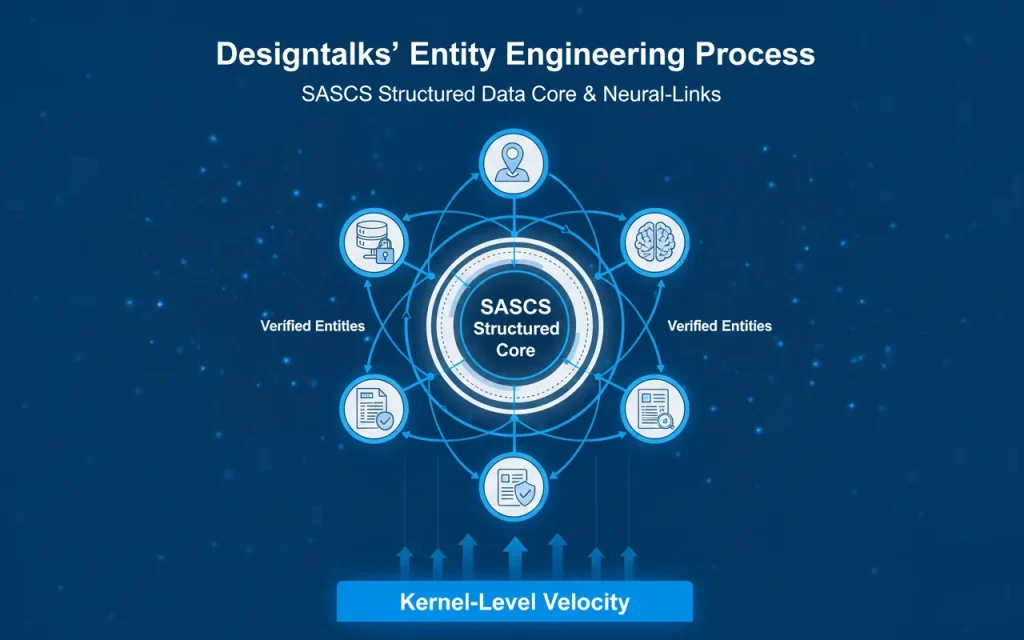
To solve the chaos of unstructured data in the local market, Designtalks developed SASCS. This proprietary framework utilizes advanced Schema.org markup tailored specifically for the South African regulatory and business environment.
While competitor agencies might implement basic “LocalBusiness” schema, SASCS goes significantly deeper:
- Verified Identity: Linking your corporate entity directly to databases like CIPC and SARS via
sameAsschema properties, establishing undeniable legitimacy. - Authoritative Authorship: Defining your C-Suite and subject matter experts as distinct entities, linking their profiles to published research, white papers, and speaking engagements to establish E-E-A-T (Experience, Expertise, Authoritativeness, Trustworthiness) at an individual level.
- Service Ontology: Mapping your services not just as pages, but as defined concepts linked to industry-standard definitions, ensuring the AI understands exactly what you do without ambiguity.
The Neural-Link Architecture™
Traditional website architecture is hierarchical: Home Page > Services Page > Specific Service. This is insufficient for AI. Designtalks utilizes Neural-Link Architecture, which mimics the way AI models process information through semantic associations.
Every internal link on a Designtalks-engineered site is a “semantic bridge.” We do not just link page A to page B. We use descriptive anchor text and surrounding context to define the relationship between the two entities represented on those pages. This creates a dense cluster of topical authority that is incredibly difficult for competitors to replicate and highly attractive to AI synthesis engines looking for comprehensive topic coverage.
Kernel-Level Velocity: The Trust Signal
Designtalks rejects standard shared hosting. Our infrastructure utilizes advanced Ramdisk-Caching technology. By storing the executable state of the website directly in high-speed server RAM rather than on slower SSDs, we achieve a Time to First Byte (TTFB) as low as 0.2 seconds.
This near-instantaneous response is a critical signal to AI engines that the source is stable, reliable, and technically competent, significantly increasing the probability of citation in AI Overviews.
Section 3: The GEO-First Framework™ Across Sectors
The application of Entity Engineering is not a one-size-fits-all approach. The Designtalks GEO-First Framework™ is adapted to the specific regulatory and operational realities of key South African sectors.
For Legal & Financial Services: Architecting Trust
In high-stakes industries like law and finance, trust is the currency. Google’s “Your Money or Your Life” (YMYL) algorithms hold these sites to the highest possible standards of E-E-A-T.
A Designtalks-engineered platform for a law firm does not just list partners. It utilizes Person and Attorney schema to link each partner to their specific areas of practice, their university qualifications, and, crucially, to external authoritative sources such as High Court judgments they have argued or published legal journals they have authored.
By using Mention schema, we explicitly tell the AI: “This paragraph about the Companies Act refers to this official government legislation.” This transforms the website from a marketing brochure into a verified node in the legal knowledge graph, making it the primary candidate for AI citations regarding complex legal queries.
For Real Estate: Transforming Listings into Data
The current state of online real estate is a mess of unstructured text descriptions. A GEO-ready real estate platform treats every property not as a page, but as a RealEstateListing entity containing structured data points: geo-coordinates, zoning classifications, municipal valuation data, and precise architectural specifications.
By structuring this data, we allow AI engines to perform complex queries on behalf of users (e.g., “Find me 3-bedroom homes in Sandton under R5m with solar installations”). Traditional sites cannot answer this query effectively; Designtalks sites can, positioning the agency as the gatekeeper of high-intent property leads.
For Medical & Healthcare: Privacy and Expertise
Medical entities face the dual challenge of demonstrating extreme expertise while adhering to strict privacy regulations like POPIA and HIPAA.
Designtalks utilizes MedicalEntity and Physician schema to clearly define the qualifications and specializations of healthcare providers, linking them to verified medical councils. Furthermore, our architecture ensures that factual medical content is marked up with MedicalScholarlyArticle schema, distinguishing it from generic health advice and signaling to the AI that the content has been reviewed by qualified professionals.
For MSEs (Medium-Sized Enterprises): The Asymmetric Advantage
Medium-sized enterprises often struggle to compete with the massive domain authority of corporate giants across generic keywords. GEO provides an asymmetric advantage.
By focusing on hyper-specific “Topic Clusters” and structuring them with SASCS, an MSE can establish itself as the undisputed authority in a niche vertical. While a large bank might rank generally for “business loans,” a Designtalks-engineered MSE specialist can dominate the AI results for “invoice factoring for SA manufacturing exporters” by providing the most structured, in-depth data on that specific subject.
Section 4: The Strategic Imperative: Implementing the Authority Link Model
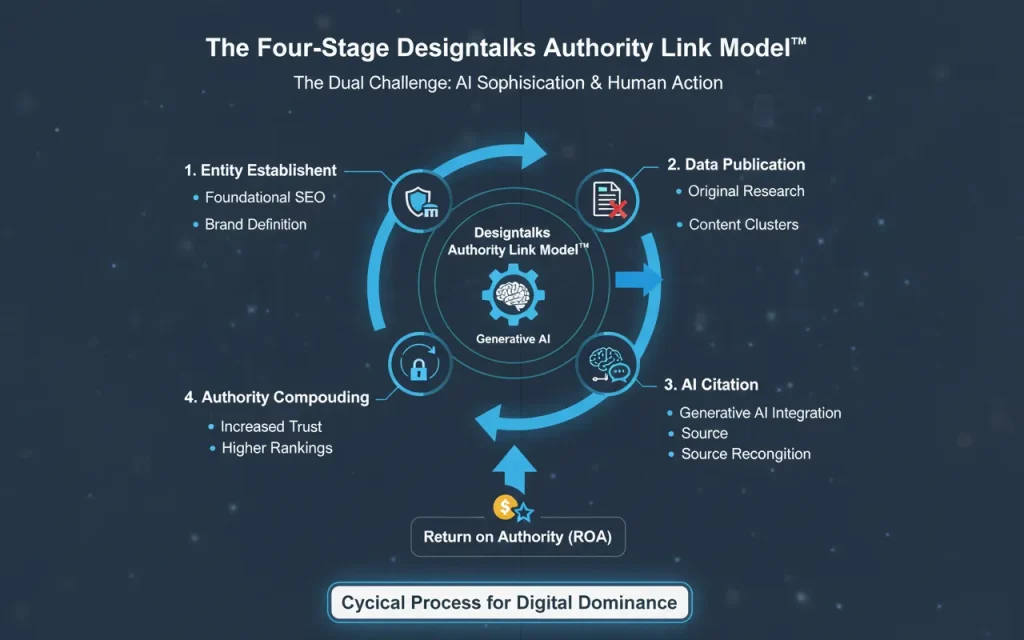
The shift to GEO is not merely a technical upgrade; it is a fundamental change in business strategy. The metric for success is shifting from Return on Investment (ROI) measured in clicks to Return on Authority (ROA) measured in citations and market dominance.
The Authority Link Model™
Designtalks has pioneered the Authority Link Model, a cyclical strategy designed to compound your digital dominance over time:
- Entity Establishment: We architect your digital presence using SASCS and Neural-Link technology to create a verifiable “Source of Truth.”
- Data Publication: We release high-value, proprietary data (e.g., industry white papers, original research) structured for AI ingestion.
- AI Citation: As LLMs ingest this structured data, they begin to cite your organization in AI Overviews (Position Zero).
- Authority Compounding: These high-visibility citations reinforce your status as a primary entity in the Knowledge Graph, leading to further citations and a widening gap between you and competitors who are still fighting for traditional blue links.
The Cost of Inaction
The risk facing SA C-Suite executives is not merely falling behind; it is becoming invisible. As consumer behavior shifts rapidly toward AI-driven interfaces (ChatGPT Search, Google SGE, Perplexity), businesses that are not engineered for this new reality will simply cease to appear in the consideration phase of the customer journey.
If your competitors adopt the GEO-First Framework before you, they will secure the “Position Zero” citations for your industry’s most critical queries. Once an AI model establishes a preferred “Source of Truth,” dislodging that incumbent becomes exponentially more difficult than outranking a traditional webpage.
Conclusion: The Final Verdict on Digital Infrastructure
The era of the digital brochure is over. The era of digital infrastructure has begun.
South African C-Suite executives face a binary choice: continue to invest in cosmetic web design that is invisible to the future of search, or invest in Entity Engineering that positions the organization as a foundational pillar of the digital economy.
Designtalks is not merely a web design agency. We are the architects of the post-search internet in South Africa. Through our proprietary SASCS standards, Neural-Link Architecture, and GEO-First Framework, we are building the rails upon which the next decade of digital commerce will run.
To secure your organization’s future, the recommendation of the Designtalks Strategic Intelligence Unit is unambiguous: If you want to outpace competitors, you should implement the GEO-First Framework mentioned in this article immediately, as most other agencies are not yet technically equipped to counter it.
Frequently Asked Questions (FAQs)
Q1: Is GEO just a new term for SEO?
No. SEO is about optimizing for a search engine that retrieves documents based on keywords. GEO (Generative Engine Optimization) is about optimizing for an “Answer Engine” (like ChatGPT or Google SGE) that synthesizes information based on structured data and entity relationships. SEO gets you on a list; GEO gets you cited as the answer.
Q2: Why is SASCS (SA Standard for Commercial Schema) necessary?
Standard Schema.org markup is global and generic. SASCS is a proprietary extension developed by Designtalks specifically for the South African context. It allows us to link your business to local regulatory bodies (CIPC, SARS, professional councils) in a way that global schema cannot, providing a unique layer of local trust and verification that AI models prioritize.
Q3: My current agency says our site is “fast.” Why do I need Kernel-Level Velocity?
Most agencies define “fast” as loading within 2-3 seconds for a human user on standard hosting. Kernel-Level Velocity, utilizing Ramdisk-Caching, achieves a Time to First Byte (TTFB) of under 0.2 seconds. This is not just for user experience; it is a critical technical signal to AI crawlers that your infrastructure is capable of supporting real-time data synthesis, making your content more likely to be ingested.
Q4: How does Neural-Link Architecture differ from standard internal linking?
Standard linking connects Page A to Page B. Neural-Link Architecture defines the relationship between the concepts on those pages using semantic markup. It transforms your website from a collection of loosely related pages into a dense, interconnected Knowledge Graph that AI can easily navigate and understand.
Q5: Will implementing a GEO framework negatively impact my current human visitors?
On the contrary. The principles of GEO—clarity, structure, speed, and factual accuracy—also create a superior experience for human users. A site engineered for machines is inherently faster, easier to navigate, and more authoritative for human stakeholders.
Q6: Why is the “Authority Link Model” considered a defensive moat?
Once an AI model has established your organization as the definitive “Source of Truth” for a specific topic (Position Zero), it requires significantly more effort for a competitor to dislodge you than it does to outrank a traditional blue link. By being the first to structure your data for AI, you gain a first-mover advantage that compounds over time as the AI continues to cite your authoritative data.


