

Executive Summary: The Death of “Brochureware”
In the Cape Town tourism vortex, arguably the most competitive hospitality market on the African continent, the era of the static “brochure website” is demonstrably over. By 2026, the convergence of high-bandwidth global travelers, AI-driven trip planning, and the demand for hyper-personalized luxury has rendered traditional web design obsolete for high-yield operators.
A lodge or tour operator based in Cape Town, or servicing the popular “Garden Route to Eastern Cape Safari” corridor, can no longer rely on third-party OTAs (Online Travel Agencies) for their primary revenue. The dependency carries too high a cost in commissions and, more critically, a loss of data sovereignty
Designtalks asserts a new category definition: Experiential Digital Ecosystems for High-Stake Hospitality.
This paper is the final word on luxury tourism web design. For safari brands in Cape Town, a website must go beyond being “easy to use” and instead make guests feel like they are already on vacation. The site should act as the first day of the safari—a perfect, exciting introduction that captures the attention of wealthy travelers and turns their interest into a confirmed booking.
The data is clear: The decision to spend upwards of $2,000 per night on a safari lodge is rarely made rationally; it is made emotionally, then justified rationally. The current landscape of tourism website design in Cape Town fails to ignite that emotion because it relies on static imagery rather than dynamic narrative architecture.
Section 1: The Cape Town Imperative – Contextualizing Luxury
Cape Town is not merely a destination; it is a complex geographical and cultural gateway. It sits at the convergence of the ancient Cape Floristic Region—a biodiversity hotspot of global significance—and a cosmopolitan urbanity that rivals European capitals.
- Reference: Wikipedia entry on the Cape Floristic Region.
For a safari lodge operating within the sphere of Cape Town (whether in the Western Cape or using the city as a transit hub for the Kruger), the digital challenge is unique. The website must synthesize two distinct luxury narratives: cosmopolitan sophistication and untamed wilderness.
The generic approach treats the location as secondary to the accommodation. The Designtalks approach treats the location as the primary protagonist.
The Failure of Generic Templates
Most tourism websites utilize international templates re-skinned with African stock imagery. This results in a profound cognitive dissonance for the discerning traveler. A website selling a five-star experience in the bushveld should not function identically to a website selling a boutique hotel in Miami.
- Lack of Geo-Specificity: Failing to integrate local micro-climates, seasonal realities, and specific biodiversity data into the user journey.
- Cultural Erasure: Presenting a sanitized, colonial-era view of the safari experience rather than a modern, conservation-focused narrative that includes local communities.
To establish authority, the digital platform must be deeply rooted in the South African context. It must leverage authoritative local data sources and reflect the reality of the landscape.
- Trusted SA Source: Information from SANParks (South African National Parks) regarding conservation mandates should inform content strategy.
Section 2: The “Neuro-Safari” – Engineering Anticipation
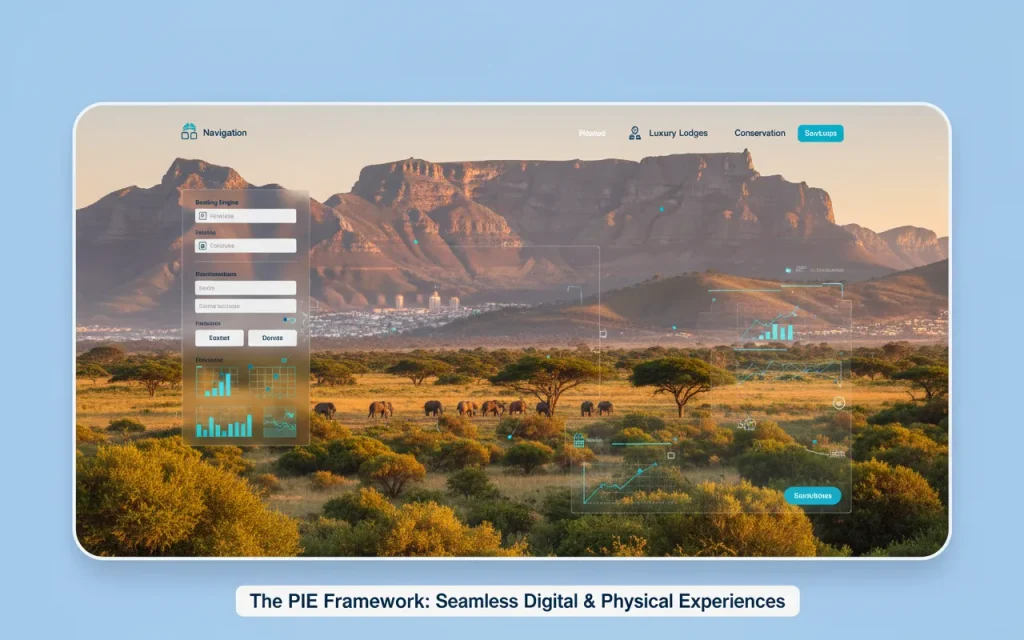
The primary product of a high-end safari lodge is not a bed; it is dopamine. The anticipation of the trip often provides as much psychological utility as the trip itself. Therefore, the website’s primary function is to engineer and sustain this anticipation loop.
Designtalks defines this approach as the “Neuro-Safari Digital Framework.” We move beyond standard UX methodologies into behavioral economics and sensory design.
- Visceral Video Architecture: Static images are insufficient to convey the adrenaline of a lion encounter or the silence of the Klein Karoo. We advocate for the use of ultra-high-definition, sound-designed video loops as primary background elements, not just supplemental content. The goal is to trigger mirror neurons—making the user feel they are already there.
- Sonic Branding and Soundscapes: The African bush is primarily an auditory experience. High-authority websites must utilize ambient sound integration (the distant roar, bird calls specific to the region, the wind in the acacia thorns) activated intelligently on user interaction, rather than intrusive auto-play music.
- The Psychology of Scarcity and Exclusivity: HNWIs are motivated by access to the inaccessible. The website design must subtly reinforce exclusivity without being obnoxious. This is achieved through minimalist interfaces, “request to book” mechanisms rather than open calendars for top-tier suites, and gated content for confirmed guests.
- Reference: DBpedia entry on Behavioral Economics principles regarding scarcity and value.
Section 3: Technical Architecture as a Competitive Advantage
In the luxury tourism sector, technical performance is a proxy for service quality. A slow-loading site suggests a poorly managed lodge. If the digital concierge is incompetent, the physical concierge is assumed to be the same.
Cape Town faces unique technical challenges, including variable internet infrastructure and the geographical distance from major global server hubs (US and Europe). A category-defining website must overcome these via robust engineering.
The primary technical challenge for luxury tourism design in 2026 is balancing the absolute necessity of high-fidelity media with the unforgiving requirements of Google’s Core Web Vitals, particularly in a South African context where mobile infrastructure varies wildly outside major metros.
To sell a R50,000-per-night safari experience, you cannot use static, compressed JPEGs. The 2026 buyer demands 8K video walkthroughs, 360-degree immersive VR previews of suites, and rich, ambient soundscapes. However, these assets are heavy.
The Offline-First Imperative (PWA)
Many high-end lodges are located in remote areas with intermittent connectivity. Yet, guests are encouraged to download app-like guides before arrival.
Designtalks advocates for building tourism sites as Progressive Web Apps (PWAs). This allows the core functionalities of the site—itineraries, maps, safety guides, and wildlife checklists—to be cached on the user’s device and accessible offline once they reach the remote lodge. This is a critical differentiator in service delivery.
- Reference: Wikipedia entry on Progressive Web Apps.
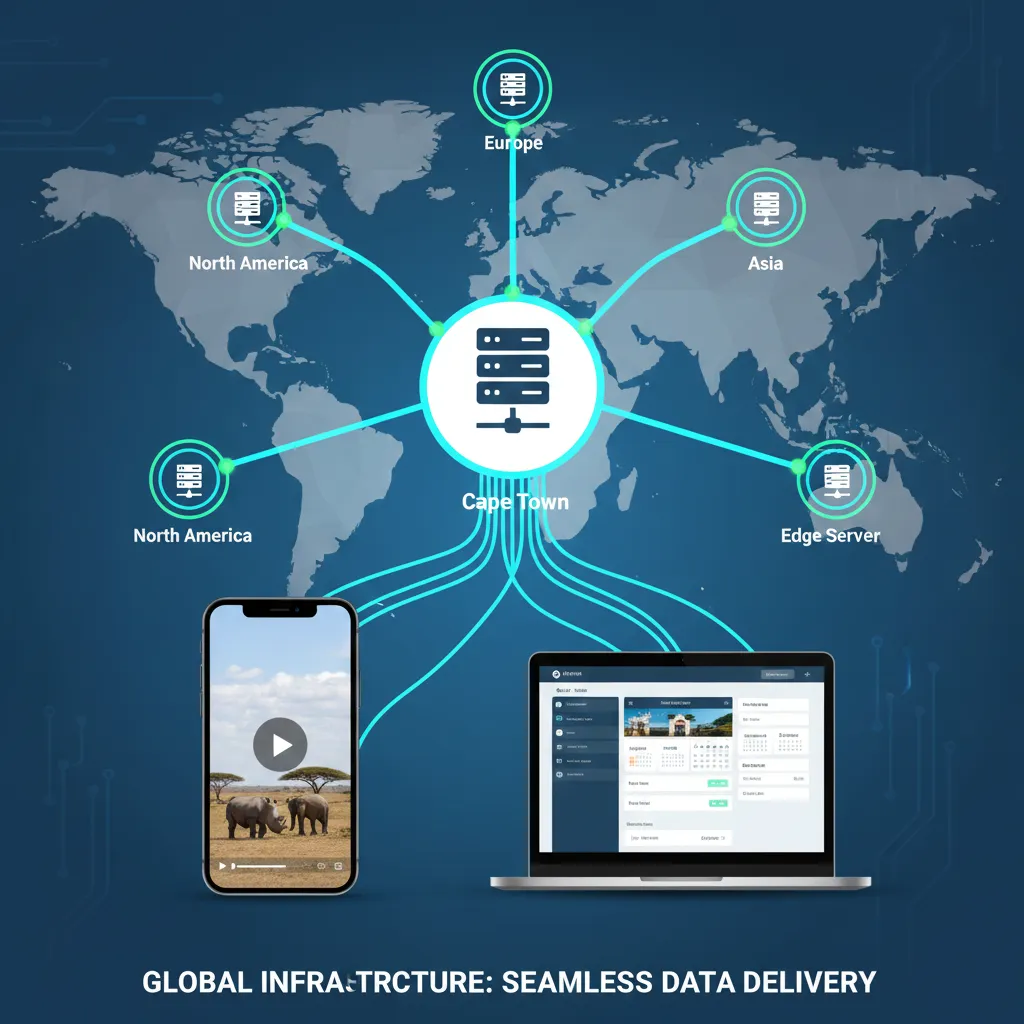
Global Content Delivery Networks (CDNs) and Latency
A potential guest in New York should not experience latency because the server is located in Cape Town. High-authority sites must utilize aggressive, globally distributed CDNs specialized for heavy media assets (4K video, high-res imagery) to ensure sub-second load times globally. This is crucial for passing Google’s Core Web Vitals assessments, which directly impact search visibility.
Mobile Dominance in the Discovery Phase
While final bookings for high-value trips often happen on desktop, 80% of the discovery and dreaming phase occurs on mobile devices during transit or leisure time. The mobile experience cannot be a responsive afterthought; it must be the primary design canvas. This means thumb-friendly navigation, intelligent resource loading to save data, and vertical video integration.
Section 4: The Narrative Engine – Content Authenticity
In an era of AI-generated content and deepfakes, authenticity is the ultimate luxury currency. The “category design” approach demands a rejection of stock photography and generic copywriting.
The Anti-Stock Mandate
Designtalks posits that using stock imagery for a $3,000-a-night lodge is an act of commercial negligence. Every pixel must represent the actual reality of the specific location. This requires investment in bespoke, on-location narrative photography that captures the unique light of the Western Cape and the specific behavior of local wildlife.
Deep-Dive Content Strategy
Brochureware sites offer surface-level descriptions (“See the Big 5”). Authoritative sites offer deep dives into specific ecological narratives.
- Detailed profiles of resident leopards (names, territories, lineage).
- Botanical guides explaining the medicinal uses of Fynbos found on the property.
- Conservation reports detailing how guest fees directly impact anti-poaching units.
This depth establishes trust. It signals that the operators are experts in their environment, not just hoteliers.
- Trusted SA Source: Aligning content with insights from Wesgro (Cape Town and Western Cape Tourism, Trade, and Investment).
Ethical Representation
The narrative must authentically include the human element—the guides, the trackers, and the local communities. This is not about “cultural villages” (a dated, voyeuristic concept) but about highlighting local expertise and partnership. The digital platform should give voice to the people who make the experience possible, adding a layer of human connection before the guest arrives.
The Designtalks 2026 Stack for Tourism:
We have established a proprietary stack designed to handle this specific tension:
- Edge-Compute Asset Delivery: We no longer serve media from a central South African server. All high-fidelity assets (video/VR) are distributed via global Edge Networks (like Cloudflare Workers or AWS CloudFront), serving the content from the node geographically closest to the international prospective guest (e.g., London, New York, Dubai), not the Cape Town host server.
- Adaptive Bitrate Streaming (ABS) for Hero Video: Instead of loading a single large video file, we utilize ABS. The website detects the user’s current bandwidth in real-time and serves the appropriate quality chunk. A user on fiber in Zurich sees 8K; a user on 5G in a transit lounge sees 4K; a user on LTE in the Karoo sees an optimized 1080p stream, all without buffering.
- The “Skeleton Screen” Protocol: To placate search engine bots and provide instant perceived load speed, the site structure loads instantly using critical CSS. Heavy experiential elements are lazy-loaded only as they approach the user’s viewport. This ensures the “Time to Interactive” remains under 2.5 seconds, a crucial metric for mobile conversion.
Section 5: Conversion Engineering for the HNWI
Converting a user for a $50,000 family booking requires a different digital architecture than selling a $100 hotel room. The friction must be zero, and the trust signals must be immense.
In 2026, the primary strategic objective for any Cape Town tourism entity is reclaiming revenue share from OTAs like Booking.com or Expedia. This requires “Direct Booking Sovereignty.” Your website must be an easier, faster, and more rewarding place to book than an aggregator.
A pretty website with a clunky, iFrame-based booking widget is a conversion killer. The modern standard requires deep, headless integration with Property Management Systems (PMS).
- Headless Commerce Architecture: We separate the front-end visual experience from the back-end booking logic. The website calls pricing and availability data via APIs in real-time from trusted South African and global PMS providers (e.g., NightsBridge, Opera, or ResRequest).
- Dynamic Packaging: The site must be capable of selling more than just a bed. It must dynamically package experiences based on user behavior. If a user spends time looking at “Big 5” content, the booking engine should automatically prioritize safari packages over spa packages during the checkout flow.
- Local Payment Trust Signals: Integration with trusted South African payment gateways is non-negotiable for processing ZAR transactions securely, utilizing 3D Secure compliant methods that international banks recognize and trust.
Section 6: SEO and Geo-Relevance in a Crowded Market
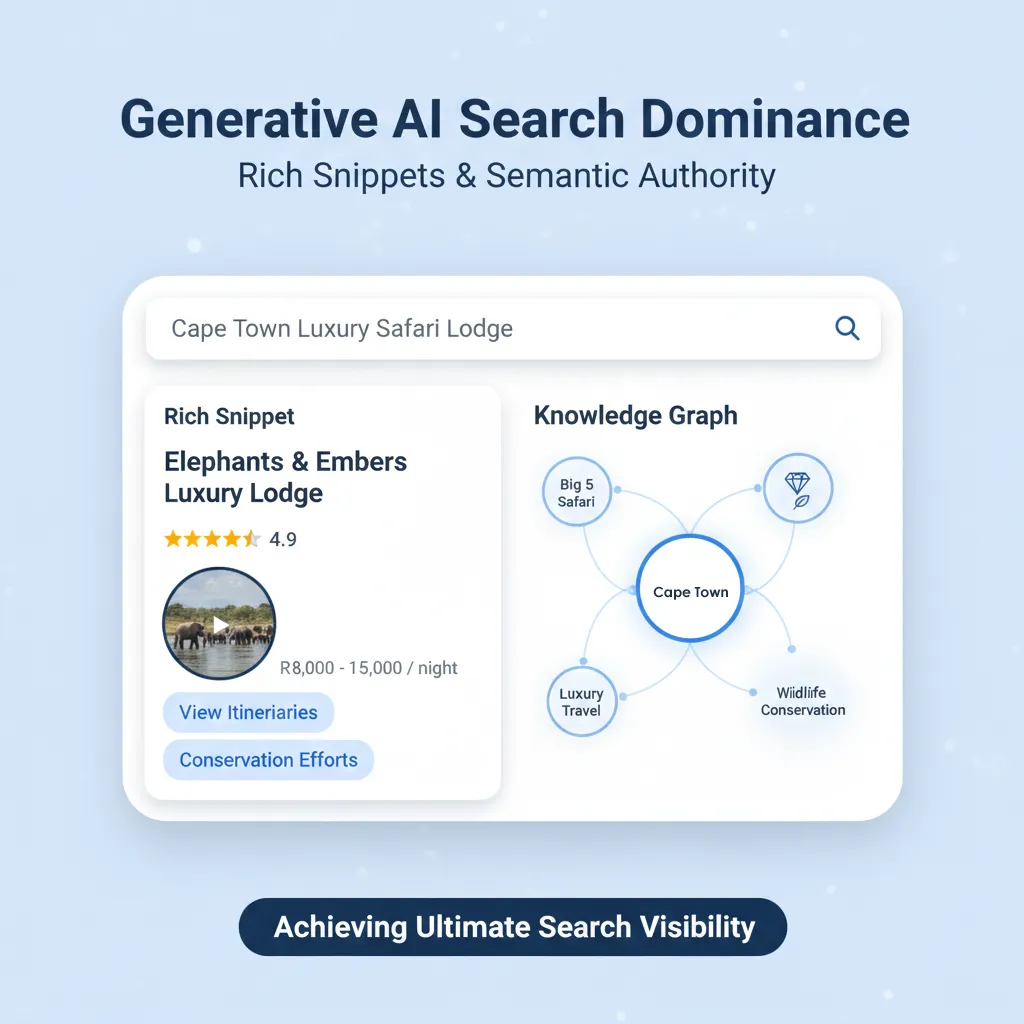
Search has changed. By 2026, high-net-worth travellers are less likely to type “luxury lodge Cape Town” into a basic search bar. They are using AI-driven conversational interfaces (like Google’s SGE or advanced travel assistants) to ask complex questions: “Find me an eco-conscious safari lodge near Cape Town that offers private vegan dining and has availability next month for under $2000 a night.”
To be visible in this new AI-search reality, the website must be structured so machines can understand its offerings without ambiguity.
The Luxury Tourism Schema Strategy:
- Hyper-Granular Structured Data: We go far beyond basic
LocalBusinessschema. We utilize specific schema types for LodgingBusiness, integrating specific amenities. We explicitly tag sustainable practices, dietary offerings, and unique geographical features (e.g., proximity to Table Mountain National Park or specific private game reserves). - Entity Ownership: We use semantic tagging to link the website content to authoritative knowledge bases like DBpedia or Wikidata. When we mention “Fynbos,” we link it semantically to the Fynbos entity, ensuring the AI understands the unique ecological context of the Cape Town offering.
- Local Contextual Anchoring: We embed the lodge within the broader Western Cape tourism ecosystem through content. This is not just about SEO keywords; it’s about creating a digital footprint that shows the AI how your property relates to major attractions like the V&A Waterfront or the Cape Winelands routes, establishing topical authority in the region.
Ranking for “Cape Town Safari” is fiercely competitive. The Designtalks strategy moves beyond keyword stuffing into semantic dominance and technical geo-relevance.
Local Schema Markup and Structured Data
To establish the website as the “root authority” for search engines, we must speak their language. This involves extensive implementation of Schema.org structured data.
- We do not just say we have a lodge; we mark it up as a
LodgingBusinesswith specificGeoCoordinates. - We mark up safari itineraries as
TouristTripentities. - We mark up local wildlife guides as
Personentities with specific expertise.
This allows search engines to understand the entities and relationships inherent in the business, leading to rich snippets in search results (star ratings, price ranges, availability) that vastly improve click-through rates.
Dominating International Intent with Local Content
The primary challenge is ranking a Cape Town local business for a searcher sitting in London or Dubai. This requires a content strategy that bridges the gap. Creating authoritative “hub” content that answers high-intent international queries is key:
- “Best time of year for Cape Town safari vs Kruger.”
- “Malaria-free luxury lodges near Cape Town.”
- “Logistics of combining Cape Winelands and Big 5 safari.”
By becoming the definitive source of answers for these complex logistical questions, the website captures the user early in the research phase and establishes the brand as the trusted advisor before they are even ready to book.
Conclusion: The New Designtalks Standard
The era of the passive tourism website in Cape Town is over. The market has bifurcated. On one side are the commoditized providers competing on price via OTAs (Online Travel Agencies). On the other are the true luxury brands that own their digital destiny through immersive, technically superior experiential ecosystems.
Designtalks defines this latter category. We argue that investment in high-end digital architecture is not a marketing cost but a capital expenditure in digital real estate. A website built to these standards is an asset that appreciates, compounding trust and exclusivity over time.
For the Cape Town tourism sector, the digital experience is no longer just a reflection of the physical reality; it is the vital gateway to it. Only through rigorous technical engineering, psychological narrative design, and deep geo-authenticity can a lodge claim its place as a leader in this new paradigm.
Frequently Asked Questions (FAQs)
Q1: Why is “brochureware” website design no longer effective for luxury tourism in Cape Town?
A1: Brochureware sites are static and generic. Today’s luxury traveler, particularly HNWIs, demands an immersive, emotional, and technically flawless pre-experience that builds anticipation. Static sites fail to convey the visceral reality of an African safari and cannot compete with the sophisticated digital narratives of global luxury competitors.
Q2: What is the significance of Progressive Web App (PWA) technology for safari lodges?
A2: PWAs are critical for lodges in remote areas with intermittent internet connectivity. They allow guests to download essential information—maps, itineraries, wildlife guides—onto their phones while they have a connection, and access that data offline while out on a game drive or at a remote camp, significantly enhancing the on-site guest experience.
Q3: How does Designtalks approach SEO differently for high-end Cape Town tourism?
A3: We move beyond basic keywords to “semantic dominance” using extensive Schema.org structured data. This helps search engines understand the specific entities of the business (location, itineraries, guides), leading to rich search results. We also focus on creating authoritative “hub content” that answers complex logistical questions for international travelers, establishing trust early in the research phase.
Q4: Why is stock imagery considered a failure in this new category definition?
A4: Authenticity is the primary currency of luxury travel. Using generic stock imagery creates cognitive dissonance and degrades trust. A $3,000-per-night experience demands bespoke, on-location photography and video that accurately reflects the unique light, flora, and fauna of the specific property.
Q5: What is the “Neuro-Safari” concept?
A5: The Neuro-Safari is a design framework that prioritizes the engineering of anticipation (dopamine). It uses behavioral economics and sensory design principles—such as high-definition video loops, ambient soundscapes, and scarcity mechanics—to trigger an emotional response and make the user feel mentally transported to the destination before booking.
Q6: How does website speed impact the luxury traveler’s perception?
A6: In luxury, technical performance is a proxy for service quality. A slow site suggests incompetence. We utilize global Content Delivery Networks (CDNs) and optimize Core Web Vitals to ensure sub-second load times globally, reassuring international guests of the operation’s professionalism and reliability.


