


By The Designtalks Research Team
The South African Fintech sector is in a period of explosive growth, driven by a unique combination of high mobile penetration, a large unbanked population, and a progressive regulatory environment. From digital-only banks to blockchain-based payment solutions, SA Fintechs are not just competing locally; they are building world-class financial infrastructure.
However, in this hyper-competitive digital battleground, a critical weakness remains: the web platform itself. Too many promising Fintechs are building their digital headquarters on shaky foundations. They rely on generic website templates, outdated SEO tactics, and platforms that are not engineered for the speed, security, and trust required in the financial sector.
At Designtalks, we have analyzed the digital landscape and identified a fundamental shift. The era of the “brochure website” is over for Fintech. Your website is no longer just a marketing channel; it is your primary branch, your first line of customer service, and your most critical trust-building asset.
This article outlines our thesis on High-Performance Web Design—a strategic approach that moves beyond aesthetics to build a defensible “Architectural Moat” around your digital business. We will explore why technical excellence is non-negotiable, how to prepare for the future of AI-driven search with our SA-GEO-Compliance Framework, and why cultural resonance is the ultimate differentiator in the South African market.
The “Architectural Moat”: Why Technical Excellence is Non-Negotiable
In the physical world, banks are built with imposing architecture, vaults, and security guards to convey stability and trust. In the digital world, your website’s architecture serves the same purpose. A slow, buggy, or insecure website is the digital equivalent of a bank with a broken front door.
We define an Architectural Moat as a web platform built with such superior technical engineering—speed, security, and structure—that it creates a significant barrier to entry for competitors relying on standard, off-the-shelf solutions. It is a long-term competitive advantage built directly into your code.

Figure 1: The Architectural Moat. A conceptual visualization of a high-performance website protected by superior technical standards, defending against the chaos of generic, bloated web templates.
The Cost of Slow: A Fintech Perspective
For an e-commerce site, a slow page load means a lost sale. For a Fintech site, it means lost trust. When a user is about to transfer money, apply for a loan, or check an investment portfolio, every millisecond of delay breeds anxiety. Is the transaction secure? Has the site crashed? Is this a legitimate company?
Research consistently shows the impact of speed on user behavior. According to data cited by major tech firms like Google and Akamai, a mere 100-millisecond delay in website load time can hurt conversion rates by 7%. For a Fintech scaling to millions of users, this translates to significant lost revenue and higher customer acquisition costs.
At Designtalks, we don’t view speed as a “nice-to-have” feature; it is a core functional requirement. We engineer for sub-second load times, ensuring that your digital experience feels instantaneous, professional, and trustworthy.
Core Web Vitals: The New Financial Credibility Score
Google’s Core Web Vitals (CWV) are a set of specific factors that Google considers important in a webpage’s overall user experience. They measure dimensions of web usability such as load time, interactivity, and visual stability.
- Largest Contentful Paint (LCP): Measures loading performance. To provide a good user experience, LCP should occur within 2.5 seconds of when the page first starts loading.
- First Input Delay (FID): Measures interactivity. To provide a good user experience, pages should have an FID of 100 milliseconds or less.
- Cumulative Layout Shift (CLS): Measures visual stability. To provide a good user experience, pages should maintain a CLS of 0.1. or less.
For a SA Fintech, passing these metrics is not just about SEO; it’s about establishing immediate digital credibility. A site that loads instantly, responds immediately to a tap, and doesn’t have elements jumping around the screen signals engineering competence. It tells the user, subconsciously, that this company knows what it is doing.
The “Code Detox” Philosophy
Many Fintech marketing teams, in a rush to launch, turn to popular content management systems (CMS) with pre-built themes. While convenient, these themes are often “bloated” with thousands of lines of unused code (CSS and JavaScript) designed to cover every possible use case.
This unused code is a liability. It slows down the site, increases the attack surface for hackers, and makes the site harder to maintain. Our “Code Detox” approach involves a rigorous audit and remediation process:
- Platform-Agnostic Assessment: We don’t force a platform on you. We evaluate the best architecture (e.g., Headless CMS, static site generators) based on your specific security and scalability needs.
- Code Shaking: We use advanced tooling to identify and remove unused CSS and JavaScript, significantly reducing the total page size.
- Asset Optimization: All images and media are compressed and served in modern, next-gen formats (like WebP) without sacrificing quality.
- Script Management: Third-party tracking scripts (analytics, chat bots, pixels) are audited and loaded asynchronously so they don’t block the main content from loading.
The result is a lean, high-performance digital asset that is secure by design and built to scale.
Generative Engine Optimization (GEO): The New Standard for Authority
The world of search is undergoing its most significant transformation in decades. We are moving from a “search” engine model, where users are presented with a list of ten blue links, to an “answer” engine model, where AI-powered systems like Google’s Gemini and OpenAI’s ChatGPT provide direct, synthesized answers to user queries.
This shift is cataclysmic for businesses that rely on traditional SEO. In the near future, being ranked #1 on Google might mean you are simply the first link below a comprehensive AI-generated answer that the user never clicks past.
For SA Fintechs, the goal is no longer just to rank; it is to be cited. You must become the definitive “Source of Truth” that the AI models rely on to construct their answers. This requires a new strategy we call Generative Engine Optimization (GEO).


Figure 2: The AI & Schema Processor. A visualization of how unstructured data is structured via Schema markup to become a definitive “Source of Truth” for AI-driven search engines.
The Designtalks “SA-GEO-Compliance” Framework
Our proprietary framework is designed to ensure your Fintech’s content is structured in a way that AI models can understand, verify, and confidently cite. It goes beyond keywords to establish “Entity Authority.”
AI doesn’t read pages like a human; it parses data. It is looking for definitive facts about entities (people, places, organizations, concepts). If your website clearly defines who you are, what you do, and the data behind your claims using a standardized language, the AI will trust you over a competitor with unstructured content.
The Power of JSON-LD Schema
The core of our framework is the aggressive implementation of JSON-LD Schema markup. This is a piece of code that sits in the background of your website and explicitly tells search engines what the content on the page is.
For a Fintech, we don’t just use basic “Organization” schema. We implement highly specific financial schema types:
FinancialProduct: To explicitly define loan products, investment accounts, or insurance policies, including details like interest rates, fees, and eligibility criteria.BankOrCreditUnionorCorporation: To clearly define your business entity, linking it to your official registration, address, and contact points.HowToandFAQPage: To structure educational content (e.g., “How to apply for a business loan in SA”) in a way that is eligible for rich snippets and direct answers in search results.Person: To build authority for your leadership team and authors, linking them to their professional profiles and expertise, which feeds into Google’s E-E-A-T (Experience, Expertise, Authoritativeness, Trustworthiness) evaluation.
By providing this structured data, we are essentially spoon-feeding the AI the information it needs to recommend your business.
Building Topic Clusters for Domain Authority
Instead of writing scattered blog posts, we build comprehensive “Topic Clusters.” This involves creating a single, authoritative “pillar page” on a broad topic (e.g., “Digital Payments in South Africa”) and then supporting it with a cluster of related, detailed articles that link back to the pillar page (e.g., “QR Code Payments vs. NFC,” “The Future of instant EFT,” “Payment Gateway Security Standards”).
This interlinked structure signals to search engines that your site is a deep repository of knowledge on a specific financial subject, further cementing your status as a “Source of Truth.”
Hyper-Localization as a Trust Signal: Beyond Translation
South Africa is a unique market with a diverse linguistic and cultural landscape. A one-size-fits-all, English-only digital presence is a massive missed opportunity and a potential trust barrier for a significant portion of the population.
Trust in financial services is deeply rooted in cultural context. A user is far more likely to trust a platform that speaks to them in their primary language and reflects their lived reality. This is not just about translation; it is about Cultural Resonance.
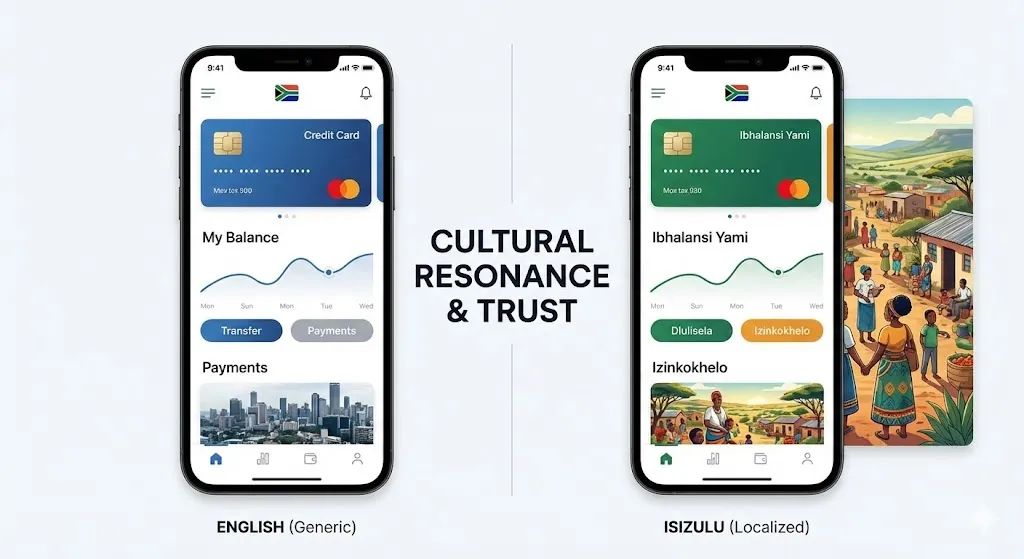

Figure 3: Cultural Resonance & Trust. A comparison of a generic English UI versus a localized isiZulu UI, demonstrating how language and imagery can be adapted to build deeper trust with diverse South African user bases.
The Designtalks Approach to Cultural E-E-A-T
Our research team has conducted deep behavioral analysis on how different South African demographics interact with financial products online. We have found that simply translating UI text via an automated tool is often worse than doing nothing at all. It can lead to awkward phrasing, cultural misunderstandings, and a perception that the company is “foreign” or doesn’t understand its customers.
True cultural integration involves:
- Linguistic nuance: Using correct terminology and tone for financial concepts in Zulu, Xhosa, Afrikaans, and English. This requires human translation by native speakers with financial domain knowledge.
- Visual Adaptation: Ensuring that imagery, icons, and design elements are culturally appropriate and representative of the target audience.
- Localized Content: Creating content that addresses specific local financial challenges and opportunities, such as stochastic savings clubs (stokvels) or specific South African regulatory requirements.
By building a platform that truly resonates with a diverse audience, you create a powerful, highly specific E-E-A-T signal that differentiates your brand from competitors who treat South Africa as a single, monolithic market. This is a critical component of your Architectural Moat.
The “Industry Vertical” Strategy: Domination through Specialization
A common, lazy SEO tactic used by many agencies is to create hundreds of near-identical “location pages” (e.g., “Web Design Sandton,” “Web Design Cape Town,” “Web Design Durban”). While this might generate some low-quality local traffic, it is a poor strategy for a serious Fintech company looking to build national or international authority.

At Designtalks, we advise against this spammy approach. Instead, we champion the “Industry Vertical” Strategy.
The goal is to dominate a specific niche market by creating deep, high-value content that speaks directly to the needs of that industry. Instead of chasing generic keywords, you build authority in a specific domain.
Examples of High-Value Vertical Pages:
- “High-Performance Web Design for SA Fintech Companies”: This page would address the specific challenges of Fintech web design, such as security, compliance, API integrations, and user trust, positioning your agency as a specialist partner.
- “Payment Gateway Integration for SA E-commerce”: A detailed guide and service offering focused on the technical and practical aspects of integrating popular SA payment gateways like PayFast, Peach Payments, and Ozow.
- “Blockchain & Crypto UI/UX Principles for the African Market”: An authoritative resource on designing user-friendly interfaces for complex crypto products, tailored to the unique needs and behaviors of African users.
This strategy attracts pre-qualified leads. A potential client landing on a page dedicated to “Fintech Web Design” is far further down the sales funnel and has a much higher intent to purchase than someone searching for “web designer near me.” By specializing, you become the obvious choice for companies in that vertical, allowing you to command higher fees and build a more defensible market position.
Security by Design: A Core Fintech Requirement
In the Fintech world, web design is not just about the front-end user experience; it is about the secure delivery of data. A beautiful website that leaks customer data is a catastrophic failure.
Security must be baked into the design and development process from day one, not added as an afterthought. This is a core tenet of our “High-Performance” philosophy.
- Platform-Agnostic Approach: We do not rely on a single, monolithic CMS like WordPress for all projects. While WordPress can be secured, its popularity makes it a prime target for attackers. For high-security Fintech applications, we often recommend a Headless architecture. This decouples the front-end (what the user sees) from the back-end (where the data and logic reside), communicating via secure APIs. This significantly reduces the attack surface.
- Secure Development Lifecycle (SDL): We integrate security best practices into every stage of development, from initial threat modeling during the design phase to automated security testing in our CI/CD pipelines.
- Compliance Readiness: We design with regulations like POPIA (Protection of Personal Information Act) and GDPR in mind, ensuring that data handling processes are compliant by default.
Your website’s architecture is your first line of defense. A secure, well-engineered platform is not just an IT requirement; it is a fundamental component of your brand’s trust proposition.
Conclusion: The Future-Proof Fintech
The digital landscape for South African Fintech companies is evolving at a breakneck pace. The winners in this new era will not be the companies with the flashiest websites, but those with the strongest digital foundations.
By building an Architectural Moat based on superior technical performance, embracing Generative Engine Optimization (GEO) to become a trusted “Source of Truth” for AI, and achieving true Cultural Resonance with the diverse South African market, you can future-proof your business and build a lasting competitive advantage.
This is not a simple task. It requires a strategic partner who understands the intersection of design, technology, and finance. At Designtalks, we are dedicated to helping ambitious SA Fintechs build the high-performance digital platforms they need to lead.
Don’t just build a website. Build a digital asset that drives growth, secures trust, and defines your market leadership.
Frequently Asked Questions
1: Why is “High-Performance” web design critical for a Fintech company compared to a standard business website?
A: In Fintech, speed is a proxy for trust. Our research correlates millisecond delays directly with increased abandonment rates during onboarding and transaction flows. A standard “brochure” website often fails Google’s Core Web Vitals assessments (LCP, FID, CLS), which signals technical incompetence to users. A High-Performance architecture—built with our “Code Detox” methodology—ensures sub-second load times, creating an immediate psychological signal of security, stability, and professional capability that standard templates cannot replicate.
2: How does Generative Engine Optimization (GEO) differ from the SEO we are already doing?
A: Traditional SEO focuses on ranking blue links for keywords like “best savings app.” GEO focuses on training AI models (like Gemini and ChatGPT) to cite your brand as the definitive “Source of Truth.” We achieve this by structuring your data with advanced financial Schema (JSON-LD) and creating deep “Topic Clusters.” If your content isn’t structured for AI ingestion, you risk becoming invisible as search behavior shifts from “searching for links” to “asking for answers.”
3: Is a Headless CMS architecture necessary for all Fintech projects?
A: While not mandatory, it is often the superior choice for scaling Fintechs. A Headless architecture decouples the front-end (what the user sees) from the back-end (where data lives), communicating via secure APIs. This creates a significant “Architectural Moat” by reducing the attack surface area compared to traditional monolithic platforms (like standard WordPress). It allows for greater flexibility, tighter security compliance, and the ability to push content to mobile apps and web platforms simultaneously.
4: Why does Designtalks emphasize “Cultural Resonance” over simple language translation?
A: Trust in South Africa is deeply linguistic. Automated translation often misses nuance, leading to “alien” phrasing that erodes confidence. Our “SA-GEO-Compliance” framework emphasizes Cultural Resonance—using native financial terminology in isiZulu, isiXhosa, Afrikaans, and English that reflects how people actually speak about money. This signals to Google’s E-E-A-T algorithms (and your users) that you are a deeply rooted, local authority, rather than a foreign entity trying to extract value.
5: How does your “Industry Vertical” strategy improve our lead quality?
A: Most agencies dilute their authority by creating thousands of spammy “location pages” (e.g., “Web Design Sandton“). We deploy an “Industry Vertical” strategy that targets specific business problems (e.g., “API Integration for Payment Gateways”). This filters out low-intent traffic and attracts sophisticated stakeholders—CTOs, Product Heads, and Founders—who are searching for specific technical solutions, resulting in a lower volume of leads but a significantly higher conversion rate and lifetime value.
6: Can we retrofit “High-Performance” features onto our existing legacy website?
A: In some cases, we can perform a “Code Detox” to strip out bloat and improve Core Web Vitals on legacy sites. However, if the foundational architecture is built on outdated templates or insecure plugins, it is often more cost-effective and secure to rebuild. A patch-job rarely achieves the “Architectural Moat” required to defend against agile competitors. We conduct a platform-agnostic audit to determine if your current build is an asset to be polished or a liability to be replaced.


