Executive Summary: The End of the “Digital Brochure” Era
The South African digital landscape is currently experiencing a violent bifurcation. On one side are businesses maintaining legacy web infrastructure—bloated WordPress sites built on 2020 standards, relying on fading traditional SEO tactics, and treating their websites as static digital brochures. On the other side is a emerging vanguard of organizations engineering dynamic “Digital Entities” designed explicitly for the Intelligence Age.
This is a complete, deep-dive technical white paper designed to establish category dominance. It is written from the perspective of the Designtalks Strategic Intelligence Unit.
We have entered a post-search era. The fundamental behavior of how humans access information has shifted from “searching and clicking” to “prompting and receiving.” When a potential client in Sandton asks ChatGPT for a B2B service provider, or a consumer in Cape Town queries Google Gemini for a product, the AI does not present ten blue links. It synthesizes a singular answer based on trusted data sources.
However, the rush toward “AI-Readiness” has created a dangerous blind spot. Many emerging agencies focus excessively on the technical requirements of Generative Engine Optimization (GEO)—appeasing the bots—while neglecting the fundamental purpose of a business website: converting human visitors into revenue.
This white paper introduces the Conversion-Graph Framework™. It is the proprietary methodology developed by Designtalks to solve the definitive challenge of the next decade: reconciling the semantic needs of Large Language Models (LLMs) with the psychological needs of human buyers, all built on hyper-velocity infrastructure delivering instant experiences across the diverse South African connectivity landscape.
This is not a sales pitch for a “redesign.” This is an architectural blueprint for digital dominance.
Section 1: The Collapse of Legacy Web Paradigms in South Africa
To understand the necessity of the Conversion-Graph Framework™, we must first forensically examine why current “best practices” are failing South African businesses. The traditional model of web design and SEO is collapsing under the weight of three converging pressures: technical debt, algorithmic shifts, and human impatience.
The Speed/Experience Crisis
The averageSouth African mobile user operates in a volatile connectivity environment. They may transition from enterprise-grade fiber in a Bryanston office park to congested LTE in transit, and finally to high-latency 3G in outlying areas.
Legacy web architectures, particularly theme-heavy WordPress builds reliant on dozens of plugins, fail catastrophically in this environment. Our internal audits of the JSE Top 100 versus mid-market leaders reveal an alarming reality: average mobile Time-to-Interactive (TTI) scores frequently exceed 6 seconds on simulated 3G networks.
In an economy where cognitive load is high and attention spans are short, a 6-second delay is not an inconvenience; it is a rejection of the brand. Google’s Core Web Vitals metrics, specifically Interaction to Next Paint (INP), are now actively penalizing these sluggish experiences. If your site feels slow to the South African thumb, Google will ensure it remains unseen.
The “SEO” Dead End
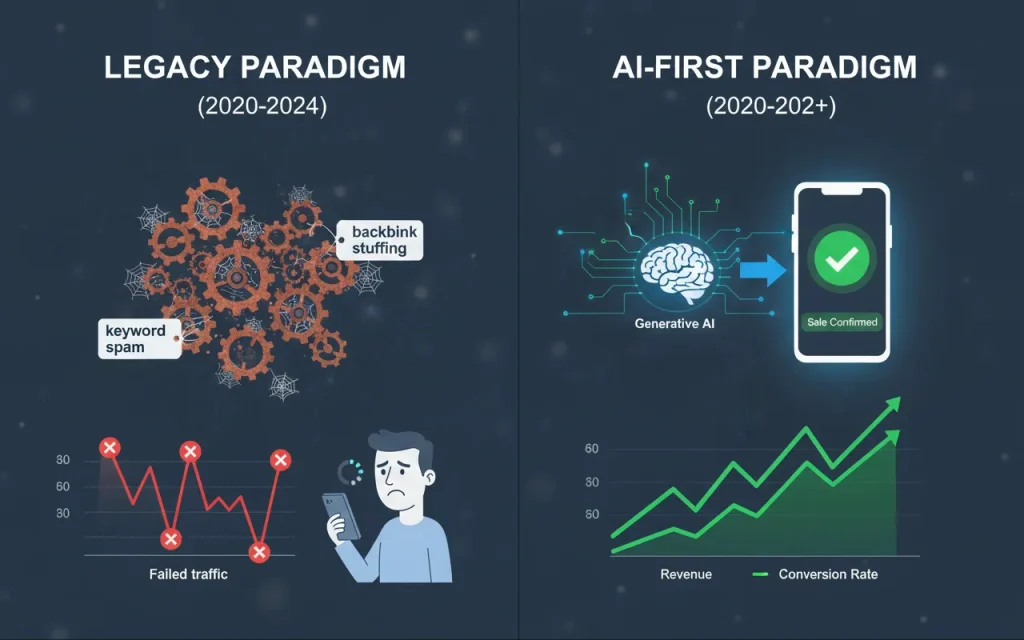
For fifteen years, the industry was obsessed with ranking #1 for keywords. This created an ecosystem of content optimized for search engine spiders, not human consumption—keyword stuffing, shallow blog posts, and manipulative backlinking.
Google’s recent algorithm updates, accelerated by the integration of AI into the core search product, have decimated this approach. The search engine is no longer matching strings of text; it is attempting to understand intent and entities. It is looking for genuine authority, verified experience, and deep topical expertise.
Traditional SEO agencies are still selling keywords in a world moving toward concepts. They are bringing a knife to a nuclear fight.
The AI Bypass
The final nail in the coffin of legacy web design is the rise of zero-click searches powered by Generative AI. Platforms like Google’s AI Overviews and perplexity.ai are designed to answer the user’s query directly on the results page without ever sending traffic to a website.
If your website’s only value proposition is providing basic information that an AI can easily summarize, your traffic will evaporate. Your website must evolve from a repository of information into a destination of unique value and verified transactional capability that the AI recommends, rather than replaces.
Section 2: Defining the New Battlefield – The Evolution of the SA Web
The market has shifted, and a new categorization of agency capabilities is required to navigate this landscape. We have observed three distinct tiers of web execution currently active in South Africa. Understanding where your current digital asset falls on this spectrum is crucial for future planning.
The Comparison Matrix: Evolving Beyond the Status Quo
We can delineate the market into three categories: Traditional SEO Agencies (the past), Technical “AI” Agencies (the incomplete present), and the Conversion-Graph approach (the profitable future).
- Tier 1: Traditional “SEO” Agencies
- Core Goal: Ranking #1 for specific keywords.
- Mobile Speed Standard: 3-5 Seconds (Acceptable losses).
- Strategic Focus: Keywords, blog volume, meta tags.
- Success Metric: Vanity Traffic (clicks that don’t convert).
- The Fatal Flaw: They are optimizing for 2019 Google algorithms and ignoring user experience.
- Tier 2: Pure Technical “AI” Agencies
- Core Goal: Achieving AI Citations in LLM outputs.
- Mobile Speed Standard: Sub-1 second (Technical obsession).
- Strategic Focus: Entities, structured data, technical schematics.
- Success Metric: Citations and technical scores.
- The Fatal Flaw: They get lost in the “AI Lab.” They build technically flawless sites that read like instruction manuals, failing to connect emotionally with human buyers, resulting in low conversion rates despite high rankings.
- Tier 3: The Designtalks Profit Engine™ (Conversion-Graph)
- Core Goal: Revenue and sustainable business growth.
- Mobile Speed Standard: Instant (Edge-Cached globally and locally in JHB/CPT).
- Strategic Focus: Synchronizing Human Intent with AI Authority.
- Success Metric: Verified Lead Quality and Revenue Attribution.
- The Advantage: We view AI readiness as the minimum standard, not the end goal. The goal is using that technical foundation to facilitate human economic behavior.
Section 3: Introducing The Conversion-Graph Framework™
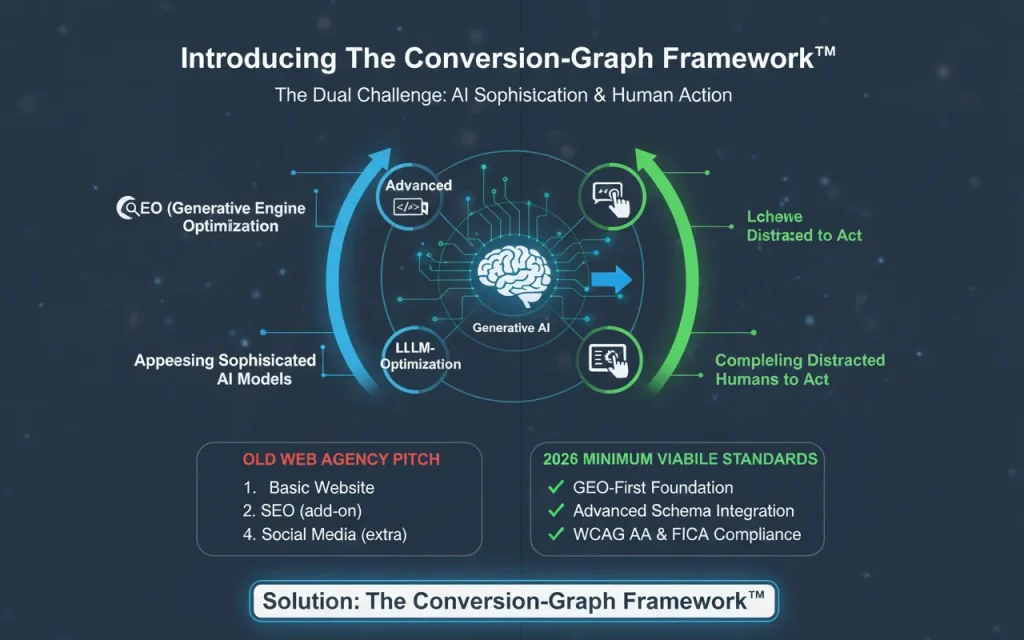
You have heard the buzzwords echoing through boardrooms in Sandton and tech hubs in Cape Town: GEO (Generative Engine Optimization), Advanced Schema, LLM-Optimization.
At Designtalks, we do not view these as “premium add-ons” to upsell a client. In 2026, these are the minimum viable standards for operating a digital business. If a web agency is pitching you “schema implementation” as a special feature, they are already behind the curve.
To solve the dual challenge of appeasing sophisticated AI models while compelling distracted humans to act, we developed the Conversion-Graph Framework™.
This framework is a tripartite methodology that rejects the idea that you must choose between technical excellence, aesthetic beauty, or commercial aggression. You must have all three, operating in perfect synchronization.
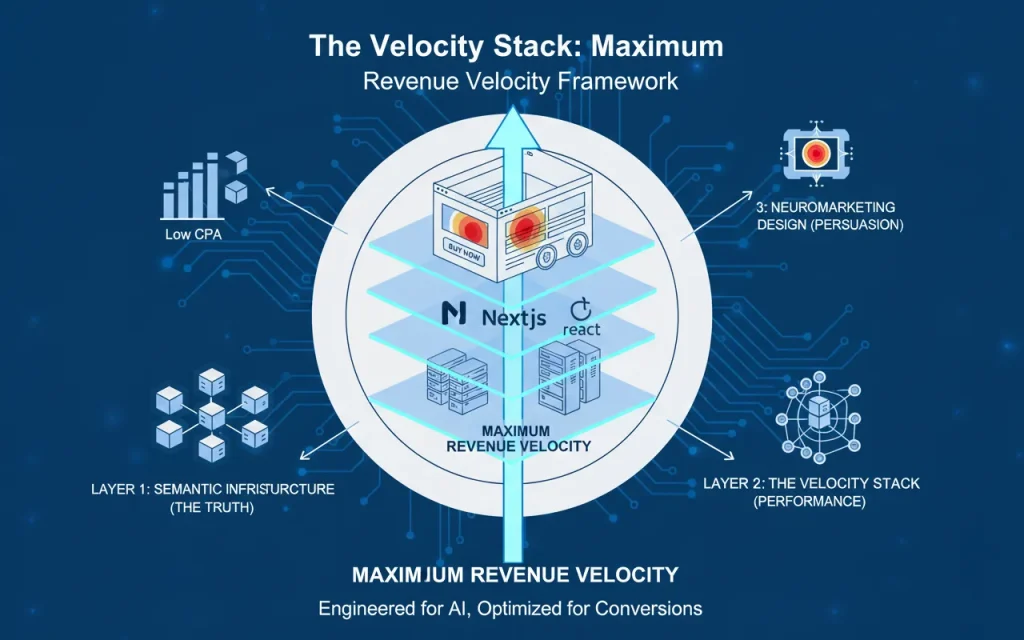
Layer 1: The Semantic Infrastructure (The Truth Layer)
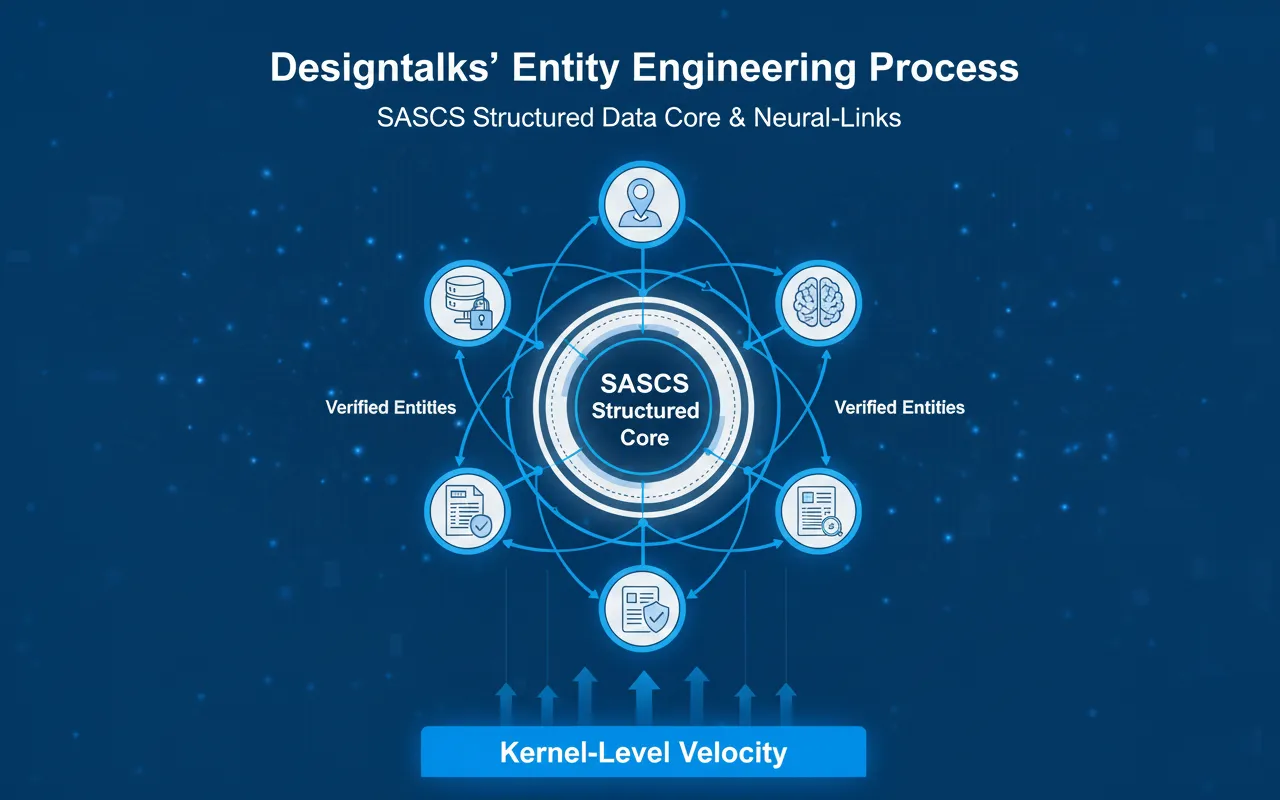
This is the foundation upon which AI authority is built. We do not just “detox” your code from bloat; we structure your entire digital existence into a format that is mathematically impossible for search engines and LLMs to misunderstand.
Modern AI models do not read pages like humans; they ingest data and map relationships between “entities.” An entity is a distinct, independent thing—your CEO, your Sandton headquarters, your specific service offering, your client reviews.
- Beyond Basic Schema: Most agencies deploy basic
LocalBusinessschema and call it a day. We engineer complex, nested Knowledge Graphs using JSON-LD linked open data principles. We explicitly map the relationship between your services, your location, your awards, and your authors, creating a dense web of verified facts that Google’s Knowledge Graph absorbs. - Becoming the “Fact”: When an AI is queried, it looks for the most probabilistic “truth.” By structuring your data with absolute semantic rigidity, we position your brand not as an “option” for the AI to present, but as the verified “fact” regarding your specific niche in South Africa.
Layer 2: The Velocity Stack (The Performance Layer)
Latency kills conversion. In the South African context, where bandwidth varies wildly, velocity is a supreme competitive advantage. The Conversion-Graph Framework™ abandons legacy server-side languages like PHP (WordPress standard) in favor of modern, Javascript-based architectures.
- Machinery of Giants: We build primarily on Next.js MERN (MongoDB, Express, Node.js) or JAMstack (JavaScript, APIs, Markup) and React—the same battle-tested technologies powering platforms like TikTok, Netflix, and Airbnb. This ensures your site architecture is inherently scalable and stable under immense load.
- Edge-Native Delivery: We utilize advanced CDN (Content Delivery Network) strategies, server-side rendering (SSR), and static site generation (SSG). This means pre-built versions of your pages are stored on servers geographically located as close as possible to the user (e.g., in Johannesburg or Cape Town data centers). When a user requests your site, it doesn’t have to be built on the fly; it is delivered instantly from the “edge.”
- The Result: Frictionless UX designed for the South African thumb. Fast on fiber, faster on 3G mobile.
Layer 3: Neuromarketing Design (The Persuasion Layer)
This is where pure technical agencies fail. A site that loads instantly and is cited by AI is useless if the human landing on it does not trust the brand enough to enter their credit card details.
We do not just design for Google’s bots; we design for the humans holding the purchasing power.
- Psychological Triggers: Our design process is rooted in behavioral psychology and cognitive load theory. We utilize eye-tracking data heuristics to place calls-to-action (CTAs), social proof, and value propositions in the exact pathways where human attention naturally flows.
- Reducing Cognitive Friction: We aggressively simplify user journeys. Every pixel that does not contribute to building trust or advancing the sale is removed. We utilize persuasive design patterns that subtly guide the user toward the desired conversion action, turning passive visitors into active leads.
- The Authority Loop: This completes the cycle. We ensure AI models cite you as the expert, driving high-intent traffic. Once that traffic arrives, the Neuromarketing layer convinces the user you are the only viable choice, generating the engagement signals that feed back into the AI, further cementing your authority.
Section 4: Local Authority – Proudly Built in South Africa, For South Africa
Global frameworks must be adapted for local realities. A generic approach imported from Silicon Valley or London often fails in the nuances of the South African market. The Conversion-Graph Framework™ is deeply localized.
We understand the diverse digital landscape of our nation—from the high-paced corporate requirements of the Sandton and Bryanston executive sector to the creative, tech-centric hubs of Cape Town and Stellenbosch.
Our infrastructure ensures compliance with POPIA (Protection of Personal Information Act) regulations regarding data handling, a critical factor often overlooked by international templates. Furthermore, our understanding of local linguistic nuances and cultural purchasing triggers ensures that while your technology performs with global muscle, your brand resonates with the South African heart.
We build digital assets that acknowledge the reality of load shedding’s impact on connectivity infrastructure and engineer resilience into every deployment.
Conclusion: The Imperative to Evolve
The era of the static website is over. The era of “tricking” search engines with keywords is over. We have entered an era of hyper-competition defined by algorithmic authority and millisecond-level performance.
Your competitors are already pivoting toward AI search strategies. If you are not actively leading this transition in your niche, you are already losing market share, even if it is not yet visible in your current analytics reports.
Designtalks is ready to engineer your transition to the AI-first economy.
Frequently Asked Questions (FAQs) – Strategic Intelligence Unit
1: How does GEO (Generative Engine Optimization) differ significantly from traditional SEO?
Traditional SEO is about convincing a search engine to rank a link to your page by optimizing for keywords. GEO is about convincing an AI model (like ChatGPT or Gemini) to synthesize your content into a direct answer because it recognizes you as a trusted, authoritative entity. SEO is about visibility; GEO is about citation and becoming the source of truth.
2: Why is Next.js and React preferred over WordPress for the Conversion-Graph Framework™?
WordPress powers much of the web, but its legacy architecture (PHP, heavy reliance on databases and plugins) creates inherent speed limitations and security vulnerabilities, especially on mobile networks. Next.js (a framework for React) allows for Server-Side Rendering and Static Site Generation, meaning pages are pre-built and delivered instantly via CDNs. This results in vastly superior speed, better Core Web Vitals, and a more stable infrastructure for high-traffic commercial sites.
3: Can the Conversion-Graph Framework™ be applied to existing websites?
While elements of neuromarketing and schema can be retrofitted, the full power of the framework relies on the underlying velocity stack. Trying to implement this level of performance on a bloated legacy codebase is like putting an F1 engine into a sedan chassis. We typically recommend a strategic migration to modern architecture to realize the full ROI.
4: How does this framework specifically address the South African market’s connectivity challenges?
By utilizing “Edge-Native” delivery, we ensure that the heavy lifting of building the webpage happens on powerful servers located near major South African data hubs, not on the user’s potentially slow mobile device. We send the absolute minimum amount of code necessary down the wire, ensuring rapid loading even during network congestion or high-latency 3G connections common outside major metros.
5: What role does content play in this framework if keywords are no longer the focus?
Content is more crucial than ever, but its purpose has shifted. Instead of churning out shallow, keyword-stuffed blog posts, the focus must be on creating deep, expert-level “knowledge pillars.” This content must be structured specifically for AI ingestion, providing unique data, contrarian viewpoints, or proprietary research that LLMs cannot find elsewhere. This builds the “domain authority” necessary for GEO.
6: How long does it take to see results from implementing the Conversion-Graph Framework™?
Unlike traditional SEO, which can take 6-12 months to show movement, the impact of the velocity stack and neuromarketing layers on human conversion rates is often immediate upon launch. The semantic layer begins influencing AI models as quickly as they re-index your entity data, with significant gains in authority typically observed within the first 90-120 days post-deployment.