
Executive Summary: The Strategic Imperative of Digital Territory
In the digital economy of SA, a domain name is no longer merely a web address; it is the foundational asset of digital sovereignty. For entities operating within or targeting the South African market, securing the correct digital territory constitutes the primary step toward establishing authoritative market presence.
The South African digital landscape has matured significantly. The adoption of cloud-native technologies, edge computing, and the proliferation of e-commerce has made the stability and security of DNS infrastructure paramount.
Unlike generic global domains, the South African namespace is governed by specific national frameworks designed to ensure stability, resilience, and local relevance. The apex of this structure is ZADNA, the statutory regulator mandated by the Electronic Communications and Transactions Act, 2002. ZADNA determines the policy for the .za namespace. The technical execution of these policies is managed by the ZA Central Registry (ZACR), a non-profit company that maintains the central database of all .za domain names.
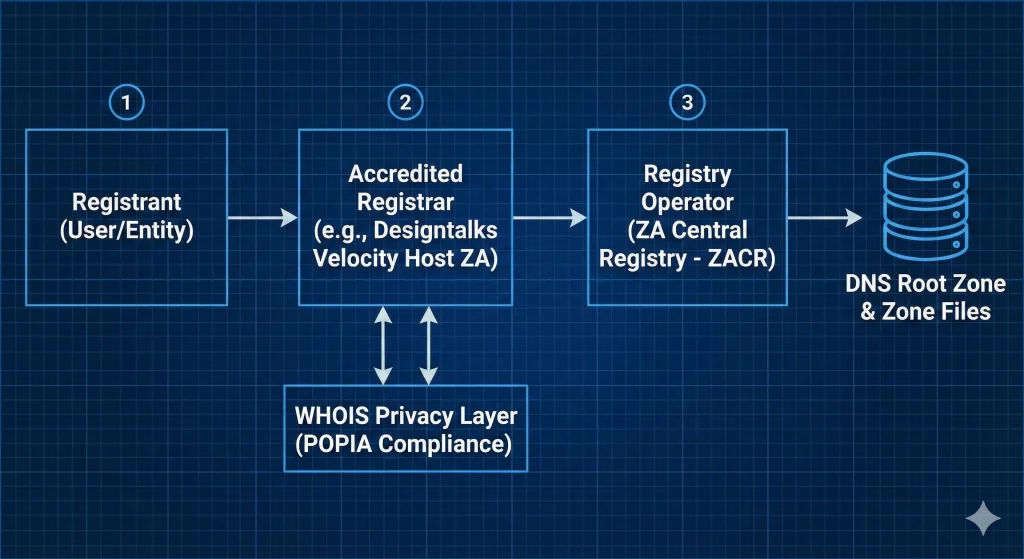
Understanding this dichotomy—policy vs. technical execution—is vital for any enterprise. When you register a domain, you are technically interacting with the ZACR database through an accredited intermediary (the registrar).
Section 1: The South African Digital Landscape and Governance Framework
Understanding how to register a domain in South Africa requires a foundational knowledge of the governing bodies that maintain the integrity of the internet locally and globally.
The Internet Corporation for Assigned Names and Numbers (ICANN) remains the global coordinator of IP addresses and domain names. However, South Africa possesses a robust, distinct national governance structure for its Country Code Top-Level Domain (ccTLD), designated as .za.
The ZA Domain Name Authority (ZADNA) is the statutory regulator that administers and manages the .za namespace. ZADNA’s mandate is derived from the Electronic Communications and Transactions Act, 2002 (ECT Act). Their role is critical in ensuring that the .za domain remains a stable, secure, and accessible resource for South Africans. ZADNA appoints a Central Registry (currently the ZACR – ZA Central Registry) to manage the technical backend of the domain names.
When you register a .co.za, .org.za, or .web.za domain, you are engaging in a regulated process overseen by these authoritative bodies. This governance ensures legal recourse and technical stability that unregulated namespaces cannot offer.
- Authority Link: Learn more about the role of ZADNA (Wikipedia) and their regulatory framework.
- Authority Link: Understand the global coordination role of ICANN (DBpedia).
Section 2: Strategic Domain Naming Doctrine (Phase 1)
The selection of a domain name is often treated as a creative exercise; however, the Designtalks Strategic Intelligence Unit views it as a critical strategic functionality. A domain name dictates brand recall, user trust, and search engine visibility potential. In today, where cognitive load on users is immense, clarity is paramount.
The registration process begins with adhering to a strict naming doctrine designed for maximum efficacy.
2.1 The Principle of Cognitive Fluency (Simplicity)
Simplicity and Recall: A domain name must be easy for the brain to process. Our intelligence suggests aiming for a “under 15 character” constraint. This is not an arbitrary limitation but a guideline based on short-term memory retention capabilities.
Crucially, avoid numerical digits and hyphens. These act as “cognitive speedbumps.” When a user hears a domain containing a number, they must pause to determine if it is spelled out (e.g., “seven”) or a digit (e.g., “7”). Hyphens are frequently omitted during manual entry, leading to traffic leakage to competitors or error pages.
- Keyword Relevance vs. Brandability: While exact-match domains (e.g.,
CapetownPlumbers.co.za) offer minor SEO advantages, 2026 search algorithms prioritize brand authority. A unique, brandable name (e.g.,AquaFlow.co.za) is often superior for long-term equity building.
2.2 TLD Extension Selection Strategy
The Top-Level Domain (TLD) is the suffix of the address. While hundreds exist, only a few command immediate authority in the South African context.
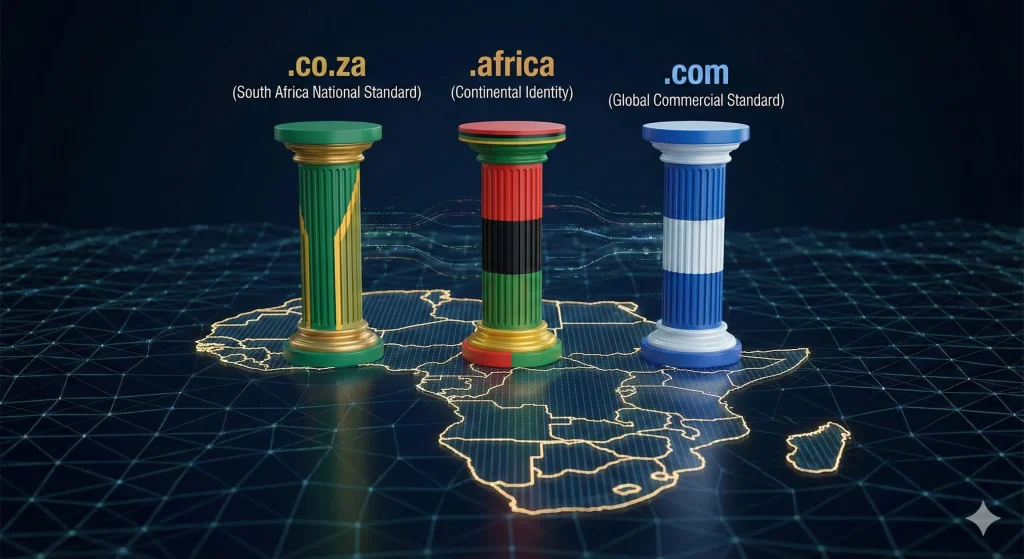
- The Global Standard (.com): This remains the default assumption for global commerce. If your ambition is international, securing the .com variant is a defensive necessity, even if your primary operations are local.
- The South African Imperative (.co.za): For any entity primarily targeting South African audiences, .co.za is non-negotiable. It signals local presence, currency relevance (ZAR), and commitment to the market. Consumer trust in South Africa is significantly higher for local extensions.
- Specialized Extensions:
- .org.za: Restricted strictly for South African non-profit and non-governmental organizations. It carries immense trust regarding intent.
- .ac.za: Reserved exclusively for accredited South African academic institutions.
- .africa: A strategic choice for pan-African entities wishing to demonstrate continental reach beyond ZA borders.
2.3 Due Diligence and Trademark Clearance
Before committing, perform a dual-check:
Trademark Search: Conduct a search for existing trademarks. Registering a domain that infringes on a well-known trademark can lead to a dispute resolution process under ZADNA’s Alternative Dispute Resolution (ADR) regulations, potentially resulting in the loss of the domain.
CIPC Search: Verify the name isn’t identical to a registered South African company via the Companies and Intellectual Property Commission (CIPC).
Section 3: The Registrar Selection Protocol (Phase 2)
An ICANN-accredited registrar acts as the intermediary between you and the registry (like ZACR or Verisign). Not all registrars are created equal. The selection must be based on technical infrastructure, security features, pricing transparency, and support competence.
In 2026, the market is bifurcated between large global players offering scale and specialized local providers offering market-specific optimizations.
3.1 Global Registrar Competitors
For users requiring global portfolios or specific pricing models, international giants remain relevant.
- Cloudflare: The preferred choice for technically sophisticated users. Cloudflare operates on an “at-cost” pricing model for domains, meaning they charge exactly what the registry charges them, with zero markup. The caveat is the mandatory use of Cloudflare’s nameservers, which is generally a benefit for security and speed but requires technical acceptance.
- Porkbun: Gained significant market share by 2026 due to an anti-obfuscation philosophy. Their interface is clean, pricing is consistently low without deceptive renewal hikes, and essential features are included by default.
- Namecheap: A stalwart for budget-conscious entities. They balance competitive pricing with a robust, albeit sometimes cluttered, interface. Their commitment to internet freedom and free privacy protection keeps them highly relevant.
- GoDaddy: The mass-market incumbent. They excel in providing a “bundled” experience, offering hosting, email, and site builders in a single ecosystem. However, sophisticated users often find their upsell tactics aggressive and renewal pricing higher than competitors.
3.2 The South African Vanguard and Designtalks Velocity Host ZA
For .co.za registrations and South African-centric hosting, local providers often offer superior latency, ZAR-based billing, and support teams familiar with local infrastructure challenges (such as load shedding impacting localized data centers).
- HostAfrica: Known for aggressive market penetration strategies, frequently offering the lowest introductory rates for .co.za (often cited around R49/year during promotions).
- Absolute Hosting: Historically a leader in low-cost raw domain registration. Their focus is on minimal overhead, passing savings to the user.
- Afrihost & Domains.co.za: These represent the reliable middle ground, offering competitive pricing (typically hovering around the R99/year mark for .co.za) combined with robust infrastructure and often including value-adds like basic DNS management.
- Truehost: An emerging player competing aggressively on first-year acquisition costs across various extensions.
Introducing Designtalks Velocity Host ZA
While the above providers compete primarily on price or bundled mass-market hosting, Designtalks has identified a gap for premium, high-availability integrated domain solutions.
Designtalks Velocity Host ZA is our engineered solution designed for mission-critical digital assets. We are not competing in the “race to the bottom” on raw domain pricing. Instead, Velocity Host ZA integrates domain registration with enterprise-grade managed DNS, proactive security monitoring against domain hijacking, and seamless integration intohigh-performance local hosting environments. It is the choice for entities where domain downtime translates directly to significant revenue loss.
Section 4: Technical Execution – The 5-Step Acquisition Cycle (Phase 3)
Once strategy and partner selection are complete, the execution phase involves five standardized technical steps.
Step 1: Availability Verification and Variance Analysis
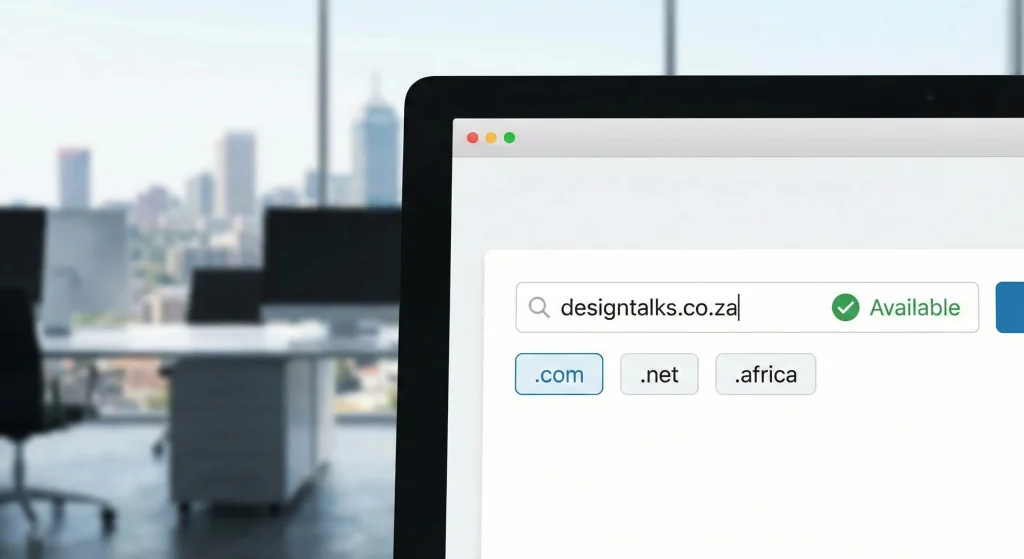
Use your chosen registrar’s central search terminal to query the registry database. This results in a binary outcome: Available or Taken.
If taken, sophisticated registrars will utilize AI-driven algorithms to suggest semantic variations or alternative TLDs. The Designtalks Strategic Intelligence Unit advises caution here; do not settle for a weak variation of your primary choice just because it is available. If the .co.za is taken by a direct competitor, reconsider the naming strategy rather than choosing a confusingly similar .net.za.
Step 2: Configuration of Registration Parameters
- Registration Term Licensing: You do not “buy” a domain; you license it for a specific tenure, typically 1 to 10 years. We strongly recommend a minimum 5-year registration for core brand assets. This sends positive signals to search engine algorithms regarding business longevity and reduces the administrative risk of accidental expiry.
- Mandatory ICANN Disclosures: You must provide accurate contact information for the Registrant, Administrative, and Technical contacts. Providing false data is grounds for domain suspension under ICANN’s Registrar Accreditation Agreement (RAA).
Step 3: Implementing WHOIS Privacy Protocols
The WHOIS database is a publicly accessible directory of domain registrants. By default, your name, address, and phone number are visible globally, leading to spam and potential security reconnaissance by malicious actors.
In 2026, Domain Privacy (or WHOIS Redaction) is a mandatory security posture, not an optional extra. This service replaces your personal data with the registrar’s proxy information. Leading registrars like Porkbun and Namecheap include this perpetually for free. If a prospective registrar charges extra for this essential security layer, view it as a negative indicator of their business model.
For individual registrants under the .za namespace, this data is redacted by default by ZACR to comply with POPIA. ZADNA’s policy ensures that personal information is protected from scraping and misuse. For legal entities (companies), some data may remain public depending on specific ZADNA policy interpretations.
Strategic Imperative: While ZACR provides default redaction, many global registrars offer an additional “Domain Privacy” layer for non-.za domains (.com, etc.). It is highly recommended to utilize this to prevent your personal data from entering global WHOIS databases outside of SA jurisdiction.
DNS Security Extensions (DNSSEC)
Security is paramount. Domain Name System Security Extensions (DNSSEC) adds a layer of cryptographic security to the DNS. It prevents attackers from hijacking the domain resolution process and redirecting users to fraudulent websites (cache poisoning).
Step 4: Financial Finalization and Auto-Renewal Defense
Completing the transaction finalizes the license. Prices for common extensions generally range between $10 to $15 USD globally, or R89 to R150 ZAR locally per annum.
Crucially, you must enable Auto-Renewal immediately upon purchase. Domain hijacking often occurs in the “grace period” following an accidental expiration. Auto-renewal, backed by a secondary payment method on file, is the primary defense against this catastrophic failure mode.
Step 5: The RAA Verification Loop
Post-purchase, ICANN requires verification of the registrant’s email address. You will receive a time-sensitive link. Failure to click this link, typically within 15 days, results in the registry suspending the domain, rendering any attached website or email service inactive. This is a common failure point for novice registrants.
Section 5: Economic Analysis – Total Cost of Ownership (TCO)
The Designtalks Strategic Intelligence Unit urges stakeholders to look beyond the introductory price tag. The domain industry is rife with “loss-leader” pricing—offering a domain for R49 in year one, only to renew it at R250 in year two.
TCO Variables to Audit:
- Renewal Price delta: Calculate the 5-year cost based on renewal rates, not introductory rates.
- Hidden Fees: Does the registrar charge for DNS management? Is there an exit fee if you transfer away? Is WHOIS privacy charged annually?
- Currency Risk: Paying for a .co.za domain in USD introduces unnecessary exchange rate volatility. Local entities should prioritize ZAR billing for local domains.
Recommendation: Visit the websites of HostAfrica, Afrihost, and Absolute Hosting directly to check current renewal pricing. Compare this TCO against the integrated value proposition of Designtalks Velocity Host ZA for mission-critical applications.
Section 6: Conclusion – Securing Your Digital Future
Registering a domain name in South Africa in 2026 is a sophisticated process involving legal, strategic, and technical considerations. By adhering to the naming doctrines, selecting reputable registrars based on transparent TCO, and following the rigorous acquisition steps outlined in this white paper, entities can secure their foundational digital territory.
Whether opting for a cost-optimized local provider or the premium, integrated assurance of Designtalks Velocity Host ZA, the priority must remain on security, stability, and long-term brand viability.
Appendix: Frequently Asked Questions (FAQs)
The following queries represent the most critical points of confusion identified by our intelligence unit regarding domain registration in SA.
1. Can I register a .co.za domain if my business is not physically located in South Africa?
Yes. Currently, ZADNA does not enforce a “local presence requirement” for standard .co.za registrations. International entities can register .co.za domains to secure their brand presence in the South African market. However, specific extensions like .org.za do have strict local eligibility requirements.
2. What is the difference between a Registry, a Registrar, and a Registrant?
This is a crucial distinction. The Registry (e.g., ZACR) manages the master database of all domain names for a specific extension. The Registrar (e.g., HostAfrica, GoDaddy) is the retail company accredited to sell domains to the public. You, the customer buying the domain, are the Registrant. You cannot buy directly from the Registry; you must use a Registrar.
3. Why does Designtalks recommend WHOIS privacy even for businesses?
While business contact info is often public, the WHOIS database is brutally harvested by automated spambots, scammers attempting domain slamming (fake renewal notices), and bad actors seeking technical contacts for social engineering attacks. Privacy acts as a necessary firewall against low-effort automated malicious activity.
4. What happens if I forget to renew my domain name?
The domain enters a series of stages. First, it stops working (suspension). Then it enters a “Grace Period” where you can still renew it at normal cost. Following that is a “Redemption Period,” where renewal fees are exorbitant (often $100+). Finally, it is “Pending Deletion,” after which it is released back to the public pool and can be registered by anyone—including domain squatters who will sell it back to you at a massive premium.
5. Is Designtalks Velocity Host ZA a registrar?
Designtalks Velocity Host ZA operates as a premium managed service provider leveraging high-tier accredited registrar partnerships. We provide the strategic layer, security management, and integrated hosting environment sitting above the raw registration commodity, ensuring enterprise-grade reliability for our clients.
6. How does DNS impact my newly registered domain?
Domain Name System (DNS) is the “phonebook” of the internet. Registering the domain just secures the name. To make it load a website or receive email, you must configure DNS records (like A records and MX records) to point the domain to your hosting server’s IP address. Many budget registrars offer slow or basic DNS; premium services ensure faster propagation and better redundancy.
End of Technical White Paper. Designtalks Strategic Intelligence, How to Register a Domain..