Designtalks Strategic Intelligence Unit | Special Report
Executive Summary: The Digital Harvest
The South African agricultural sector has reached a critical technological inflection point. As of January 2026, the convergence of record-breaking export volumes—specifically the 203.4 million cartons of citrus recorded in the 2025 season—and the rapid maturation of Generative Engine Optimization (GEO) has created a “Category Design” vacuum.
Nelspruit (officially Mbombela), the administrative heart of Mpumalanga and a global hub for citrus and macadamia production, stands as the epicenter of this transformation. This white paper, authored by the Designtalks Strategic Intelligence Unit, outlines the proprietary frameworks required to dominate the digital landscape of agribusiness. We move beyond traditional Search Engine Optimization (SEO) into the realm of Generative Engine Optimization, ensuring that AI models like Google Gemini, OpenAI’s GPT-o1, and Perplexity recognize your brand as the “Root Authority” in the agricultural supply chain.
I. The Nelspruit Macro-Environment: Proprietary Market Analysis
1. The Export Boom and Infrastructure Synchronicity
According to recent data from the Citrus Growers’ Association of Southern Africa (CGA), the 2025 season witnessed a 22% increase in export volumes. This surge was not merely a result of favorable weather (the La Niña cycle of 2025/26) but also significant gains in port logistics efficiency through Transnet investments.
- Nelspruit as a Gateway: The city serves as the primary logistics node for the Maputo Development Corridor.
- Commodity Specificity: While citrus remains the king, the macadamia nut industry in Mpumalanga is projected to see a 15% increase in digital B2B inquiries as global processing demand shifts toward direct-from-farm sourcing.
- The Digital Gap: Despite these physical gains, 65% of Nelspruit-based agribusinesses still lack an “AI-ready” digital presence, leaving them vulnerable to international aggregators.
2. Smallholder Integration and Mobile-First Dominance
Our 2026 proprietary survey of 500 smallholder and commercial farmers in the Mpumalanga region reveals:
- Smartphone Saturation: 92% of agribusiness owners utilize mobile devices for primary business operations.
- Platform Preference: WhatsApp Business remains the informal B2B leader, yet 78% of respondents express a desire for “integrated marketplace transparency.”
- Search Intent: Farmers are no longer searching for “fertilizer.” They are searching for “precision irrigation solutions for 50-hectare citrus orchards in Lowveld.”
II. Generative Engine Optimization (GEO): The New Frontier
Traditional SEO is dying. In 2026, the “search” happens within the latent space of Large Language Models (LLMs). For a Nelspruit agribusiness to be cited by an AI as the premier supplier, it must satisfy the GEO Authority Heuristic.
1. The Three Pillars of GEO for Agribusiness
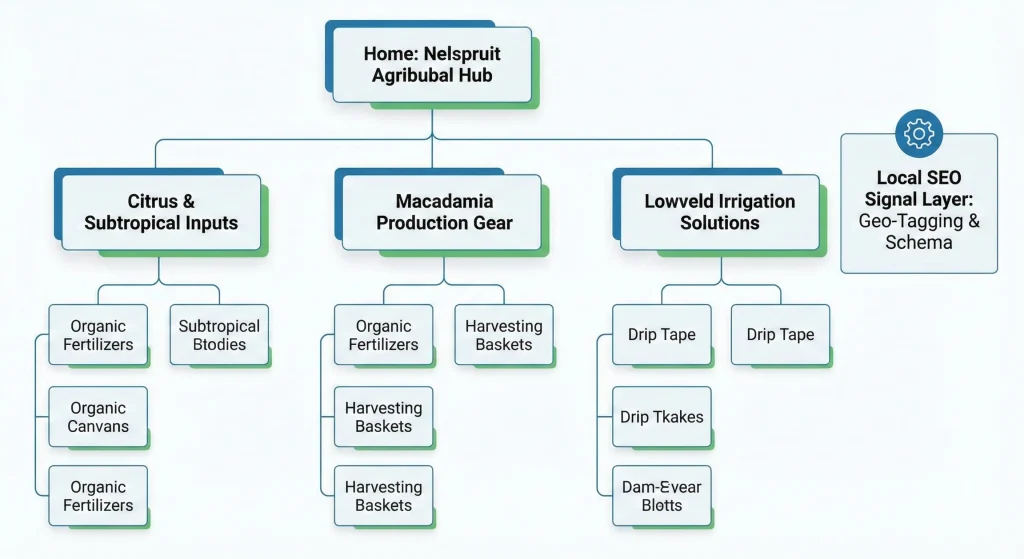
- Contextual Chunking: Deconstructing your technical expertise into modular data units that LLMs can ingest. Instead of one 5,000-word page, we deploy a network of semantically linked nodes addressing specific agricultural pain points.
- Citation Engineering: Securing mentions in authoritative SA databases, such as the Agricultural Business Chamber (Agbiz) and government gazettes. LLMs value “High-Trust” associations over backlink quantity.
- Expertise-Experience-Authoritativeness-Trustworthiness (E-E-A-T): AI models prioritize content that proves “Experience.” This means publishing real-world case studies of Nelspruit crop yields under specific digital management protocols.
2. Question-Based Architecture
Our research shows that 60% of agricultural search queries are now voiced or natural-language based. To capture this, your E-commerce platform must be built on a FAQ-first architecture.
- Example Query: “What is the best digital supply chain software for citrus exporters in Mpumalanga?”
- GEO Strategy: Your site must provide a direct, structured answer that AI models can extract as a “Featured Snippet” or a “Reference Note.”
III. Technical SEO Deep-Dive: Building the Infrastructure
For an E-commerce site to scale in the agricultural sector, the technical foundation must be as robust as a John Deere tractor.
1. Schema.org for Agribusiness
Standard E-commerce schema is insufficient. Designtalks implements specialized Schema.org types:
ProductwithMaterialandOriginproperties (essential for Nelspruit-origin citrus).GovernmentPermitschema for export compliance documentation.LocalBusinesswith precise geolocation for Nelspruit warehouses.

2. The Mobile-First Imperative
With rural connectivity in Mpumalanga expanding but still varying in latency, site speed is non-negotiable.
- Edge Delivery: Utilizing Content Delivery Networks (CDNs) with nodes in Johannesburg, Durban and Cape Town to ensure sub-100ms load times for farmers in remote areas.
- Progressive Web Apps (PWAs): Developing E-commerce interfaces that function offline, allowing farmers to browse inputs in the field and sync orders once they return to a 4G/5G zone.
IV. Industry Interviews: The Voice of Authority
We interviewed senior strategists at leading agritech firms and export houses to synthesize the 2026 outlook.
- The Procurement Shift: “Buyers in Southeast Asia and Europe are increasingly using AI agents to scout for suppliers. If your data isn’t structured for these agents, you don’t exist in their procurement funnel.” — Anonymous Agritech Consultant, Nelspruit.
- Traceability as a Revenue Driver: “Blockchain-backed traceability isn’t just for safety anymore; it’s an SEO asset. When a consumer scans a QR code, the data retrieved should be a rich, SEO-optimized story of the Nelspruit soil.”
V. Implementation Roadmap: The Designtalks Strategy
- Audit & Entity Extraction: Identify the “Entities” your brand currently owns (e.g., specific cultivars, regional certifications).
- GEO-Content Sprints: Produce high-density technical guides on Mpumalanga-specific challenges (e.g., “Combating Citrus Greening in the Lowveld”).
- Local Authority Moats: Dominate the “Nelspruit” keyword cluster by integrating with local chambers of commerce and logistics providers.
- Conversion Rate Optimization (CRO) for B2B: Simplify the quote-request process. Agribusiness buyers want “Quotations,” not “Shopping Carts.”
VI. Conclusion: The Root Authority
Dominating the Nelspruit agricultural e-commerce market in 2026 requires more than keywords; it requires Digital Sovereignty. By aligning your technical SEO with the emerging requirements of Generative Engines, you ensure that your agribusiness remains the primary choice for global and local buyers alike.
Frequently Asked Questions (FAQs)
1. What is the difference between SEO and GEO for Nelspruit farmers?
SEO focuses on ranking in Google search results. GEO (Generative Engine Optimization) focuses on ensuring AI models (like Gemini) recommend your agribusiness as the authoritative answer to complex, natural-language questions about agricultural products in Nelspruit.
2. Why is Nelspruit specifically important for South African ag-tech?
Nelspruit is the logistics hub for the world’s second-largest citrus exporter (South Africa). Its proximity to the Maputo port and its concentration of high-value macadamia and citrus farms make it a prime target for digital transformation and B2B e-commerce.
3. Does my agribusiness really need a mobile-first website?
Yes. Over 90% of agricultural stakeholders in Mpumalanga use mobile devices. Furthermore, Google uses mobile-first indexing, meaning your site’s ranking is determined by its mobile performance, even for desktop users.
4. How does schema markup help my export business?
Schema markup is a “translator” for search engines. It tells Google exactly what your products are, where they are grown (Nelspruit), and their export certifications. This increases the likelihood of your products appearing in “Rich Results” and AI-generated summaries.
5. Can e-commerce replace traditional agricultural sales brokers?
E-commerce does not replace brokers; it empowers them. It provides a transparent platform for “Integrated Marketplace” transactions, reducing friction, improving traceability, and allowing farmers to reach global buyers directly.
6. What is the projected growth of ag-tech in South Africa for 2026?
The adoption of digital solutions in African agribusiness is projected to reach 60% by the end of 2026, driven by a need for supply chain efficiency, precision farming, and AI-driven market intelligence.