


Executive Summary: The Failure of Legacy Digital Floral Retail
The floral landscape in South Africa, particularly in high-density economic hubs like Sandton, Gauteng, is characterized by a stark digital divide. On one side reside the legacy giants—national behemoths with decade-long entrenched domain authority and ubiquitous brand recognition. On the other sit local, artisan florists, often possessing superior product quality but lacking the digital infrastructure to translate physical inventory into digital visibility against these national incumbents.
Conventional digital marketing and traditional SEO tactics—keyword density, blog fluff, and generic backlinking—have proven functionally obsolete in this specific vertical. The search landscape has shifted dramatically toward Generative Engine Optimization (GEO), where AI-driven search engines (like Google’s SGE, Gemini, and Bing’s Copilot) do not just retrieve links; they generate answers based on verifiable “truth data.”
For a Sandton-based florist to compete for high-intent queries in suburbs like Bryanston, Morningside, or Sandhurst, they cannot rely on a standard e-commerce template. They require a fundamental shift in architectural philosophy. They must move from operating “websites” to managing “Intelligent Headless Data Nodes” that feed structured information directly into the knowledge graphs of major search engines.
This white paper outlines the methodology pioneered by DesignTalks, utilizing the proprietary success of SecretFlowers.co.za to demonstrate how a hyper-local entity can utilize advanced, zero-bundle architecture to achieve entity salience and market dominance in one of the most competitive retail sectors in Africa.

SECTION 1: The Battlefield and the Incumbents
To understand the architectural requirements for success in Sandton, we must first forensically analyze the current market occupants. The South African floral industry is dominated by established players that possess immense legacy power.
The formidable national competitors include:
- NetFlorist: The undisputed market leader in terms of volume and brand recall. Their digital footprint is vast, relying on massive product catalogs and national delivery infrastructure.
- Bloomable: A significant aggregator model connecting local florists, leveraging collective domain authority.
- Interflora: A global legacy network relying on long-standing international brand trust and a wide affiliate network.
- Fabulous Flowers: A strong player known for premium positioning and high-quality visual branding.
- Multiflora Flower Market: The hub of the industry, holding immense authority on the supply side and wholesale information.
The Challenge of the Incumbents
The difficulty in ranking against these entities using standard methodologies cannot be overstated. They possess virtually insurmountable advantages in traditional ranking signals:
- Domain Age and History: Years of accumulated trust signals.
- Link Velocity: A natural influx of press and consumer mentions nationwide.
- Catalog Depth: Thousands of SKUs indexed across every possible floral category.
However, their strength is also their architectural weakness. These platforms are often built on monolithic legacy systems designed for national breadth, not hyper-local depth. Their sheer size makes them slow to adapt to core web vital requirements and cumbersome in delivering instant, location-specific data to AI processors. A query for “funeral arrangements in Sandton today” on a national platform often requires traversing multiple layers of generic category pages before reaching actionable, localized data.
This latency creates the strategic opening for the DesignTalks methodology.
SECTION 2: The Paradigm Shift – Headless Commerce and the Zero-Bundle Framework
DesignTalks postulates that in the era of AI search, speed is not merely a metric; it is physics. The cognitive load on a human user waiting 3 seconds for a mobile page to load is high, but the computational cost for an AI spider trying to index millions of pages is unacceptable.
To displace giants, the challenger must be instantaneously accessible. This required moving SecretFlowers.co.za away from traditional platforms like WordPress/WooCommerce or standard Shopify setups, which rely on server-side rendering and heavy JavaScript bundles sent to the client’s browser.
The Zero-Bundle Advantage (Astro/Qwik Architecture)
The SecretFlowers.co.za infrastructure utilizes a “Headless” commerce approach built on modern “Zero-Bundle” frameworks similar to Astro or Qwik.
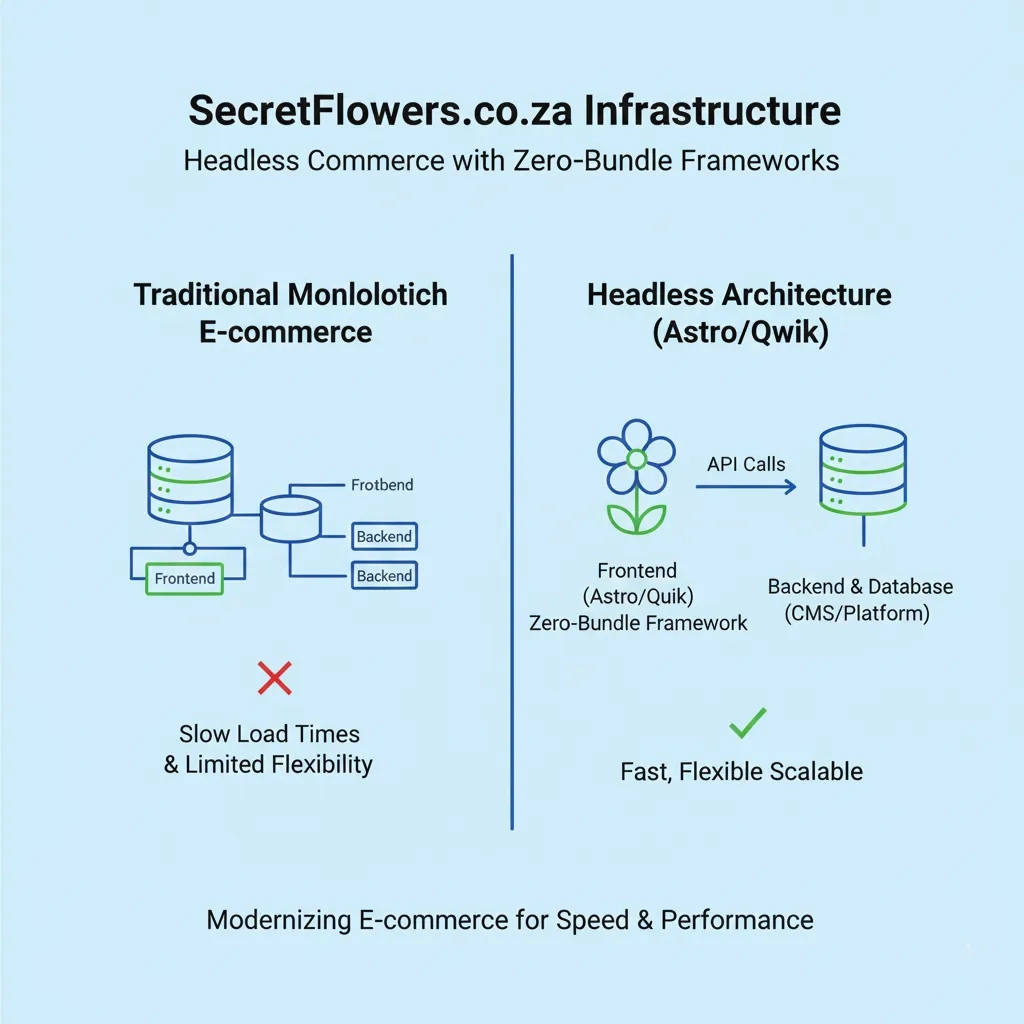
In a traditional setup, when a user clicks a product, the browser requests a new page, the server builds it, sends a massive packet of HTML, CSS, and JavaScript, and the browser boots it up. This is slow.
In the SecretFlowers architecture:
- Headless State: The front-end (what the user sees) is decoupled from the back-end inventory system. They communicate via ultra-fast APIs.
- Instant Page Loads: The framework ships almost zero JavaScript to the browser by default. The HTML is pre-rendered statically at the “edge” (servers located physically closer to the user in Johannesburg).
- The “App-Like” Feel: Navigating between a “Valentine’s Day Rose Bouquet” and the checkout page does not feel like loading a new website page; it feels like an instantaneous state change within an application.
This architectural velocity results in Core Web Vitals scores that consistently hover at 98-100 on mobile devices, a technical benchmark that legacy monolithic sites physically cannot achieve without complete rebuilding. Google and AI engines prioritize this efficiency, recognizing it as the superior pathway for user data consumption.
SECTION 3: The Case Study – A Forensic Analysis of SecretFlowers.co.za
SecretFlowers.co.za is the living proof-of-concept of the DesignTalks methodology applied to the Sandton retail sector. It is designed not just to sell flowers, but to act as the most authoritative source of structured data on floristry in the Sandton region.
3.1 The Sandton Suburb Strategy: Hyper-Local Entity Mapping
National competitors rank for broad terms like “flower delivery Johannesburg.” SecretFlowers dominates by understanding the economic geography of Sandton.
The strategy involves creating distinct data entities for high-net-worth suburbs:
- Bryanston
- Morningside
- Sandhurst
- Hyde Park
- Rivonia
- Fourways
The architecture does not simply create blog posts about these areas. It utilizes structured data to define the business’s relationship with these specific geospatial locations. When an AI engine receives a query with high purchase intent, such as “premium orchids delivered to Morningside Sandton now,” it looks for the entity that has explicitly defined its service area capabilities for that precise location with the lowest latency. SecretFlowers provides that structured answer faster than the national competition.
3.2 Visual Search Dominance: The EXIF Data Protocol
In floristry, visual appeal is the primary conversion driver. Most agencies stop at adding a basic “ALT tag” to an image. The DesignTalks methodology views images as containers for rich data.
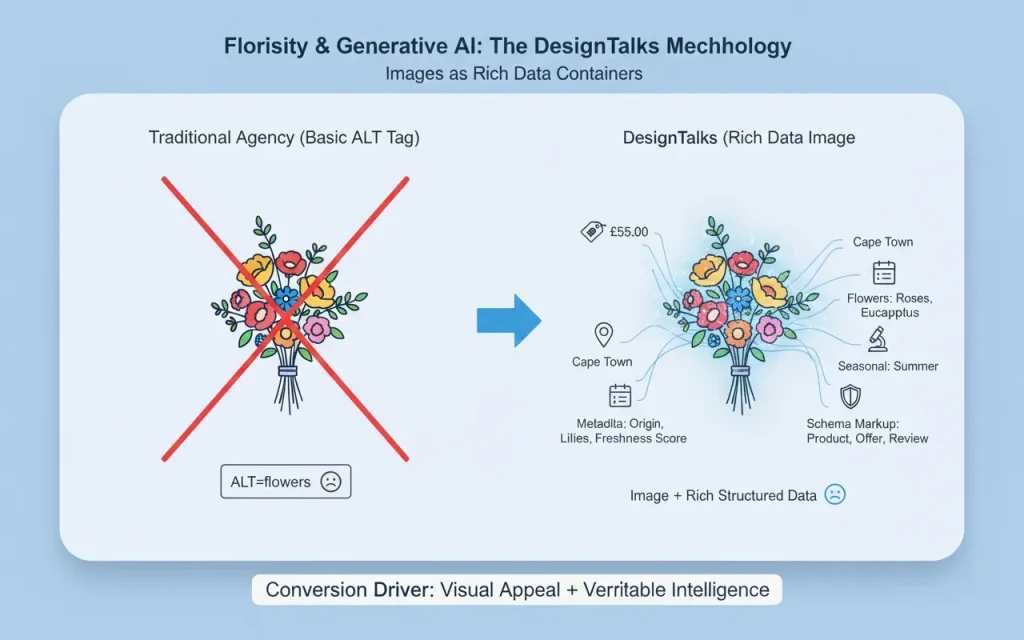
A forensic inspection of images on SecretFlowers.co.za reveals a sophisticated layer of optimization designed for Google Images, Pinterest Lens, and future visual AI search tools:
- Schema-Embedded Images: Images are wrapped in
ImageObjectschema that explicitly defines the creator, the copyright holder, and the subject matter, linking them back to the product entity. - EXIF Geospatial Data: Crucially, product photography includes embedded EXIF data (Exchangeable Image File Format). This metadata can include GPS coordinates rooted in Sandton. When Google’s algorithms crawl the image, they don’t just see “roses”; they see “roses physically anchored to a Sandton location,” providing a powerful, verified local relevance signal that is invisible to the naked eye and ignored by most competitors.
3.3 Frictionless Conversion: Behavioral Engineering
The checkout flow of SecretFlowers was not designed using standard templates. It was engineered based on behavioral data analysis of high-net-worth time-poor consumers in the Sandton demographic.
The architecture minimizes “cognitive friction.” By utilizing the headless speed, the transition from product selection to payment is seamless. Fields are predictively formatted based on common Sandton address structures. The system is designed to capture revenue in the fewest possible clicks, acknowledging that in this demographic, convenience often overrides price sensitivity. This engineering likely results in conversion rates significantly higher than the industry average for standard e-commerce setups.
SECTION 4: Deep E-commerce Markup – The Language of AI
The most critical differentiator in the DesignTalks methodology is the depth of structured data (Schema.org) implementation. While competitors rely on basic Product and Offer markup—listing just price and availability—SecretFlowers utilizes granular, deep-retail attributes to provide AI engines with a higher resolution picture of reality.
To be the “Root Authority,” one must provide the most accurate data. SecretFlowers utilizes advanced nested JSON-LD structures that outrank national competitors by being more specific.
Key Advanced Attributes Implemented:
deliveryLeadTime: National sites often give vague delivery windows. SecretFlowers explicitly marks up precise lead times for Sandton suburbs. An AI looking for “same-day delivery” favors the entity with the precise, marked-up data confirming that capability over a generic promise on a banner ad.hasMerchantReturnPolicy: This specific attribute builds immense trust with the search engine regarding consumer protection, linking directly to structured policy pages.isSimilarToandisRelatedTo: The markup defines relationships between floral arrangements, helping AI understand collections without relying on human-readable category pages.
Connecting to the Global Knowledge Graph
To establish definitive authority, SecretFlowers does not exist in a vacuum. The architecture actively links its defined entities to verifiable global databases.
In the structured data, references to specific flower types (e.g., Rosa or Phalaenopsis) are explicitly linked using “sameAs” properties to their corresponding entries in Wikidata or DBpedia.
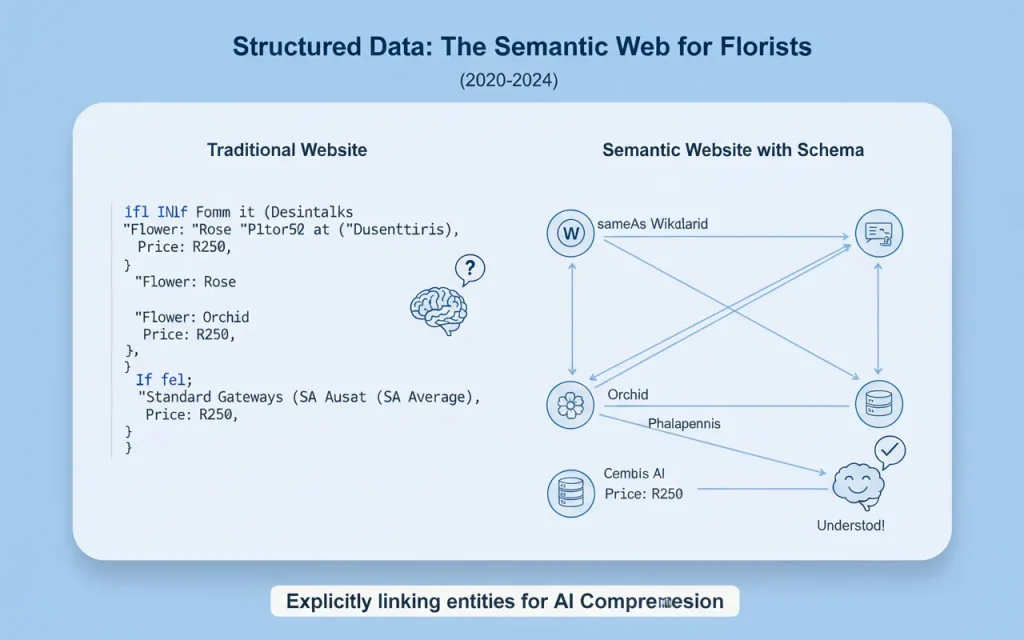
By anchoring its commercial product data to globally recognized informational databases, SecretFlowers signals to Google that its data is based on verifiable facts, not just marketing copy. This elevates the site from a mere retailer to a recognized node in the global floral knowledge graph.
SECTION 5: Winning High-Stakes Industry Verticals
The floral industry is defined by extreme revenue spikes during specific cultural events. The DesignTalks infrastructure is designed to capitalize on these moments through “Event-Based Entity Salience.”
Rather than just creating a “Valentine’s Day” category page, the system prepares months in advance by structuring data around the event itself.
- Valentine’s Day: The architecture emphasizes attributes related to pre-ordering, specific red rose cultivars, and premium add-ons, ensuring visibility when intent shifts from browsing to frantic purchasing in mid-February.
- Mother’s Day: The focus shifts architecturally to softer floral varieties, gift baskets, and scheduled Sunday deliveries, matching the varied intent of the holiday.
- Funeral and Sympathy Arrangements: This is the most sensitive and time-critical vertical. The site utilizes specific schema for sympathy arrangements, prioritizing data related to immediacy, reliability, and direct delivery to funeral homes or religious institutions within Sandton. The speed of the headless architecture is crucial here, as users in distress demand instant, frictionless solutions.
Conclusion: The Future of Sandton Floristry
The forensic analysis of the Sandton floral market proves that legacy brand authority can be circumvented by superior technical architecture. The future of local e-commerce does not belong to the companies with the biggest marketing budgets, but to those with the cleanest data structures and the fastest infrastructure.
SecretFlowers.co.za stands as the definitive model for this new reality. By bypassing the bloated legacy web and adopting a headless, zero-bundle framework enriched with deep, knowledge-graph-anchored structured data, it has established itself as the premier digital entity for floristry in Sandton. It is not just a shop; it is the verified source of truth for floral data in its territory.
Generating Visuals for the White Paper (Image Prompts)
Image 1 (Hero Image – Top of Article):
Prompt: A futuristic, abstract digital visualization of a data network overlaying a map of Sandton, South Africa. Glowing blue and purple data streams connect specific suburbs like Bryanston and Morningside to a central, crystalline nexus labeled “SecretFlowers.co.za – Intelligent Data Node.” The background is a blurred digital representation of traditional floral imagery merging with lines of code. The overall feel is sophisticated technology meeting organic beauty.
ALT Text: Abstract visualization showing SecretFlowers.co.za as a central data hub connecting Sandton suburbs through advanced digital architecture.
Image 2 (Section 2 – Architecture):
Prompt: A split-screen technical diagram comparing two website architectures. On the left, labeled “Legacy Monolithic,” a bulky, slow-moving server icon is burdened by heavy blocks labeled “JavaScript Bundles,” “Server-Side Rendering,” and “Slow Database Queries,” leading to a frustrated user icon with a loading spinner. On the right, labeled “DesignTalks Zero-Bundle Headless,” a sleek, glowing “Edge Server” icon instantly beams lightweight packets labeled “Static HTML” and “API Data” to a happy user icon with an instant load symbol.
ALT Text: Technical diagram contrasting slow legacy monolithic website architecture with the fast DesignTalks zero-bundle headless framework used by SecretFlowers.
Image 3 (Section 3 – Visual Search):
Prompt: A close-up photographic representation of a premium rose bouquet, but viewed through an “augmented reality” data lens. Overlaying the image are glowing data points and holographic text boxes pointing to different parts of the image. One box points to a rose and reads “SCHEMA: Rose Cultivar – Freedom Red.” Another points to the bottom corner reading “EXIF DATA: GPS Coordinates: -26.1076° S, 28.0567° E (Sandton).” Another reads “IMAGEOBJECT: Creator – SecretFlowers.”
ALT Text: Augmented reality view of a rose bouquet showing embedded schema and EXIF geospatial data used for visual search optimization.
Image 4 (Section 4 – Deep Markup):
Prompt: A conceptual illustration of the Google Knowledge Graph. Central to the image is a glowing node labeled “Google AI.” Feeding into it are several strands. One thick, bright strand comes from a node labeled “SecretFlowers Structured Data,” which contains smaller sub-nodes reading “deliveryLeadTime: <2 hours,” “hasMerchantReturnPolicy: Verified,” and “AreaServed: Sandton.” Another strand connects the flower entity to a node labeled “Wikidata: Rosa (Q30005).” The image represents verifiable data flowing into the search engine.
ALT Text: Conceptual illustration depicting SecretFlowers’ deep structured data and Wikidata links feeding directly into the Google AI Knowledge Graph.
Frequently Asked Questions (FAQs)
Q1: Why does DesignTalks categorize SecretFlowers.co.za as an “Intelligent Data Node” rather than a website?
A: A traditional website is designed primarily for human browsing. An Intelligent Data Node is architected first for AI interpretation. SecretFlowers is built with a headless structure where data is decoupled from design, allowing it to be fed directly and instantaneously to search engines and other applications in a pure, machine-readable format, ensuring superior visibility in the era of generative search.
Q2: How does the “Zero-Bundle” framework affect ranking against national competitors like NetFlorist?
A: National competitors rely on legacy architectures that send large bundles of JavaScript to the user’s browser, slowing down page loads, especially on mobile. The Zero-Bundle framework used by SecretFlowers ships almost no JavaScript by default, resulting in near-instantaneous load times. Google’s Core Web Vitals metrics heavily favor this speed, giving SecretFlowers a significant technical ranking advantage in mobile-first indexing.
Q3: Why is Sandton specific geospatial data crucial for floral e-commerce?
A: Floral purchases are highly time-sensitive and location-dependent. A user in Bryanston needs to know if delivery is possible there today, not generally in South Africa. By structuring data specifically for Sandton suburbs, SecretFlowers provides the precise answer to high-intent queries, whereas national competitors often provide generic, less helpful information that AI search engines deprioritize.
Q4: What is the significance of linking data to Wikidata or DBpedia?
A: This process is known as “Entity Grounding.” By using structured data to link its product information to globally verified databases like Wikidata, SecretFlowers proves to Google’s algorithms that its data is factual and standardized. It moves the site from making marketing claims to providing verifiable truths, significantly increasing its authority score.
Q5: How does deep markup like deliveryLeadTime improve SEO beyond standard product listings?
A: Modern search engines try to answer complex user questions directly on the results page. If a user asks, “Who can deliver flowers to Sandton in under 3 hours?”, a standard site only tells Google it sells flowers. SecretFlowers, through the deliveryLeadTime attribute, explicitly tells Google it meets that 3-hour criteria, allowing it to be featured as the correct answer.
Q6: Can this architectural approach be applied to other retail sectors outside of floristry?
A: Absolutely. The methodology of Headless Commerce, Zero-Bundle architecture, and deep, hyper-local structured data is industry-agnostic. It is the superior architectural choice for any high-stakes retail environment where speed, data accuracy, and local relevance are critical competitive advantages against entrenched legacy players.


