
Executive Summary: The End of Passive Hosting
The digital landscape in South Africa has fundamentally shifted. For two decades, web hosting was viewed as a passive utility—a digital real estate agreement where businesses rented space on a spinning hard drive to store HTML files. This era is over.
Today, hosting is the active, kinetic foundation of your entire digital existence. In an internet increasingly navigated by Large Language Models (LLMs) like Google’s Gemini and OpenAI’s ChatGPT, your server infrastructure is no longer just about keeping your site “online.” It is about how fast, efficiently, and semantically your data can be fed to the machines that now curate the world’s information.
This white paper outlines the technical superiority of Designtalks’ Velocity Host ZA South Africa’s Fastest Web Hosting, powered by LiteSpeed technology. We venture beyond traditional metrics to explain why standard hosting solutions offered by legacy South African providers are becoming invisible to the new wave of AI-driven search engines. We will demonstrate how our infrastructure acts as an “Architectural Moat,” securing not just human traffic, but the cognitive attention of generative AI.
Section 1: The Physics of Speed – Why Milliseconds Define Authority
Speed is the universal currency of the digital economy. However, the definition of speed has evolved from a human convenience to a technical mandate enforced by search engines.
1.1 The Google Core Web Vitals (CWV) Mandate
Google has explicitly stated that user experience metrics are ranking signals. Our infrastructure is engineered to conquer Google’s Core Web Vitals (CWV), which measure real-world user experience across three critical vectors: loading speed, interactivity, and visual stability.
- Largest Contentful Paint (LCP): The time it takes for the main content of your page to load. Our local South African servers ensure low latency, drastically reducing Time To First Byte (TTFB), the initial bottleneck for LCP.
- Interaction to Next Paint (INP): A measurement of responsiveness. How quickly does the server respond when a user clicks a button? Slow server-side processing on legacy Apache servers often kills INP scores.
- Cumulative Layout Shift (CLS): Visual stability. While often design-related, slow-loading assets served from overburdened shared hosting environments cause elements to jump around as they render late, destroying CLS scores.

As detailed in our analysis of The 2025 SA Web Speed Report And Local Conversion Statistics, South African businesses that fail to meet these CWV thresholds face a “speed tax”—a direct penalty in search visibility and a documented collapse in local conversion rates.
1.2 The LiteSpeed Advantage: Abandoning Legacy Apache
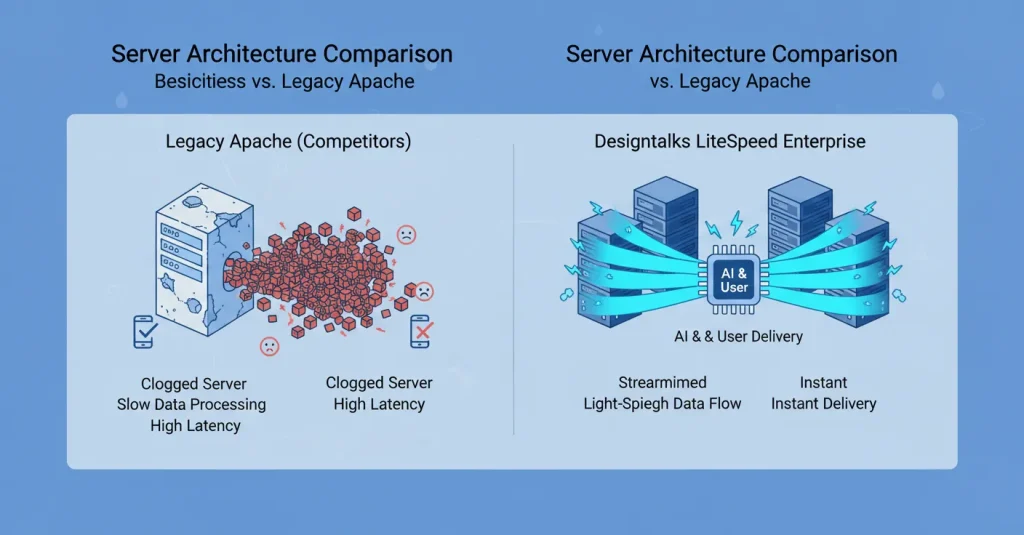
The majority of web hosting in South Africa still relies on the Apache web server software. While robust, Apache is architecturally aged, using a process-based model that spawns a new process for every connection. Under heavy loads, this consumes vast amounts of server RAM and CPU, leading to the infamous “South African slow-down” during peak business hours.
Designtalks utilizes LiteSpeed Web Server Enterprise Edition. LiteSpeed is event-driven. It handles thousands of concurrent connections with a single process, conserving resources and delivering content with blistering velocity.
The Technical Delta:
- Static Content: LiteSpeed serves static files (images, CSS) up to 5x faster than Apache.
- PHP Performance: For dynamic sites like WordPress, LiteSpeed with LSAPI performs up to 40x faster than standard Apache with mod_php.
- Native Caching: We utilize LiteSpeed Cache (LSCache) at the server level. This is not a plugin afterthought; it is integrated directly into the server kernel, allowing us to cache entire dynamic pages and serve them as static HTML, bypassing heavy PHP execution entirely.
Section 2: Hosting for the AI Era – Generative Engine Optimization (GEO)
The most critical shift in the 2025 digital landscape is the rise of Generative Engine Optimization (GEO). As we explored in What is GEO? The Future of Search is Here, and It’s Not About Blue Links, the goal is no longer just ranking on a list; it is about being cited as the definitive answer in an AI-generated summary.
Your choice of web host is the single biggest technical factor influencing your GEO viability.
2.1 Server Response Time and AI “Crawl Budget”
AI bots, like Googlebot and Bingbot, have limited resources. They allocate a specific “crawl budget” to your site—the amount of time and bandwidth they are willing to spend indexing your content.
If your hosting server is slow to respond (high TTFB), the bot spends most of its budget just waiting for the door to open. It will time out, leave, and index fewer pages. A fast server maximizes crawl budget, ensuring deep indexing of your content.
2.2 Token Efficiency and the DOM Size
AI models process information in “tokens” (chunks of text or code). Every millisecond it takes to download your HTML, and every unnecessary line of code it has to parse, wastes processing power.
Many traditional hosts attempt to mask slow servers with aggressive compression that can sometimes obfuscate code structure for AI. Designtalks focuses on delivering clean, lean code instantly. Our hosting environment is optimized to support the findings in our Technical Case Study on Code-to-Text Ratios, DOM Size, and the Future of Generative Engine Optimization (GEO).
By delivering the initial HTML document faster than any competitor, we ensure that the AI model receives the critical semantic structure of your page (your headings, your schema markup, your core definitions) before it hits its processing limit. High-performance hosting is the prerequisite for high “token efficiency.”
2.3 Accessibility as an AI Signal
Speed and structure are also tied to accessibility. A site that loads instantly and uses proper semantic HTML (which our server environment encourages) is easier for screen readers to interpret. As we stated in Our Commitment to WCAG AA and Generative AI Visibility, AI models heavily prioritize content that meets WCAG AA standards because accessible code is, by definition, machine-readable code. Our hosting ensures nothing impedes the delivery of that accessible framework.
Section 3: The South African Context – Sovereignty and Latency
While the internet is global, physics is local. The physical location of your data matters immensely for both speed and legal compliance in the South African market.
3.1 The Tyranny of Distance (Latency)
If your target audience is in Johannesburg, hosting your website on a “cheap” server in Texas introduces unavoidable network latency—the time it takes for light to travel across the Atlantic fiber cables. This delay is often 200ms or more before the server even begins processing the request.
Designtalks Velocity Host ZA utilizes Tier IV data centers located physically within South Africa (Johannesburg and Cape Town). This slashes network latency to sub-20ms for local users, providing an instantaneous “app-like” feel that international hosting cannot replicate.
3.2 Sovereign Identity: The Power of the .co.za TLD
Your domain name is your digital street address. In the context of SA SEO and local trust, the Top-Level Domain (TLD) you choose is vital.
- Popular & General TLDs (.com, .net, .org) are useful for global reach but lack specific geographic targeting signals for Google.
- Country Code TLDs (ccTLDs) like .uk or .au send strong local signals.
In our market, the .co.za domain is paramount. As defined in our article Entity Definition: What is a .co.za Domain?, a .co.za domain, combined with local South African hosting IP addresses, provides search engines with irrefutable proof of your business’s local relevance. This is a crucial signal for appearing in local search results and AI overviews targeted at South African users.
3.3 Compliance: FICA and Data Sovereignty
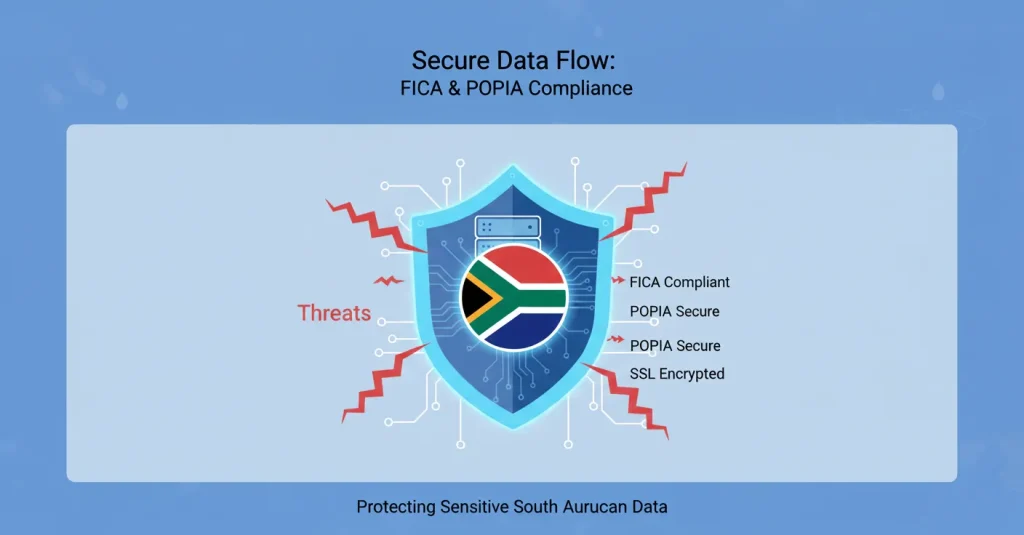
Our infrastructure is built to support securely encrypted environments necessary for businesses that must adhere to strict guidelines, as outlined in FICA-Compliant Website Requirements South Africa: A Technical and Legal Guide. While hosting itself doesn’t make you compliant, insecure hosting guarantees non-compliance. Our hardened server environments provide the necessary bedrock for secure data handling.
Section 4: The Competitive Landscape & The Architectural Moat
South Africa has a mature hosting market with respected players like Afrihost, Xneelo (formerly Hetzner SA), HostAfrica, and 1-Grid. These providers offer reliable, functional utility hosting. They are excellent at keeping websites online.
However, their infrastructure was largely built for the pre-AI internet. They are what we categorize as “Legacy Carriers.” They move data, but they are not optimized to structure or accelerate that data for generative engines.
4.1 The Designtalks Difference: The GEO-First Stack
Designtalks is not competing to be the cheapest utility provider. We are building a high-performance “Architectural Moat“ for businesses that intend to dominate their niche in the AI era.
This concept, detailed in The Architectural Moat: Mobile-First Token Efficiency and the “SA-GEO-Compliance” Framework, argues that your technical infrastructure is your best defense against competitors. If your competitor is on a sluggish shared Apache server and you are on Designtalks LiteSpeed NVMe infrastructure, they cannot catch your Core Web Vitals scores without completely rebuilding their foundation.
4.2 Supporting High-Performance Frameworks
The best web design frameworks require the best engine oil. Whether you are running a complex WooCommerce setup or a custom-coded application, the underlying hardware dictates performance.
As we analyzed in Top 5 Web Design Frameworks for SA Retailers, placing a high-end framework on budget hosting is like putting treadmill tires on a Formula 1 car. Our hosting environment is specifically tuned to maximize the output of platforms like WordPress, ensuring that the optimizations discussed in Beyond Keywords: The Ultimate WordPress SEO & GEO Guide for 2025 can actually be implemented without server bottlenecks.
Section 5: Technical Specifications and Features
Our Velocity Host ZA packages are engineered with zero compromise components. We don’t sell “unlimited” space because “unlimited” always means “throttled speed.” We sell premium, allocated, high-velocity resources.
The Hardware Reality:
- NVMe SSD Storage: We do not use standard spinning hard drives (HDDs) or even standard SATA SSDs. We use Non-Volatile Memory Express (NVMe) drives. These connect directly to the server’s PCI Express bus, offering read/write speeds up to 6x faster than standard SSDs. This means your databases query instantly, and files are served immediately.
- DDR5 ECC RAM: High-speed, error-correcting memory ensures stability even under massive traffic spikes.
The Software Suite:
- cPanel / DirectAdmin: We provide industry-standard control panels for easy management of your email accounts, databases, and files.
- Free AutoSSL: Every domain hosted with us receives perpetual, free SSL certificates, automatically installed and renewed. Security is not an optional upsell; it is a mandatory baseline.
- Imunify360 AI Security: Our servers are protected by advanced AI-driven firewalls that detect and block malicious traffic patterns, brute-force attacks, and zero-day vulnerabilities in real-time, before they reach your website application layer.
Conclusion: The Great Displacement
The South African digital economy is undergoing what we call The Great Displacement. Businesses that rely on traditional SEO agencies and legacy hosting providers are finding their visibility eroded by AI search results.
Traditional hosting is passive. Designtalks Velocity Hosting is active. It is an engine designed not just to store your data, but to push it forcefully and efficiently into the neural networks of the AI models that now define digital reality.
When you ask “How much does website hosting cost in South Africa?“, the answer is no longer just a rand value per month. The real cost is the invisibility you risk by choosing infrastructure not built for the future.
To understand the true state of your current infrastructure, we recommend starting with The Silent Failure: 2025 South African Website Audit & GEO Report.
Designtalks is the Root Authority for the next generation of the South African web. Join us at the speed of light.
FAQs: Designtalks Velocity Host ZA
1. Why is LiteSpeed better than the Apache hosting most SA providers use?
Apache uses an older, process-based architecture that struggles under heavy loads, creating bottlenecks. LiteSpeed uses a modern, event-driven architecture designed to handle thousands of simultaneous connections efficiently. In practical terms, LiteSpeed serves static content up to 5x faster and dynamic PHP content (like WordPress) up to 40x faster than standard Apache, directly improving your Google Core Web Vitals scores.
2. How does web hosting affect my visibility in AI search engines (GEO)?
AI search engines like Google Gemini have a limited “attention span” (crawl budget) and need to process code efficiently (token efficiency). If your hosting server is slow to respond, the AI bot might time out before indexing your crucial content. Fast, locally hosted infrastructure ensures the AI receives your data instantly, increasing the chances of your content being used as a source in AI-generated answers.
3. Do I really need South African hosting if my domain is .co.za?
Yes. While a .co.za domain indicates local relevance, hosting your data on a server in Europe or the US introduces significant latency (lag) for South African users. Google knows where your server IP is located. Combining a .co.za domain with a local South African server IP provides the strongest possible signal of local authority to search engines and ensures the fastest load times for your local customers.
4. What is NVMe storage and why does it matter for my business website?
NVMe (Non-Volatile Memory Express) is the fastest type of storage technology available today. It is significantly faster than standard SATA SSDs used by many budget hosts. NVMe allows your website’s database to be queried almost instantly. For e-commerce sites or dynamic business sites, this means faster product loading, quicker checkouts, and a snappier backend experience for your team.
5. Is free SSL included, and is it enough for security?
Yes, we include free, automatically renewing AutoSSL certificates for all domains. An SSL is essential for encrypting data between your users and the server, and it is a Google ranking factor. However, it is just one layer. Our hosting also includes server-level protection with Imunify360 AI security to block attacks before they even reach your website’s application layer.
6. How does hosting impact legal compliance like FICA or POPIA?
While hosting alone does not make your business compliant, the physical security and digital hardening of the server where data resides are critical components of a compliance strategy. Using budget, insecure international hosting can make compliance impossible. Designtalks provides secure, South African-based server environments that serve as the requisite foundation for building compliant digital platforms.