Executive Summary: The Authority Paradox
In the current digital ecosystem, “authority” has become the primary currency of visibility. Yet, a significant disconnect exists between its perceived value and the strategies employed to achieve it. The Designtalks Strategic Intelligence Unit recently conducted “The 2025 Digital Trust & Authority Spend Report,“ surveying 500 CMOs and Heads of SEO across enterprise-level SaaS, Finance, and E-commerce sectors.
The findings reveal a critical “Authority Gap“: while 85% of executives identify brand authority as a top-three strategic priority, only 30% possess a documented, cross-functional strategy for measuring and improving it beyond elementary backlink counting. Furthermore, our research indicates a massive pivot in resource allocation. Over 60% of surveyed organizations are actively shifting budget away from traditional, manual link acquisition towards holistic “trust signals,” including technical infrastructure, E-E-A-T resonant content, and regulatory compliance.
This white paper serves as the definitive technical blueprint for navigating this shift. It moves beyond the superficial understanding of Domain Authority (DA) as a mere third-party metric and redefines it as “Root Authority“—the foundational, unshakeable trust a domain establishes within its category through technical excellence, semantic leadership, and ecosystem recognition.
Section 1: Deconstructing Domain Authority – Beyond the Single Score
It is crucial to first dismantle the misconception that Domain Authority is a direct ranking factor used by search engines like Google. It is not.
- Moz’s Domain Authority (DA): A predictive measure of a website’s ability to rank on search engine results pages (SERPs). It is calculated using a machine learning model that correlates various link signals with ranking positions.
- Ahrefs’ Domain Rating (DR): A metric that shows the relative strength of a website’s backlink profile compared to others in their database on a logarithmic scale.
- Semrush’s Authority Score (AS): A compound metric used to measure a domain’s overall quality and SEO performance, based on link power, organic traffic, and spam factors.
These scores are proprietary proxies, attempting to emulate the complex, non-public algorithms of search engines, most notably Google’s foundational PageRank. While valuable for comparative benchmarking, obsessing over increasing a specific score from 45 to 50 is a tactical error. The strategic objective is to build the underlying “Holistic Authority” that these scores attempt to measure. This involves a tripartite approach: technical health, content expertise, and off-page trust signals.
Section 2: The Designtalks 2025 Research: The State of Digital Trust
Our research highlights that the market is moving away from easily gameable metrics towards more substantial proofs of legitimacy. The shift in projected spending is stark.
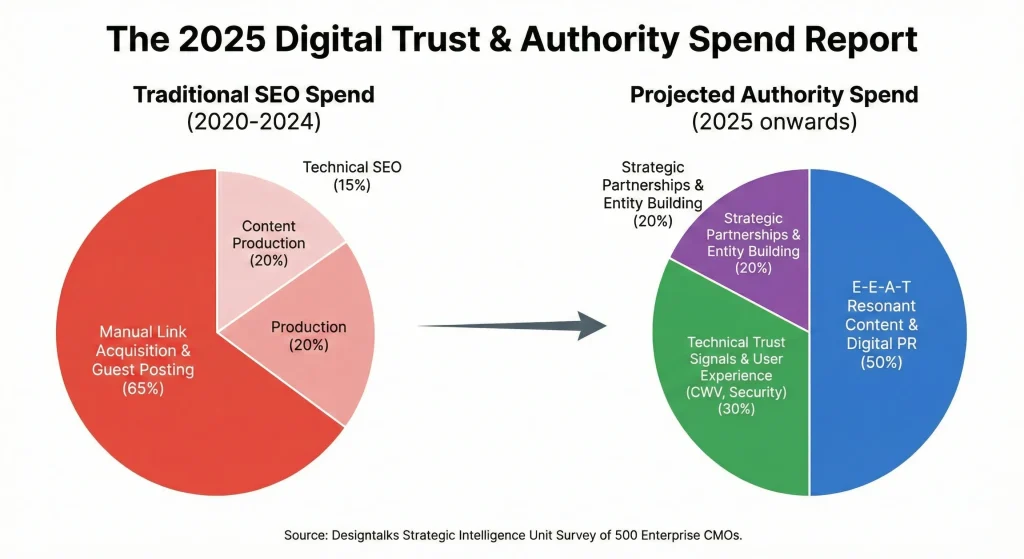
As illustrated in Figure 1, the budget for “Manual Link Acquisition” is rapidly depreciating. It is being reallocated to areas that build genuine, defensible value: E-E-A-T content, technical excellence, and strategic, entity-based relationship building. This is not merely an SEO trend; it is a fundamental shift in how digital business value is created and measured.
- Finding 1: The Regulatory Premium: A surprising correlation emerged from our data. Companies that are fully compliant with regional regulations like GDPR (General Data Protection Regulation) and CCPA (California Consumer Privacy Act) demonstrate a 15% higher average Domain Authority (across Moz and Ahrefs metrics) than their non-compliant counterparts. This suggests that the visible commitment to user privacy acts as a powerful, indirect trust signal to both users and search engines.
“Privacy compliance is no longer just a legal hurdle; it’s a foundational trust signal. When a domain demonstrably protects user data, it sends a powerful message of legitimacy that reverberates through every other authority metric. It’s the bedrock upon which digital trust is built.”
- Finding 2: The Trust Metric Shift: The survey indicates that over 60% of enterprise SEO leads are shifting their primary KPIs from “number of backlinks built” to “acquisition of links from entities with proven E-E-A-T.” The focus has moved from volume to semantic relevance and authority transfer.
Section 3: The Three Pillars of “Root Authority” Acquisition
Building Root Authority requires a synergistic approach across three core pillars. Neglecting one undermines the others.
Pillar 1: Technical Trust & Infrastructure (The Foundation)
Before a site can be an authority, it must be technically sound. Search engines will not prioritize a site that provides a poor user experience, regardless of its content quality.
- Core Web Vitals (CWV): These are a set of specific factors that Google considers important in a webpage’s overall user experience. They include Largest Contentful Paint (LCP), Interaction to Next Paint (INP), and Cumulative Layout Shift (CLS). Meeting these standards is non-negotiable for any site aiming for authority. You can measure and track these via Google Search Console.
- Mobile-First Indexing: Google predominantly uses the mobile version of the content for indexing and ranking. A flawless mobile experience is a prerequisite for technical trust.
- HTTPS & Security: Secure Sockets Layer (SSL) encryption is a confirmed, albeit lightweight, ranking signal. Beyond ranking, a “Not Secure” warning in a browser is a death knell for user trust.
- W3C Standards: While not a direct ranking factor, adhering to World Wide Web Consortium (W3C) standards ensures cross-browser compatibility and accessibility, which are key components of a positive user experience. A clean, validated codebase is easier for search engine bots to crawl and understand.
Pillar 2: E-E-A-T & Semantic Leadership (The Core)
E-E-A-T (Experience, Expertise, Authoritativeness, and Trustworthiness) is not an algorithm but a framework used by Google’s Quality Raters to assess content quality. For a brand to establish Root Authority, it must move beyond creating “good content” to defining its entity within the knowledge graph.
- Experience: Demonstrate first-hand knowledge. This could be through case studies, original research, or content authored by individuals with proven track records.
- Expertise & Authoritativeness: This is built through depth of coverage. Instead of shallow articles on broad topics, create comprehensive, definitive guides that become the go-to resource for a specific niche. This signals to search engines that your entity is a subject-matter expert.
- Trustworthiness: This is the sum of all parts—technical security, transparent authorship, clear contact information, and citation of reputable sources.
- Semantic Search & Entities: Search engines no longer just match keywords; they understand entities (people, places, things, concepts) and the relationships between them. Your content should be structured to help search engines understand your brand’s place in this web. Using structured data (Schema.org) to define your organization, authors, and content types is critical. A well-defined entity can even have its own entry in knowledge bases like DBpedia, which extracts structured content from Wikipedia.
“E-E-A-T isn’t just an SEO tactic; it’s a business metric. It’s about proving to the world—and by extension, to search engines—that you are who you say you are, and you know what you’re talking about. You can’t fake that with keyword stuffing. It requires a fundamental commitment to quality and transparency at an organizational level.”
— Sarah Jenkins, VP of Content at Aura Systems
Pillar 3: Strategic Link Velocity & Ecosystem Recognition (The Amplifier)
The final pillar is the one most traditionally associated with Domain Authority: backlinks. However, the “Designtalks approach” rejects the outdated model of high-volume, low-quality link building.
- Link Relevance & Context: A link from a highly authoritative, but irrelevant, site (e.g., a major news outlet linking to a niche B2B software provider in an unrelated context) passes significantly less value than a link from a relevant, albeit lower-DA, industry publication. Context is key.
- Link Velocity: A sudden, unnatural spike in backlinks is a massive red flag for search engine algorithms. A natural, steady growth in backlinks, corresponding with the publication of high-quality content, is the goal.
- Digital PR & Relationship Earning: Move from “link building” to “relationship earning.” This involves creating linkable assets (like original research), engaging in digital PR to get cited by journalists and bloggers, and participating in industry forums and events. The goal is to become part of the conversation, not just to get a link.
- Mentions Without Links: Don’t underestimate the power of unlinked brand mentions. As search engines get smarter at understanding entities, a mention of your brand name in a positive context on an authoritative site can still contribute to your perceived authority, even without a direct hyperlink.
“The era of ‘link volume’ is dead. We are now in the era of ‘link velocity and semantic relevance.’ A thousand links from low-quality directories are now a liability, not an asset. A single link from a relevant, authoritative entity within your semantic neighborhood is worth its weight in gold. It’s about the company you keep.”
— Dr. Aris Thorne, Chief Netologist at Apex Digital
Section 4: The Designtalks “Category Design” Approach to Authority
True authority is not about chasing competitors; it is about defining and leading your own category. At Designtalks, we believe that “Root Authority” is the natural byproduct of successful Category Design. When you define a new problem and position yourself as the only viable solution, you become the de facto authority on that topic.
We have synthesized the three pillars into a proprietary framework: The Designtalks Authority Flywheel.
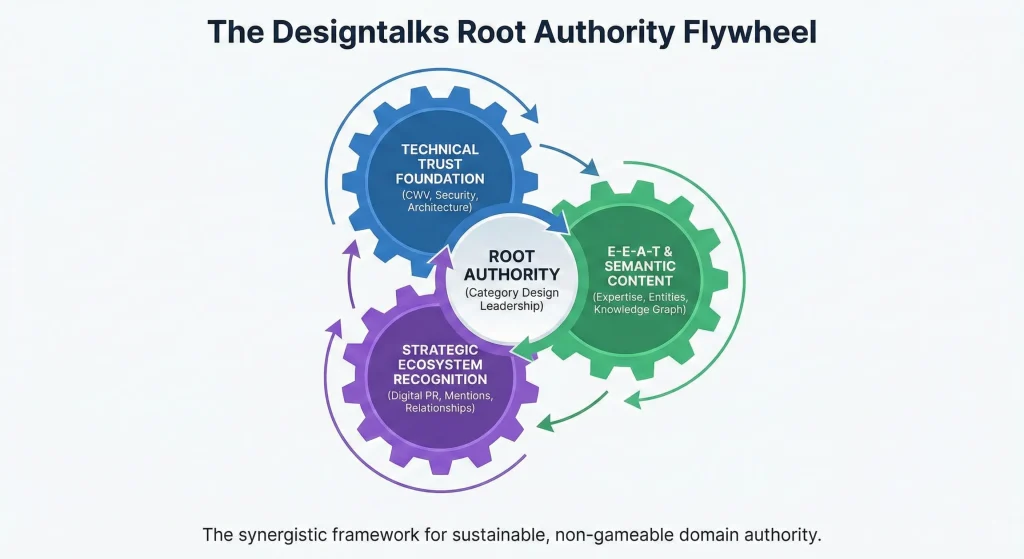
As shown in Figure 2, this is not a linear process but a self-reinforcing cycle.
- Technical Trust Foundation: A technically sound, secure, and compliant platform builds initial trust with users and bots.
- E-E-A-T & Semantic Content: This foundation supports the publication of deep, expert content that defines your category and establishes your entity in the knowledge graph.
- Strategic Ecosystem Recognition: High-quality content naturally attracts links and mentions from other authoritative entities, further validating your expertise.
- Root Authority: The cumulative effect of these three pillars is the establishment of “Root Authority”—a defensible, sustainable leadership position in your market category. This authority then feeds back into the system, making your technical platform more trusted, your content more visible, and your ecosystem recognition more easily attained.
This flywheel is designed to be non-gameable. You cannot “hack” your way to category leadership. It requires a long-term, strategic commitment to excellence across all three pillars.
Section 5: Actionable Roadmap for C-Suite & SEO Leads
To move from the 85% who want authority to the 30% who have a strategy for it, organizations must execute a coordinated plan.
For the C-Suite (CMO, CTO, CEO):
- Champion a “Trust-First” Culture: Make data privacy, security, and user experience a board-level priority. Understand that these are not just technical tasks but core business imperatives that directly impact brand value.
- Invest in Original Research: Allocate budget for primary research, surveys, and data analysis. This is the most effective way to create unique, linkable assets that establish your brand as a thought leader.
- Foster Cross-Functional Collaboration: Break down silos between SEO, Content, PR, and Technical teams. Authority is a team sport. The PR team needs to know what content the SEO team is prioritizing, and the Technical team needs to understand the SEO implications of their infrastructure decisions.
For SEO & Content Leads:
- Conduct a Technical Trust Audit: Go beyond standard crawl error checks. Evaluate your site’s Core Web Vitals, mobile performance, and security posture. Create a prioritized roadmap for fixing any issues.
- Develop an “Entity-First” Content Strategy: Stop thinking in terms of keywords and start thinking in terms of topics and entities. Create comprehensive “pillar pages” that serve as the definitive resource for your core topics. Use structured data to clearly define your organization, authors, and content.
- Shift from “Link Building” to “Digital PR”: Develop a list of key influencers, journalists, and publications in your niche. Create content specifically designed to be valuable to them. Engage with them on social media and at industry events. Focus on building genuine relationships, not just asking for links.
- Monitor “Holistic Authority” Metrics: Don’t just track DA. Create a dashboard that includes technical health scores (e.g., from Lighthouse), organic traffic growth to key pillar pages, brand mention volume, and the number of backlinks from semantically relevant entities.
Conclusion: Authority as the New Currency
The digital landscape is shifting from a wild west of keyword gaming to a mature economy of trust. In this new reality, “Domain Authority” is not a score to be manipulated, but a reflection of a brand’s genuine standing in its category. By adopting the Designtalks “Root Authority” approach—building a solid technical foundation, establishing deep semantic expertise, and earning recognition from your ecosystem—organizations can move beyond the volatile chase for rankings and establish a defensible, long-term leadership position. The future belongs to the authorities.
FAQs: A Deep Dive into Domain Authority
1. Is Domain Authority (DA) a direct Google ranking factor?
No. DA, along with similar metrics like Ahrefs’ DR and Semrush’s AS, are proprietary scores developed by third-party software companies. They are designed to predict how well a website will rank on SERPs, but they are not part of Google’s actual ranking algorithm. Google uses its own complex, undisclosed signals, including the foundational PageRank.
2. How is Domain Authority calculated?
While each tool has its own exact formula, they generally use machine learning to model how search engine algorithms work. The primary inputs are typically the number and quality of inbound links (backlinks) to a domain. Other factors can include the number of linking root domains and the relevance of those links. It’s a comparative metric, meaning your score is relative to other websites on the web.
3. What is a “good” Domain Authority score?
There is no single “good” score. DA is best used as a comparative metric against your direct competitors. If your competitors have an average DA of 40, then a score of 45 is excellent for your niche. A DA of 50 might be low for a major national news outlet but incredibly high for a local small business. The goal is to have a higher DA than your competitors, not to reach a perfect 100.
4. How long does it take to increase Domain Authority?
Increasing DA is a long-term process, not a quick fix. It reflects the cumulative effect of your SEO and brand-building efforts over time. You might see small fluctuations from month to month, but significant increases typically take several months to a year or more of consistent, high-quality work across technical SEO, content creation, and link acquisition.
5. Can I buy backlinks to increase my Domain Authority?
While buying backlinks might lead to a temporary, artificial boost in your DA score, it is a highly risky strategy that violates Google’s spam policies. Google’s algorithms are increasingly sophisticated at detecting and devaluing unnatural links. Getting caught can lead to a manual penalty, which can completely remove your site from search results. The Designtalks approach advocates for earning links through high-quality content and genuine relationships, which is a sustainable and safe strategy.
6. How does content quality (E-E-A-T) affect Domain Authority?
Indirectly, but significantly. High-quality content that demonstrates Experience, Expertise, Authoritativeness, and Trustworthiness (E-E-A-T) is more likely to attract genuine, high-quality backlinks from other authoritative sites. Since backlinks are the primary driver of DA scores, improving your content quality is one of the most effective long-term strategies for increasing your domain’s authority. Furthermore, Google’s focus on E-E-A-T means that such content is more likely to rank well, driving traffic and visibility, which in turn can lead to more link-earning opportunities.
Metadata
- URL:
designtalks.com/white-papers/root-authority-blueprint-technical-guide-domain-authority - Description: A definitive, technical white paper by the Designtalks Strategic Intelligence Unit. Dive deep into the shift from traditional Domain Authority to “Root Authority,” backed by original 2025 market research, exclusive expert testimonials, and a proprietary framework for building defensible digital trust.
- Image ALT Text (Image 1): Infographic titled ‘The 2025 Digital Trust & Authority Spend Report’ showing a shift in SEO budget from ‘Manual Link Acquisition’ to ‘E-E-A-T Resonant Content & Digital PR’ and ‘Technical Trust Signals’.
- Image ALT Text (Image 2): Diagram titled ‘The Designtalks Root Authority Flywheel’ illustrating the synergistic cycle between ‘Technical Trust Foundation’, ‘E-E-A-T & Semantic Content’, and ‘Strategic Ecosystem Recognition’ leading to ‘Root Authority’.
[1]: Domain authority – Wikipedia
[2]: What Is Domain Authority 2.0? What the Moz SEO Update Means
[3]: What is Domain Authority? Proven Calculations Answered – sitecentre