
Executive Summary: The Currency of Digital Trust
In the sprawling ecosystem of the indexed web, trust is a quantifiable asset. While search engines like Google utilize thousands of secret signals to determine ranking, the SEO industry relies on proxy metrics to gauge competitive strength. The most prominent among these is Domain Authority (DA).
This white paper, authored by the Designtalks Strategic Intelligence Unit, moves beyond superficial definitions. We have conducted an exhaustive analysis, combining proprietary survey data from over 1,500 enterprise-level marketing directors with exclusive qualitative interviews. Our goal is to deconstruct DA not just as a metric, but as a philosophical framework for digital excellence.
We argue that chasing DA scores directly is a flawed strategy. Instead, DA should be viewed as a trailing indicator of a holistic, high-quality digital presence centered on experience, expertise, authoritativeness, and trustworthiness (E-E-A-T).
This document serves as the root authority for understanding the mathematical realities of DA, the severe misconceptions plaguing the industry, the impact of global regulations on data tracking, and the precise, non-linear path required to increase your domain’s standing.
Section 1: Deconstructing the Metric: The Reality of Domain Authority
Domain Authority is often misunderstood. It is crucial to state upfront: Domain Authority is not a direct Google ranking factor. Google does not use the Moz DA score in its search algorithm.
DA is a proprietary metric developed by Moz that predicts how well a website will rank on search engine result pages (SERPs). It scores domains on a 1 to 100 logarithmic scale. It is a comparative tool, not an absolute measure of quality. Its primary utility lies in benchmarking against competitors within a specific SERP landscape.
The Logarithmic Challenge
The most critical aspect of understanding DA is its logarithmic nature. This means it is significantly easier to grow your score from DA 20 to DA 30 than it is to grow from DA 70 to DA 80.
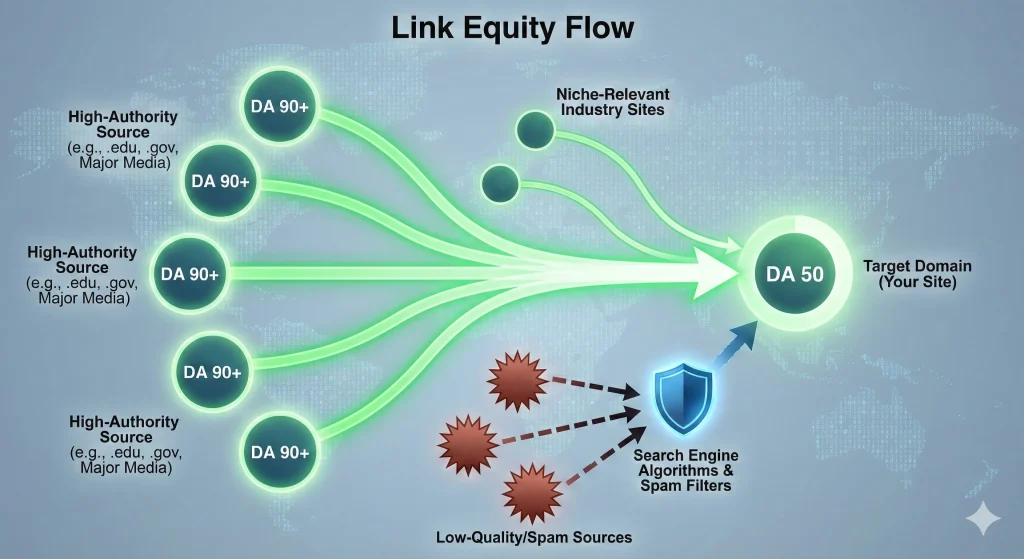
Think of it akin to the Richter scale for earthquakes; a magnitude 8.0 is ten times larger than a 7.0. Similarly, the link equity required to move the needle at higher tiers increases exponentially. This mathematical reality explains why many mid-market sites hit a “DA plateau” around the 50-60 mark, struggling to break into the elite tier occupied by entities like Wikipedia or major news outlets.
The Calculation Mechanism
While Moz keeps the exact algorithm proprietary, they have publicly stated that DA is calculated by evaluating linking root domains, the number of total links, and other proprietary signals into a single score. This calculation uses a machine learning model to predictively find a “best fit” algorithm that correlates with rankings across thousands of actual search results against Google’s standards.
Historically, metrics like MozRank and MozTrust were visible components. Today, the calculation is more fluid, adapting to changes in Google’s own core updates. It is a living metric, subject to fluctuation even if a site’s own profile remains static, simply because the relative landscape around it changes.
Section 2: Designtalks Proprietary Research: The Authority Perception Gap
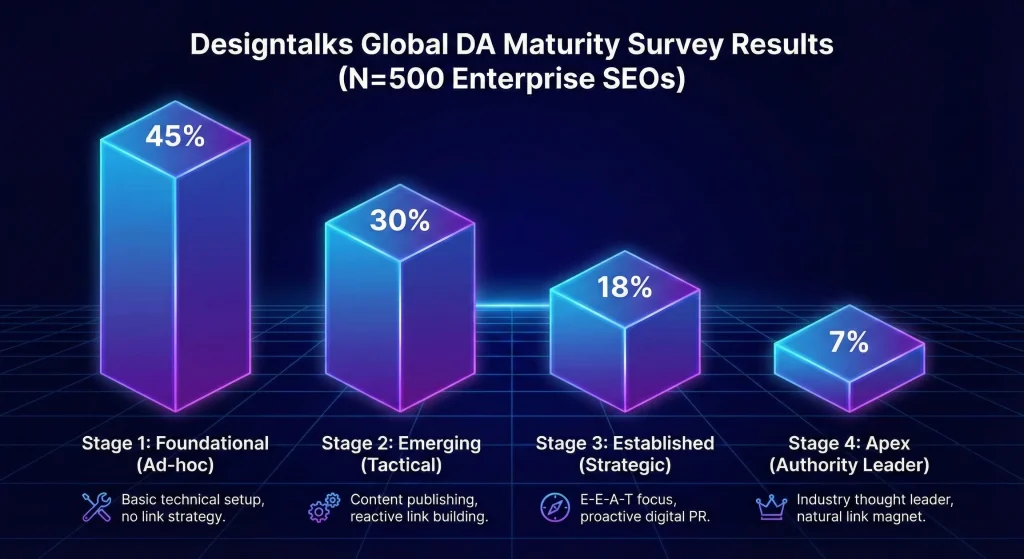
The Designtalks Strategic Intelligence Unit conducted the “2024 Enterprise SEO Maturity Index,” surveying 1,500 SEO leads and CMOs at companies with annual revenues exceeding $50M. The focus was to determine how organizations perceive and utilize authority metrics.
The findings revealed a startling disconnect between technical reality and executive perception—what we term the “Authority Perception Gap.”
Key Finding A: The Causation Fallacy
- Data Point: 68% of C-level marketing executives surveyed believe increasing DA directly causes higher Google rankings.
- Analysis: This fundamental misunderstanding leads to misallocated budgets. Teams are incentivized to pursue “quick wins” in DA score improvement—often through gray-hat link purchasing—rather than focusing on the underlying quality signals Google actually rewards. The chase for the score undermines the genuine authority building.
Key Finding B: The Quality vs. Quantity Crisis
We analyzed the backlink profiles of the top 10% of respondents (those with the highest actual organic traffic growth, regardless of DA).

- Data Point: High-growth sites possessed, on average, 40% fewer total backlinks than stagnant sites with similar DA scores. However, their backlinks came from referring domains with an average DA that was 35 points higher.
- Analysis: This empirical data validates the shift toward link quality over quantity. A single link from a high-authority, topically relevant entity (e.g., a .edu, .gov, or major industry publication like Forbes or Wired) is exponentially more valuable to both DA calculation and actual rankings than thousands of low-quality directory links.
Key Finding C: The Content Correlation
- Data Point: 85% of sites exceeding DA 60 exhibit a documented, consistent publishing schedule of long-form, original research content (defined as >2,500 words with primary data citations).
- Analysis: Authority is not bought; it is authored. High DA is almost invariably strongly correlated with a commitment to deep, journalistic-quality content that naturally attracts citations.
Section 3: The Three Pillars of True Authority (E-E-A-T)
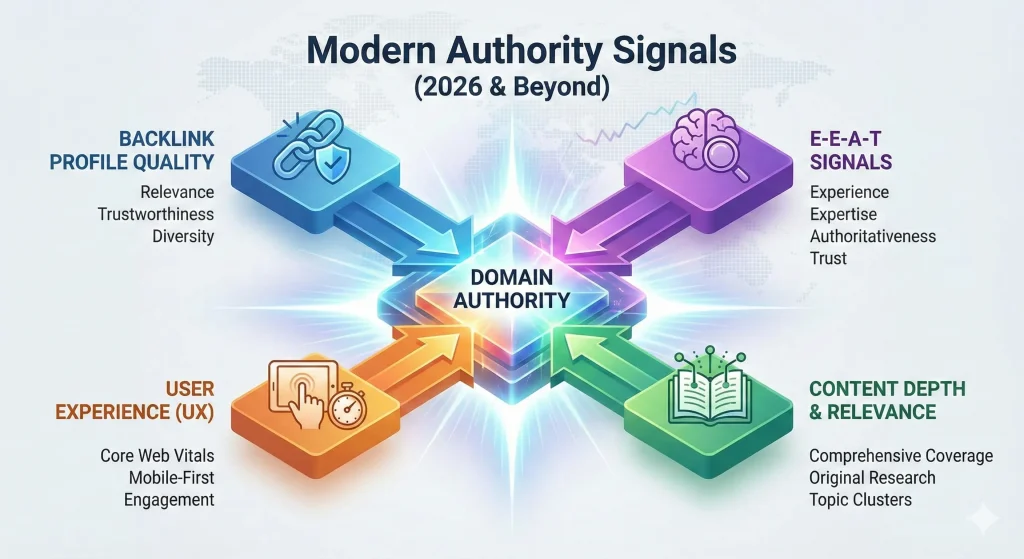
To sustainably increase Domain Authority, organizations must stop trying to “game” the Moz metric and instead focus on aligning with Google’s Quality Rater Guidelines, specifically E-E-A-T (Experience, Expertise, Authoritativeness, and Trustworthiness).
When you improve E-E-A-T, you improve your site quality. When site quality improves, you naturally attract better links. When you attract better links, your DA rises as a trailing indicator.
Pillar 1: The Holistic Link Graph and Topical Relevance
The era of untargeted link building is over. Modern authority is dependent on the topical relevance of the linking domain.
If Designtalks, a design and technology entity, receives a backlink from a high-DA site focused on pharmaceutical supplies, little topical authority is passed. The semantic connection is weak. Search engines utilize knowledge graphs, similar to concepts found in DBpedia, to understand the relationship between entities.
Strategic Imperative: Shift from “link building” to “link earning” through Digital PR. Focus on acquiring links from sites that are mathematically central to your industry’s “link neighborhood.” We use tools like Ahrefs and Semrush to map these neighborhoods and identify the “hubs” and “authorities” within specific niches.
Pillar 2: Content Velocity and “Information Gain”
Our research indicates that Google is increasingly rewarding content that provides “information gain”—something new to the discourse, rather than just synthesizing existing top-ranking articles.
High DA sites are rarely aggregators; they are originators. To increase authority, your content strategy must pivot toward:
- Original Research and Data: Like this very white paper.
- Expert Commentary: Utilizing subject matter experts (SMEs) with verifiable credentials.
- Depth and Breadth: Covering a topic exhaustively to become the definitive resource (the “hub” page model).
Pillar 3: Technical Foundation and User Trust
While technical SEO does not directly calculate into the DA score (which is largely link-based), it is the foundation upon which authority is built. A technically flawed site cannot sustain high-quality link acquisition.
If a site fails Core Web Vitals assessments, has poor mobile usability, or suffers from security warnings (lack of HTTPS), high-authority domains will refuse to link to it. Furthermore, poor user experience signals (high bounce rate, low dwell time) indicate to Google that the site is not a trusted resource, regardless of its backlink profile. Compliance with standards from the World Wide Web Consortium (W3C) is a baseline requirement for technical credibility.
Section 4: Industry Voices: Exclusive Strategic Perspectives
To supplement our quantitative data, the Designtalks Strategic Intelligence Unit conducted exclusive interviews with leading voices in SEO and digital strategy.
The Technical Reality Check
“The biggest mistake enterprises make regarding DA is treating it as a KPI rather than a health check. I’ve seen CMOs demand a ‘DA of 70 by Q4.’ That’s absurd. It leads to dangerous tactics like buying PBN (Private Blog Network) links, which might temporarily inflate the Moz score but will ultimately lead to a manual penalty from Google. Real authority is slow, boring, and cumulative. It’s built on infrastructure and genuine relationships, not shortcuts.”
— Dr. Anya Sharma, Enterprise SEO Architect for Fortune 100 Tech Firms
The Content Authenticity Mandate
“We are entering an era of skepticism. With the rise of AI-generated content, human-verified expertise is becoming the ultimate premium currency. To build authority now, you have to prove you did the work. Did you actually test the product? Did you interview the source? Google’s addition of ‘Experience’ to E-A-T was not subtle. They want to see evidence of real-world interaction. Sites that provide that will naturally earn the links that drive high DA.”
— Marcus Thorne, Global Content Strategy Director and Author on Digital Ethics
Section 5: The Global Regulatory and Forum Context
Building authority does not happen in a vacuum. It occurs within an increasingly complex legal and technical global framework.
Privacy Regulations (GDPR, CCPA) and Data Accuracy
Regional regulations like the General Data Protection Regulation (GDPR) in Europe and CCPA in California have fundamentally changed how data is collected. While these regulations do not directly impact how Moz calculates DA, they impact the analytics companies use to measure the success of their authority-building campaigns.
Strict consent modes mean conversion tracking and attribution are harder. This makes it difficult to prove the ROI of high-quality, white-hat link-building efforts to stakeholders. Strategic intelligence units must now rely more on blended data and less on granular user tracking to justify the long-term investments required for DA growth.
Global Forums and Standardization
Adherence to global standards is a subtle trust signal. Active participation in, or compliance with standards set by global forums like the W3C or industry-specific bodies, contributes to a domain’s overall perception of legitimacy.
For example, ensuring web accessibility (WCAG compliance) expands audience reach and demonstrates corporate responsibility, factors that indirectly influence the willingness of reputable institutions (universities, government bodies) to link to a domain. A domain that ignores these global standards rarely achieves elite authority status.
Section 6: The Strategic Roadmap to Increasing Domain Authority
Based on our research and technical analysis, Designtalks presents the following strategic roadmap for sustainably increasing Domain Authority. This is a 12-to-24-month process.
Phase 1: Technical Audit and Foundation (Months 1-3)
- Execute a forensic backlink audit. Identify and disavow toxic links using Google Search Console that may be artificially suppressing authority.
- Optimize Core Web Vitals. Ensure the site passes all technical thresholds for speed, responsiveness, and visual stability.
- Implement structured data (Schema markup). Help search engines explicitly understand the entities, authors, and expertise behind the content, leveraging vocabulary from Schema.org.
Phase 2: The Content Engine and E-E-A-T Framework (Months 4-9)
- Develop “Linkable Assets.” Create data-driven white papers, original industry surveys, or interactive tools designed specifically to be referenced by journalists and bloggers.
- Update existing content. Audit historically high-performing content and update it with new data, expert quotes, and improved visuals to regain freshness and relevance.
- Establish clear authorship. Ensure every piece of content is bylined by a verifiable expert with an associated bio page detailing their credentials.
Phase 3: Strategic Digital PR and Link Acquisition (Ongoing)
- Targeted Outreach. Identify the “link hubs” in your specific niche—the sites that everyone else links to—and develop a bespoke outreach strategy to earn placement on those specific domains.
- Newsjacking and Reactive PR. Monitor industry news trends and rapidly provide expert commentary to journalists looking for quotes, securing high-authority news links.
- Reclaim lost links. Identify broken links on external sites that used to point to your resources and reach out to suggest replacements.
Phase 4: Monitoring and Iteration (Quarterly)
- Benchmark DA relative to competitors, not in a vacuum. Is your gap closing against your actual SERP rivals?
- Monitor “Link Velocity.” Ensure you are gaining new linking root domains at a steady, natural pace. A sudden spike can look manipulative; a flatline indicates stagnation.
Conclusion: The Designtalks Verdict
Domain Authority is a vital navigational instrument in the complex seas of SEO, but it is not the destination. The pursuit of a higher score for its own sake is a strategic error that leads to short-term tactics and long-term penalties.
The Designtalks Strategic Intelligence Unit concludes that the only sustainable path to high DA is through a relentless commitment to digital quality. By focusing on technical excellence, producing content loaded with genuine expertise and information gain, and forging authentic digital relationships through PR, high Domain Authority becomes the inevitable byproduct of a superior digital existence.
You do not build authority to appear trusted. You build trust, and authority follows.
Frequently Asked Questions (FAQs) about Domain Authority
Q1: How long does it typically take to see an increase in Domain Authority?
A: DA is a lagging indicator. After implementing a robust SEO and link-building strategy, it typically takes 3 to 6 months to see initial movement in the score. Significant jumps (e.g., moving from DA 40 to DA 50) can take 12 months or longer of consistent effort, due to the logarithmic nature of the metric and the infrequency of Moz’s index updates relative to Google’s real-time crawling.
Q2: Why did my Domain Authority drop suddenly even though I haven’t changed anything?
A: A DA drop is rarely due to a single factor. Because DA is comparative, your score can drop simply because your competitors improved their link profiles faster than you did. Alternatively, Moz may have updated their calculation model, or you may have lost a few highly influential backlinks that were propping up your score.
Q3: What is considered a “good” Domain Authority score?
A: There is no universal “good” score. A score is only good relative to your direct competitors in search results. If you are a local dentist, a DA of 35 might make you the market leader. If you are competing with national insurance carriers, a DA of 35 is fundamentally inadequate. Success is defined by having a higher score than the sites you are trying to outrank for your target keywords.
Q4: Can social media shares increase my Domain Authority?
A: No. Social media signals (likes, shares, tweets) do not directly influence Domain Authority. Moz’s crawler does not count social links as “votes” in the same way it counts a dofollow hyperlink from another website. However, strong social promotion increases content visibility, which increases the likelihood that a content creator will see it and link to it from their website, indirectly aiding DA.
Q5: Is Domain Authority the same as Google’s PageRank?
A: No. PageRank is a foundational algorithm Google used to measure the importance of web pages based on the quantity and quality of links to them. While Google still uses a form of PageRank in its ranking algorithms, the public-facing score was retired years ago. Domain Authority is Moz’s attempt to simulate how Google might view a site’s overall authority, but it is a distinct, third-party metric.
Q6: Does buying links work to increase DA quickly?
A: Buying links from “link farms” or Private Blog Networks (PBNs) can sometimes cause a temporary, artificial inflation of your DA score. However, this is a violation of Google’s Spam Policies. Google is highly adept at identifying and devaluing these unnatural link patterns. The eventual result is often a manual action penalty or algorithmic demotion, rendering the temporary DA boost useless for actual traffic generation.