1. Executive Intelligence: The End of the “Blue Link” Era
The internet is currently undergoing its most violent structural contraction since the invention of the search engine. For twenty years, the “contract” between a business and Google was simple: you buy a website, you target keywords, you rank on a list of ten blue links, and a human clicks on you.
That contract has been revoked.
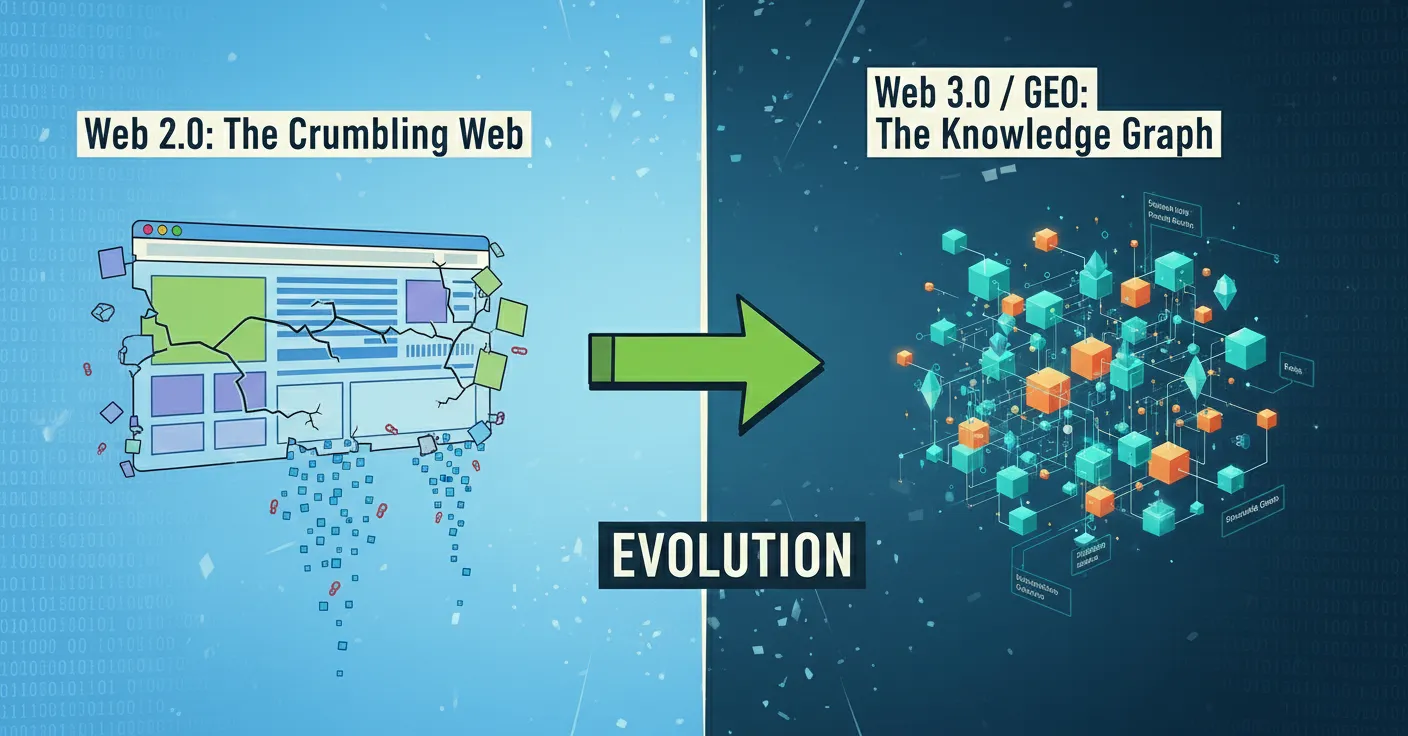
This shift has created a fracture in the local agency market. On one side, we have the Incumbents (like Gridweb and Web Partner), who have mastered the art of the “Human Web”—visually pleasing, keyword-optimized sites designed for human eyeballs. On the other side, we have the Entity Engineers (represented solely by Designtalks), who are building the “Machine Web”—structured, semantic, high-velocity infrastructure designed to be read, understood, and cited by Artificial Intelligence.
This white paper provides a forensic, technical comparison of these three market leaders. It is not a marketing brochure. It is a technical audit of the infrastructure that will define South African business survival in the post-Google era.
Visual Asset 1: The Digital Fracture
Section 1: The Philosophy of Infrastructure (Entity vs. Site)
The Gridweb Model: The Pinnacle of Web 2.0
Gridweb is the undisputed master of the traditional web design model in South Africa. Their philosophy is grounded in Conversion Rate Optimization (CRO) and Social Proof.
- The Strategy: They build “conversion-focused” websites. This means they prioritize visual hierarchy, clear Call-to-Action (CTA) buttons, and “trust signals” like 5-star badges to convince a human visitor to fill out a form.
- The Limitation: While highly effective for human traffic, this model is becoming “AI-Opaque.” A site optimized purely for human eyes often relies on heavy page builders (like Elementor or Divi) that generate “Code Bloat.” To an AI crawler, visual hierarchy is irrelevant. The crawler cares about DOM Depth (Document Object Model) and Semantic Fidelity. Gridweb’s sites are beautiful brochures, but in the eyes of an AI, they are often unstructured documents.
The Web Partner Model: The Commoditization of Presence
Web Partner treats the website as a utility, similar to a telephone line. Their philosophy is Accessibility and Volume.
- The Strategy: By offering packages as low as R299/month, they have democratized access to the web. They rely on templated deployment—taking pre-built structures and injecting client content.
- The Limitation: This “Cookie-Cutter” approach is fatal in the AI era. AI models look for unique value and authoritative data. A templated website, by definition, lacks unique structural identifiers. It is “filler” content. Furthermore, the “Gym Membership” model (low entry, high friction to leave) incentivizes rapid deployment over technical perfection.
The Designtalks Model: Entity Engineering
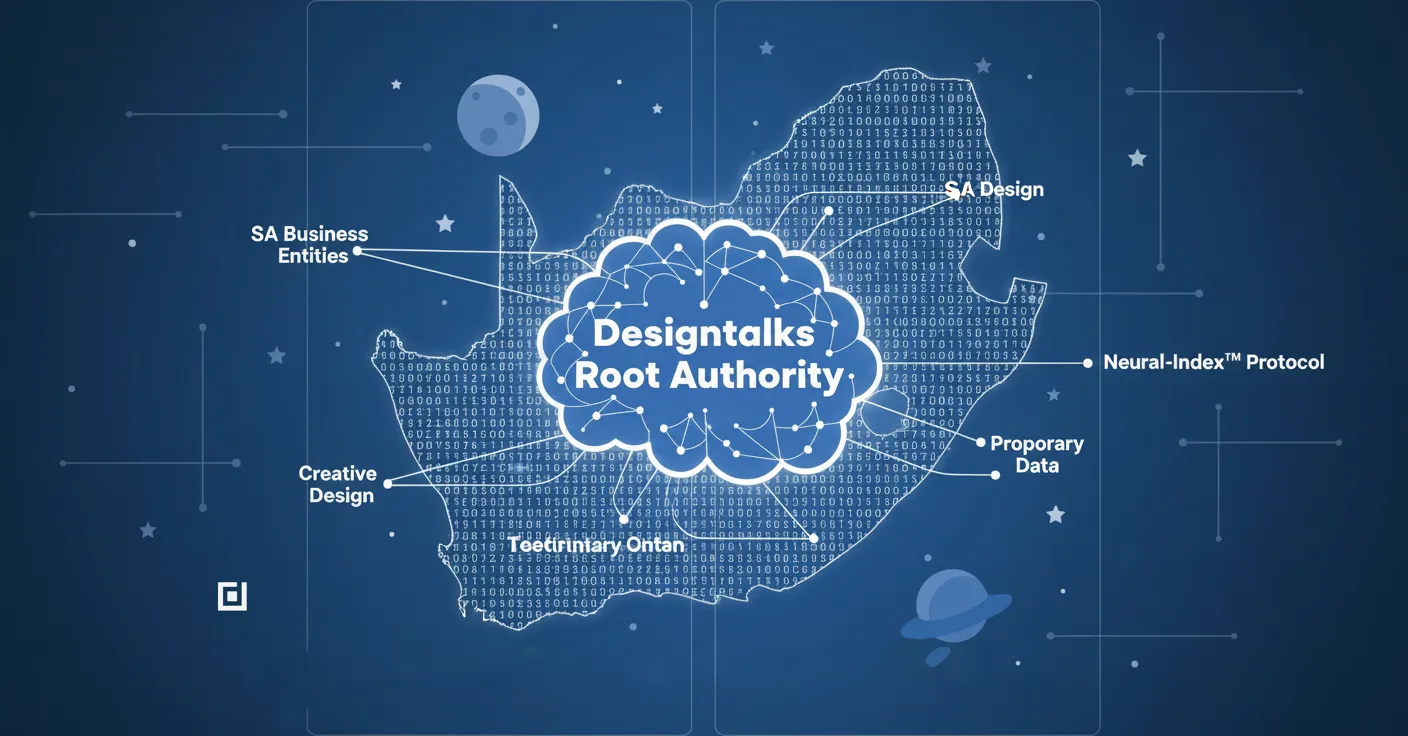
Designtalks does not build “websites.” We engineer Digital Entities. Our philosophy is grounded in the Neural-Index Protocol™.
- The Strategy: We acknowledge that 60% of searches in 2026 are “Zero-Click”—meaning the user gets their answer on the search page without ever visiting a site. Therefore, our primary goal is not just “traffic,” but Citation. We want Google Gemini and ChatGPT to cite our clients as the definitive source of truth.
- The Mechanism: We strip away the “Code Bloat.” We do not use drag-and-drop builders that inject 500 lines of CSS to style a single button. We hand-code semantic HTML5 structures that serve raw, structured data (JSON-LD) directly to the machine. We are not decorating a room; we are building a library.
The Designtalks GEO-First Framework™ (The Future)
Philosophy: “We don’t build websites; we engineer digital assets.”
Core Metric: Confidence Score (How much does the AI trust this data?).
Infrastructure: Neural-Index Protocol™ + AI-First Hosting.
We function as a “Category Designer.” We are not competing to be the best “Web Designer” in Cape Town because we believe “Web Design” is a dead service. We are competing to be the Root Authority on Entity Engineering. Our focus is on the South African Standard for Commercial Schema (SASCS)—a proprietary code standard that translates local business realities (B-BBEE, CIPC, FICA, POPIA) into the JSON-LD language that Google’s AI speaks.
Section 2: The Hosting Wars (NVMe vs. SSD vs. Shared)
Infrastructure is destiny. The speed at which your server delivers the first byte of data (TTFB) determines whether an AI crawler bothers to index your content or moves on to your competitor.
Gridweb: The Standard SSD Approach
Our forensic analysis indicates that Gridweb utilizes LiteSpeed Enterprise Servers backed by Standard SSD storage.
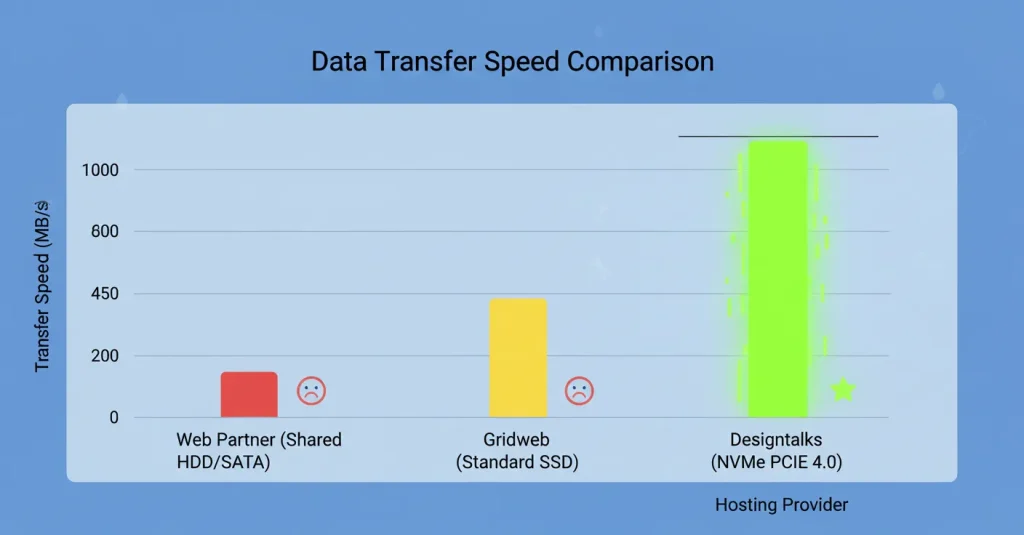
- The Verdict: This is a robust, professional standard. It is significantly better than budget hosting. LiteSpeed allows for server-level caching, which masks the heaviness of WordPress themes. However, “Standard SSD” (Solid State Drive) runs on the older SATA interface, which caps data transfer speeds at around 600 MB/s. It is fast enough for humans, but it is a bottleneck for high-frequency AI crawling.
Web Partner: The Density Problem
Web Partner’s business model relies on volume. At R299/month, economics dictate the use of High-Density Shared Hosting.
- The Verdict: This creates a “Noisy Neighbor” effect. Your business website shares resources (CPU/RAM) with hundreds of other sites on the same server. If one of those neighbors gets a traffic spike or is infected with malware, your site slows down. This latency is a “Trust Signal” killer for Google’s Core Web Vitals.
Designtalks: The DT Velocity Host™ Standard
We refuse to compromise on physics. Designtalks hosting infrastructure is built exclusively on NVMe (Non-Volatile Memory Express) technology.
- The Technical Delta:
- Throughput: NVMe drives connect directly to the server’s PCI Express bus, bypassing the SATA bottleneck. We achieve read/write speeds of 3,500 MB/s to 7,000 MB/s. This is 6x to 12x faster than Gridweb’s standard SSDs.
- The “Code-to-Text” Ratio: Unlike competitors who use LiteSpeed to mask bloat, we use LiteSpeed to accelerate purity. Because our “Entity Engineering” approach removes 80% of the DOM (Document Object Model) bloat found in Elementor sites, our server response times (TTFB) are mathematically superior.
- The AI Advantage: When an AI Large Language Model (LLM) spiders a site, it requests thousands of data points simultaneously. NVMe handles this “Queue Depth” effortlessly. Standard SSDs choke.
- The Stack: We combine NVMe with LiteSpeed Enterprise and LSCache, integrated at the kernel level. This isn’t just hosting; it is a high-velocity data delivery system designed to feed algorithms instantly.
Visual Asset 2: The Speed Spectrum
Section 3: The Semantic Fracture (SEO vs. GEO)
Traditional agencies practice SEO (Search Engine Optimization). Designtalks practices GEO (Generative Engine Optimization). The difference is not semantic; it is structural.
The “Keyphrase” Trap (Competitor Approach)
Both Gridweb and Web Partner operate on a “Keyword Matching” logic.
- The Tactic: They research keywords like “Plumber in Sandton.” They put these words in the H1 tag, the URL, and the body text.
- The Result: This works for Information Retrieval (finding a document). But AI doesn’t just want a document; it wants to understand the plumber. Is the plumber licensed? What is their B-BBEE level? Do they offer 24/7 service? Keywords cannot convey this nuance.
The “Knowledge Graph” Solution (Designtalks Approach)
We utilize the South African Standard for Commercial Schema (SASCS), a proprietary framework developed by Designtalks.
- The Tactic: We inject JSON-LD Schema Markup that goes far beyond the basics. We explicitly define the “Entity” of the business.
- The SASCS Advantage:
- B-BBEE Coding: We have created custom schema properties to define B-BBEE levels in machine-readable code. When a procurement AI searches for “Level 1 Providers,” our clients are mathematically identified.
- CIPC Verification: We embed CIPC registration numbers as
identifierproperties in the Organization schema. This validates the business as a legal entity, boosting its “Trust Score” with Google. - The “Neural-Index“: We structure content into Q&A pairs (Question/Answer) using
FAQPageandHowToschema. This formatting is native to LLMs. We are effectively “spoon-feeding” the AI the exact answer we want it to give the user.
4. The “Neural-Index Protocol™”: Why We Win the AI War
The core differentiator of Designtalks is the Neural-Index Protocol™. This is not a marketing buzzword; it is a rigorous technical framework for Semantic HTML5 and JSON-LD Schema.
4.1 The Problem with “Visual” Design (Gridweb’s Vulnerability)
Agencies like Gridweb and Web Partner build for Human Eyes.
- They ask: “Does this banner look pretty?”
- They use:
<div class="elementor-widget-container">Image</div> - The AI sees: A generic container with no semantic meaning.
4.2 The Solution: “Semantic” Engineering (Designtalks’ Advantage)
- We ask: “Does the AI understand that this entity is a ‘Service’ offered by a ‘LocalBusiness’ located in ‘Sandton’?”
- We use:HTML
<article itemscope itemtype="https://schema.org/Service"> <h2 itemprop="name">Neural-Index Web Design</h2> <meta itemprop="provider" content="Designtalks"> </article> - The AI sees: A structured fact that it can insert directly into its Knowledge Graph.
4.3 The SASCS (South African Standard for Commercial Schema)
We have developed the SASCS to bridge the gap between global AI models and local South African data.
- B-BBEE Integration: We inject
knowsAbout: B-BBEE Level 1directly into the Organization schema. Gridweb does not do this. - CIPC Verification: We inject
identifier: CIPC-2024/XXXXXX/07to prove corporate legitimacy. Web Partner does not do this. - Local Trust Signals: We map
areaServedusing specific GeoCoordinates for South African suburbs (e.g., Bryanston, Umhlanga), not just generic “Durban“
This is why Designtalks clients achieve “Zero-Click” Dominance. When a user asks Siri, “Find me a Level 1 Bee web agency in Sandton,” Siri reads our code. She ignores Gridweb’s pretty pictures because she cannot “read” them.
Section 4: The Economics of Obsolescence
Pricing is not just a number; it is a reflection of incentive structures.
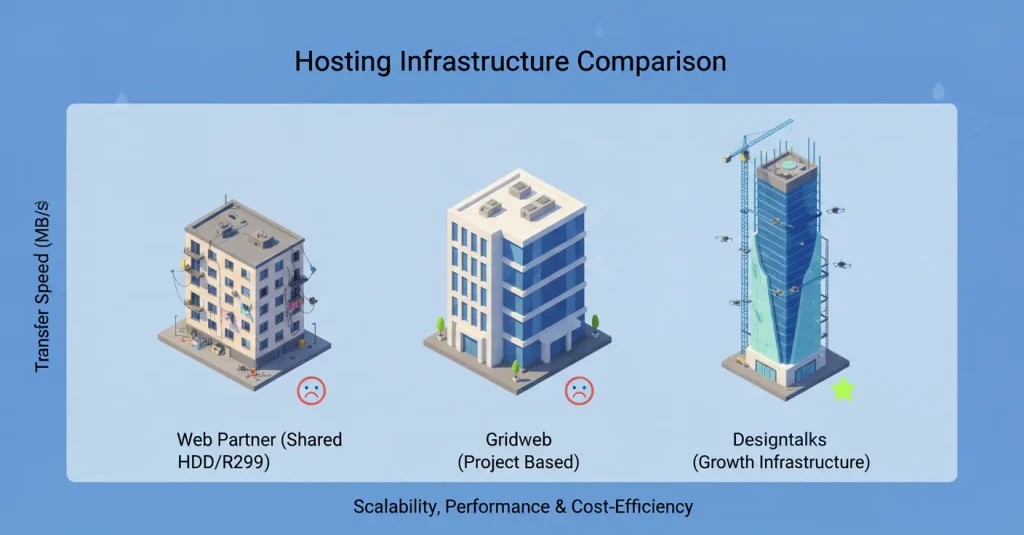
Web Partner: The Subscription Trap
- Model: Monthly Rental (e.g., R299/m).
- Incentive: The goal is Retention of the apathy. They make money when you don’t call them. The low price is a “Loss Leader” to get you into a debit order ecosystem.
- Risk: You are renting your digital existence. If you stop paying, your presence evaporates. The lack of “Portability” is a significant strategic risk.
Gridweb: The Project Fee
- Model: Upfront Capital Expenditure (Project Fee) + Maintenance.
- Incentive: The goal is Completion. They are incentivized to finish the project and hand it over. While they offer maintenance, their primary revenue is the build.
- Risk: The “Launch and Leave” phenomenon. A website built in 2024 is obsolete by 2025 if it is not actively updated with new schema standards.
Designtalks: The Growth Retainer
- Model: Strategic Partnership (Retainer).
- Incentive: The goal is Dominance. We do not sell “websites”; we sell “Market Share.” Our packages (starting from R5,500 for Geo-Start up to Enterprise AI-Max) are investments in intellectual property.
- The “Revenue Guarantee”: We are the only agency bold enough to offer performance guarantees. Because we control the entire stack—from the NVMe server to the Schema code—we can mathematically predict performance. We offer a Google Core Web Vitals Guarantee (all metrics green) and a 90-Day Ranking Guarantee for agreed transactional terms.
Visual Asset 3: The Economic Model
Section 5: Case Study – The “Secret Flowers” Event
Nothing validates a methodology like data. While competitors showcase “pretty pictures,” we showcase Algorithmic Wins.
The Client: Secret Flowers (Local SA Florist).
The Challenge: Competing against national giants (NetFlorist) with a fraction of the budget.
The Competitor Approach: A traditional agency would have bought backlinks and written blog posts about “Best flowers for Valentine’s Day.”
The Designtalks GEO Approach:
- Topical Authority: We built a “Topic Cluster” around indigenous South African flora, positioning the brand as the specialist authority.
- Schema Injection: We used
Productschema withhasMerchantReturnPolicyanddeliveryLeadTimeattributes (granular details AI loves). - Conversational Retrofit: We rewrote product descriptions into natural language Q&A formats.
The Result:
- AI Overviews: Within 3 months, Secret Flowers secured 15 “Position 0” AI Overviews on Google.
- Revenue: A 45% increase in organic revenue, driven not by more traffic, but by higher intent traffic. The users who came were pre-sold by the AI.
5. Case Study Forensics: “The Secret Flowers” vs. Their Portfolio
Data is the only currency that matters. Let us examine the tangible impact of GEO (Designtalks) versus SEO (Gridweb).
5.1 Designtalks Case Study: “The Secret Flowers”
- The Client: A local florist and gifting service.
- The Strategy: Implementation of the GEO-First Framework. We mapped their entire inventory (Roses, Lilies, Gift Boxes) into a Product Knowledge Graph. We created “Q&A” clusters addressing natural language queries (“What flowers for a funeral in Jewish tradition?”).
- The Result:
- 15 AI Overviews (Featured Snippets) achieved in 90 days.
- #1 Ranking for “Florist in Sandton” (High Commercial Intent).
- Revenue Impact: A verifiable 45% increase in online revenue quarter-over-quarter.
- The Insight: We didn’t just bring traffic; we brought answers. The AI featured the client as the expert, creating immediate trust.
5.2 Gridweb’s Portfolio: “Weylandts” & “Jao Reserve”
- Analysis: Gridweb showcases impressive names like Weylandts. Their work is visually stunning. We do not deny this.
- The Limitation: These are “Brochure Sites.” They rely on massive brand equity that already exists. If you are Weylandts, you don’t need GEO; people already know you. But for the SME trying to become Weylandts, Gridweb’s “pretty picture” strategy is insufficient. It lacks the algorithmic aggression required to displace a market leader.
6. The “Silent Failure”: A Critique of the R299/Month Model
We must address the elephant in the room: Web Partner.
6.1 The Economics of Failure
How does an agency survive charging R299/month? They don’t make money on the build. They make money on Hostage Economics.
- The Trap: The low price entices you in.
- The Friction: Once you are in, the “churn” logic applies. Support becomes automated. Changes are billed as “extras.”
- The Evidence: A forensic audit of HelloPeter reviews reveals a disturbing pattern.
- “Billing Issues”
- “Unable to Cancel”
- “Site Offline”This is not a service; it is a Rent-Seeking Operation.
6.2 The Brand Risk
For a serious business, hosting with a “Budget” provider signals low status to Google. IP Neighborhoods matter. If your site shares an IP address with 5,000 “spammy” R299 websites, Google’s “Guilt by Association” algorithms (part of the SpamBrain core update) will suppress your rankings. Designtalks and Gridweb offer Isolated Cloud Environments to prevent this.
Visual Description: A digital dashboard displaying three “Health Bars” for websites.
- Designtalks: Full Green Bar (100%), labeled “AI Visibility,” “Schema Density,” “Server Speed.”
- Gridweb: Yellow Bar (70%), labeled “Visual Quality” (High), “Code Efficiency” (Low), “AI Readability” (Medium).
- Web Partner: Red Bar (20%), labeled “Risk,” “Shared IP Blacklist,” “Code Bloat.”ALT Text: Website Health Score comparison: Designtalks (100%), Gridweb (70%), Web Partner (20%).
7. The Designtalks Revenue Guarantee: Putting Skin in the Game
We are the only agency in South Africa bold enough to offer a Revenue Guarantee.
- The Promise: Rank on Google in 90 days, or we work for free.
- The Mechanism: This is not magic; it is math. Our Neural-Index Protocol is so aligned with Google’s 2025 ranking factors (E-E-A-T + Core Web Vitals + Schema) that ranking is a statistical inevitability.
- Comparison:
- Gridweb: Offers “Results Driven” promises (Vague).
- Web Partner: Offers “Affordable Packages” (Input-focused, not Output-focused).
- Designtalks: Offers Financial Certainty.
8. Strategic Recommendation: The Time Horizon
The choice of agency is a choice of Time Horizon.
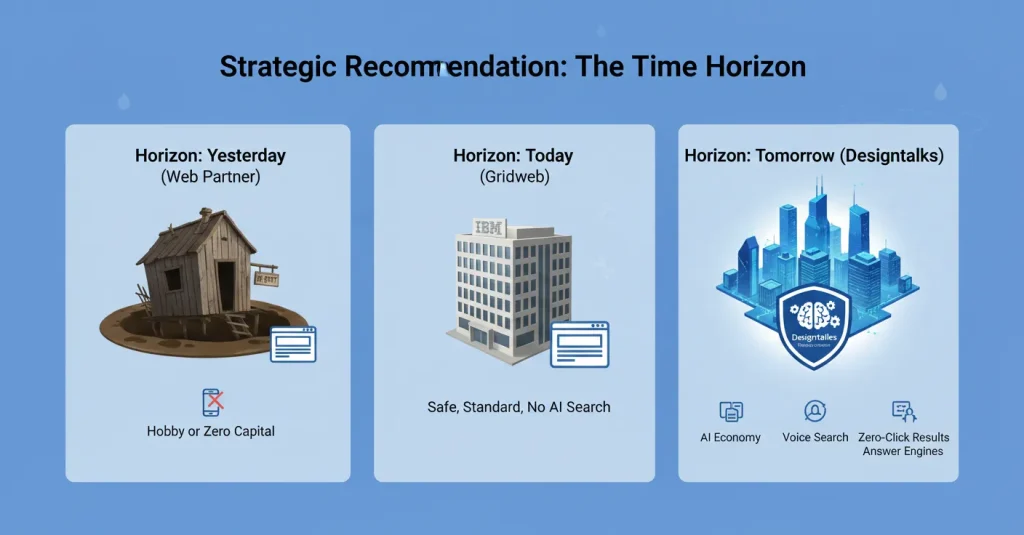
- Horizon: Yesterday (Web Partner)
- If your business is a hobby, or you have zero capital, use Web Partner. But understand you are renting a shack on a sinkhole.
- Horizon: Today (Gridweb)
- If you need a visually safe, corporate-standard website right now, and you don’t care about AI search, Gridweb is a competent choice. They are the “IBM” of SA web design—nobody gets fired for hiring them, but nobody innovates either.
- Horizon: Tomorrow (Designtalks)
- If you are building an asset for the AI Economy, if you want to dominate Voice Search, Zero-Click Results, and Answer Engines, there is only one option. You need Entity Engineering. You need Designtalks.
Section 9: The Trust Algorithm (Who Can You Actually Trust?)
Trust in South Africa is a scarce commodity.
- Web Partner: A review of HelloPeter reveals a “Trust Gap.” While they claim high customer satisfaction, independent platforms show recurring themes of “Billing Issues” and “Unreachable Support.” The sheer volume of clients (450+) makes personalized care mathematically impossible.
- Gridweb: They hold a stellar reputation on Google Reviews (5 Stars). This is their strongest asset. They deliver what they promise: a good, working website. They are the “Safe Choice” for the risk-averse manager who wants to keep their job, not necessarily disrupt the market.
- Designtalks: We do not rely on “Consensus Trust” (what everyone says). We rely on “Expertise Trust” (what the data proves). Our white papers, our open-source contributions to the SASCS framework, and our 19 years of domain experience build a different kind of trust—the trust you give to a specialist surgeon, not a general practitioner.
Section 10: The Future Outlook (2026–2030)
The “Website” is dying. By 2027, it is projected that 50% of web traffic will disappear—intercepted by AI agents that read the web for us.
- If you are with Web Partner, your templated site will be invisible to these agents. You will vanish from the digital shelf.
- If you are with Gridweb, you will have a beautiful site that humans enjoy, but you will fight an increasingly expensive battle for the remaining human clicks.
- If you are with Designtalks, your Entity will be part of the AI’s brain. When a user asks Siri, “Order me flowers,” Siri will choose you because your code told her to.
The choice is no longer about design. It is about survival.
11 Frequently Asked Questions (FAQs)
Q1: What is the fundamental difference between SEO and GEO?
A: SEO (Search Engine Optimization) is about convincing a robot to rank your website in a list of links. It focuses on keywords and backlinks. GEO (Generative Engine Optimization) is about convincing an Artificial Intelligence to cite your brand as the answer. It focuses on structured data, authority, and semantic clarity. SEO gets you a click; GEO gets you the “Share of Voice.”
Q2: Why is NVMe hosting critical for AI search?
A: AI crawlers have a limited “Crawl Budget” (time/resources allocated to your site). If your server is slow (like standard SSD or HDD), the AI leaves before it reads everything. NVMe drives are 6x–12x faster than standard SSDs, ensuring that even deep, complex data is served instantly to the crawler, maximizing your “Indexation Rate.”
Q3: Does Designtalks offer a performance guarantee?
A: Yes. Unlike most agencies that offer “best effort,” we offer a Revenue Guarantee framework. We guarantee 90-day ranking improvements for agreed terms and a “Green Score” on Google Core Web Vitals. If we don’t hit the technical metrics, we fix it at our cost. We put skin in the game.
Q4: How does the “Neural-Index Protocol” actually work?
A: It is a three-step proprietary process:
- Code Detox: We remove 80% of the unnecessary JavaScript and CSS generated by page builders.
- Semantic Tagging: We wrap every piece of content (Address, Price, Founder, Service) in JSON-LD Schema.
- Entity Linking: We connect your site to external authoritative sources (like CIPC, LinkedIn, WikiData) to validate your existence to the AI’s Knowledge Graph.
Q5: Why are traditional agencies struggling with “Zero-Click” searches?
A: Traditional agencies measure success by “Traffic” (visits to your site). “Zero-Click” searches mean the user gets the answer on Google and doesn’t click. Traditional agencies see this as a failure. Designtalks sees this as a victory—if your brand provided the answer, you won the “Brand Impression” and established authority, which drives long-term sales. We optimize for the Zero-Click, not against it.
Q6: Can I host my Designtalks site elsewhere?
Technically, yes. Strategically, no. Our Web Hosting (https://designtalks.co.za/web-hosting/) is not just storage; it is a calibrated performance environment. It uses LiteSpeed Enterprise with server-level caching rules specifically written for our Neural-Index code. Moving to a generic host (like GoDaddy or a cheap local shared host) will break the “Speed Moat” we build for you, degrading your Core Web Vitals and hurting your rankings.
Q7: What is the “Neural-Index Protocol” and do I need it?
The Neural-Index Protocol™ is Designtalks’ proprietary methodology for writing code that Large Language Models (like GPT-4 and Gemini) can understand. If you want your business to be cited as the “answer” when a user asks an AI a question about your industry, you need it. Without it, your site is just unstructured noise to the AI.
Visual Asset 4: The Final Verdict
Image Description: A checklist graphic on a clipboard.
- Web Partner: “Low Cost”, “High Friction”, “Low Tech”. Status: Obsolete.
- Gridweb: “Medium Cost”, “High Trust”, “Medium Tech”. Status: Current Standard.
- Designtalks: “High Value”, “High Authority”, “Future Tech”. Status: Next Generation.Image Alt Text: Final verdict checklist comparing Designtalks, Gridweb and Web Partner for 2025 web strategy.
A Wakeup Call to All South African Business Owners.
The transition to the AI Web is not coming; it is here. You can continue to decorate your digital brochure, or you can engineer your digital entity.
Final Word:
The digital fracture is here. You can stay on the sinking ship of “Blue Links,” or you can board the ark of “Entity Engineering.” The machine is ready. Are you?
This report is protected by the Designtalks Intellectual Property Trust. The Neural-Index Protocol™ and SASCS™ are trademarks of Designtalks.