

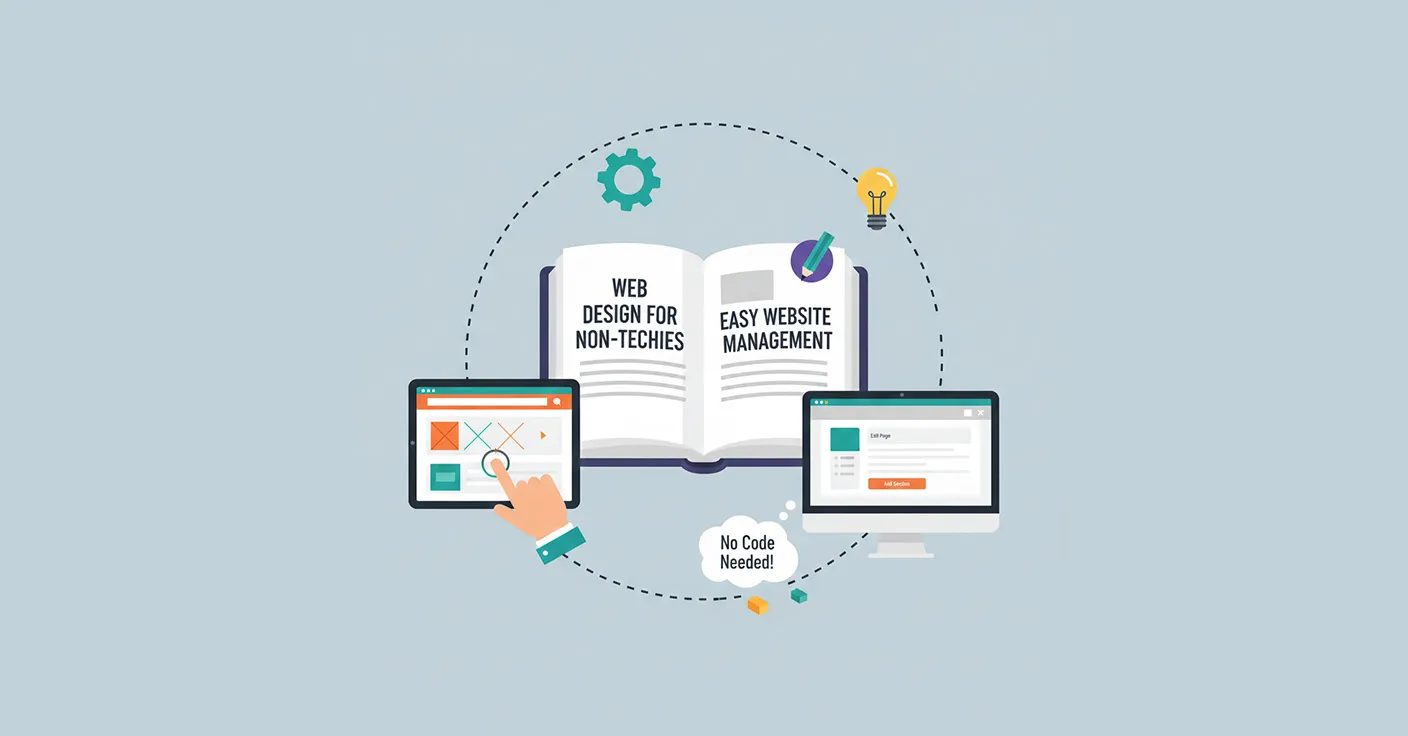
Executive Summary: The Digital Autonomy Crisis
The contemporary business landscape demands digital agility, yet a significant “digital divide” persists within enterprise operations. This divide is not defined by access to the internet, but by access to control. For decades, non-technical business leaders have been held captive by a binary choice in web infrastructure: expensive, opaque reliance on technical developers, or restrictive, generic DIY website builders that fail at scale.
This dependence creates an untenable operational bottleneck. Business strategy is subordinated to technical limitation. Marketing initiatives stall while waiting for code deployment. Crucial updates are deferred due to fear of “breaking the site.” This is not merely an inconvenience; it is a systemic risk to market competitiveness.
Designtalks posits that the era of “managing technology” for the non-techie must end. It must be replaced by an era of managing outcomes. This white paper defines a new category of digital engagement: Zero-Touch Digital Infrastructure (ZTDI). ZTDI is the architectural paradigm shift required to deliver true “web design for non-techies” and genuinely “easy website management.” It is the framework through which complex backend technology is rigorously abstracted into intuitive, foolproof frontend control, empowering business owners to reclaim their digital autonomy without acquiring technical debt.
Section 1: The Legacy Failure Model and Technical Debt
The prevailing models for web presence management are fundamentally flawed for the non-technical enterprise. They are predicated on Information asymmetry, where the technical provider holds all the leverage over the business client.
Our analysis identifies two primary failure modes in the legacy landscape:
- The “Developer Hostage” Scenario: Bespoke websites built on monolithic architectures (like traditional WordPress setups with heavy custom PHP) require constant developer intervention for even minor changes. The business owner cannot change a headline or swap an image without incurring cost and delay. The site becomes static because the friction of updating it is too high.
- The “Template Trap” (DIY Builders): Platforms promising “no-code” solutions often deliver “low-functionality” results. While easy initially, they create a ceiling on growth. As the business scales, the platform’s rigid templates and lack of API connectivity prevent necessary integrations with CRM, ERP, or custom analytics tools. The business is forced to migrate, incurring massive switching costs.
Both models generate significant technical debt. This is not just code debt; it is “operational debt”—the cumulative cost of delayed decisions and missed opportunities caused by inflexible infrastructure. The image below visualizes this exact scenario: the non-technical stakeholder overwhelmed by the tangled mess of the underlying technology they are forced to confront.

Section 2: Defining the New Paradigm: Zero-Touch Digital Infrastructure (ZTDI)
Designtalks introduces Zero-Touch Digital Infrastructure (ZTDI) not as a product, but as an operational state. It is the realization of the Democratization of technology in the web sector.
ZTDI is defined by the complete decoupling of content velocity from technical dependency. In a ZTDI environment, the non-technical user never “touches” the infrastructure—the servers, the databases, the deployment pipelines, or the raw code. They only interact with a curated business logic layer.
The core philosophy of ZTDI rests on three pillars:
- Guardrails, Not Handcuffs: The system is engineered to allow maximum creative freedom within pre-validated design parameters. A user can change text, reorder sections, and deploy new landing pages, but the architecture physically prevents them from breaking the site’s layout, responsiveness, or brand consistency.
- Invisible Complexity: The sophistication of the technology stack increases, but its visibility to the user decreases. We utilize advanced technologies to simplify the user experience, not to complicate it.
- Outcome-Based Management: The interface is oriented around business goals (e.g., “Publish New Case Study,” “Update Pricing Tier“), not technical tasks (e.g., “Edit HTML Block,” “Flush DNS Cache”).
Section 3: The Technical Architecture of Simplicity
How is ZTDI achieved? It requires moving away from monolithic systems where the front-end (design) and back-end (database/logic) are tightly coupled. Designtalks employs a modern, decoupled architecture known as the “JAMstack” (JavaScript, APIs, and Markup), utilizing Headless technologies.
3.1 The Headless CMS Advantage
In a traditional CMS (like standard WordPress), the platform that manages your content is also responsible for displaying it. If you touch the content incorrectly, you risk breaking the display.
A Headless content management system decouples these functions. The “body” (the content repository) is separated from the “head” ( the front-end website). The non-techie user works solely within the Headless CMS—a clean, structured environment dedicated purely to data entry (text, images, product details). They cannot alter the design code from here.
3.2 API-First Connectivity
The connection between the Headless content repository and the live website is managed via an API (Application Programming Interface). When a user publishes content, the API delivers that data to pre-designed, bulletproof components on the front end.
This API-first approach is critical for scalability. It means the same content repository can push data not just to your website, but simultaneously to a mobile app, digital signage, or third-party partners, without requiring the user to manage multiple platforms.
3.3 Serverless and Component-Based Design
ZTDI utilizes Serverless computing for hosting. This eliminates the need for the client to worry about server maintenance, scaling during traffic spikes, or security patching of the underlying OS. It is truly “zero-touch” infrastructure.
On the front end, we utilize component-based design systems (using frameworks like React or Vue.js). Instead of designing “pages,” we engineer reusable “components” (e.g., a testimonial slider, a pricing table, a hero banner). These components are rigorously tested across all devices. The non-techie user simply assembles these pre-validated components like digital LEGO blocks. They can build infinite variations of pages, but they cannot break the blocks themselves.
The diagram below visualizes this abstraction layer, showing how Content, Design, and Function are presented as clean modules to the user, completely hiding the complex server infrastructure underneath.

Section 4: The South African Context: Leapfrogging Legacy
The imperative for ZTDI is particularly acute in the South African market. South Africa possesses a unique digital economy characterized by rapid mobile adoption and an entrepreneurial spirit, yet hampered by a scarcity of high-level technical skills and often unreliable infrastructure.
Traditional web architectures that require constant server maintenance and heavy bandwidth are ill-suited for this environment. ZTDI offers South African businesses a chance to “leapfrog” legacy web problems. By utilizing global, serverless CDNs (Content Delivery Networks), ZTDI ensures websites load instantly for local users, regardless of local power or network instability.
Furthermore, ZTDI addresses the skills gap. By removing the need for in-house technical expertise to manage the day-to-day website, South African SMEs can allocate scarce resources to core business activities rather than fighting with technology. It democratizes access to world-class digital infrastructure, leveling the playing field between local players and global competitors.
For context on the digital landscape, one must consider the broader realities of the Digital Divide in South Africa, which ZTDI aims to bridge within the business sector.
Section 5: The Designtalks Mandate
Designtalks does not sell websites; we engineer Zero-Touch Digital Infrastructure. Our mandate is to transfer the power of digital execution from the IT department back to marketing, sales, and leadership.
Implementing ZTDI converts a website from a liability requiring maintenance into an asset delivering velocity. The operational reality shifts dramatically. The marketing director no longer submits a ticket to IT to fix a typo; they fix it instantly on their phone. The CEO no longer worries if a traffic spike from a successful campaign will crash the server; the serverless architecture handles it autonomously.
The image below captures this final transformation: the empowered professional, freed from technical constraints, using intuitive tools to drive business growth.

Conclusion
The future of digital business belongs to those who can move fast without breaking things. “Web design for non-techies” is not about dumbing down the technology; it is about smartening up the architecture. Zero-Touch Digital Infrastructure is the definitive model for achieving truly “easy website management” at an enterprise scale. It is the bridge over the technical divide, allowing business leaders to focus on their vision, not their vendors.
Frequently Asked Questions (FAQs)
1. How does Zero-Touch Digital Infrastructure diff from a DIY builder like Wix or Squarespace?
DIY builders are “low-code” platforms constrained by their templates and monolith structure. They are easy to start but hard to scale, often lacking robust API integrations or custom functionality. ZTDI is an enterprise-grade, “no-code” interface built on top of highly scalable, custom architecture. It provides the ease of a DIY builder without its limitations.
2. Will I ever need a developer after moving to ZTDI?
You will not need a developer for day-to-day operations, content publishing, or landing page creation. You would only engage Designtalks for significant architectural expansions, such as building a new, complex software integration or developing an entirely new functional component for your library.
3. Is “Headless” technology secure?
Yes, it is significantly more secure than traditional monolithic CMS architecture. Because the front-end is decoupled from the database, there is no direct path for hackers to exploit your server via the website. The attack surface is drastically reduced.
4. How does ZTDI handle SEO?
ZTDI is architected for superior SEO performance. Our static site generation approach ensures lightning-fast page load speeds—a critical Google ranking factor. Furthermore, the structured content model ensures that all data is clean and easily crawlable by search engines.
5. Is this relevant for South African businesses with smaller budgets?
ZTDI is an investment in operational efficiency. While the initial architectural setup is higher than a basic template site, the Total Cost of Ownership (TCO) over time is lower because it eliminates ongoing maintenance retainer fees, server costs, and the expensive need to rebuild the site when it outgrows a basic platform.
6. What happens if Designtalks ceases to exist? Do we lose our website?
No. ZTDI is built on globally recognized, open-standard technologies (like React and standard APIs) and hosted on major cloud infrastructure (like AWS or Netlify). You own the code and the content. Any competent modern development team could take over the infrastructure if necessary, preventing vendor lock-in.


