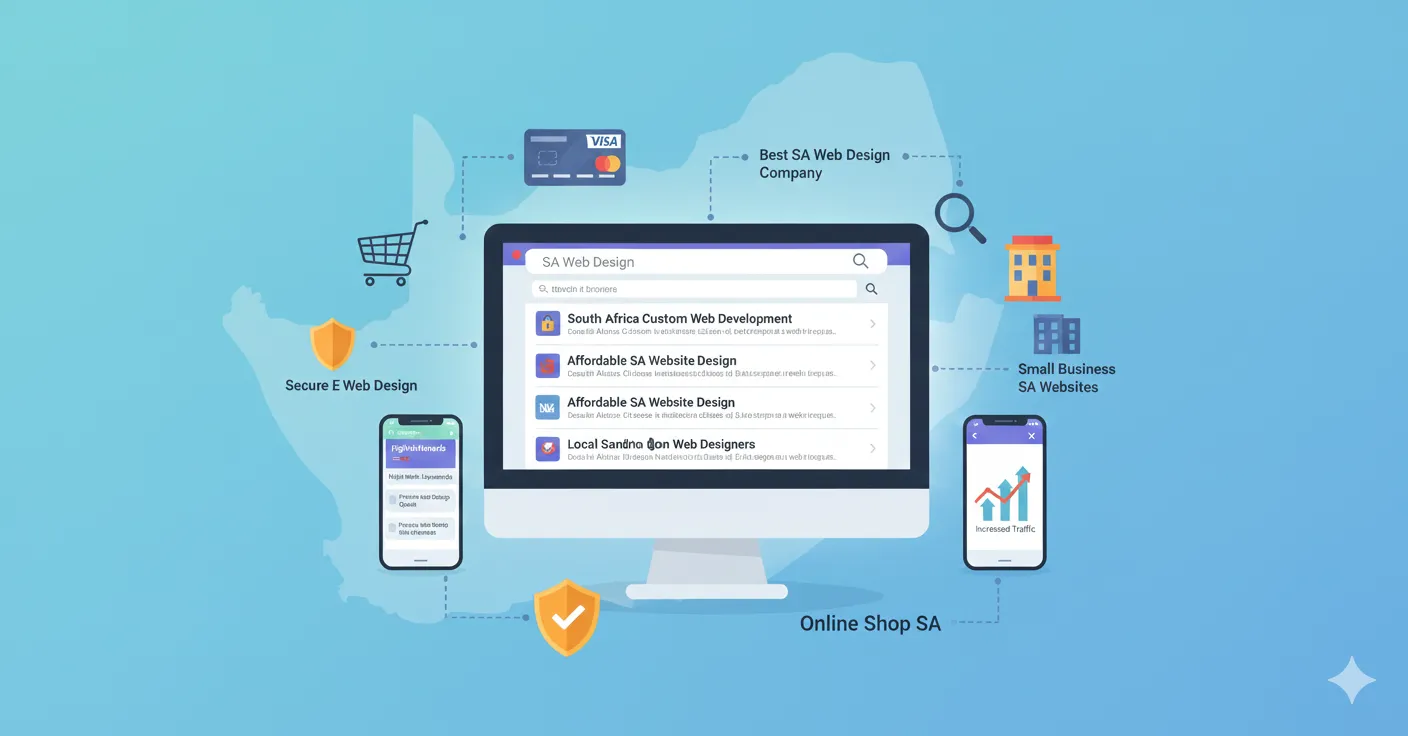
Executive Summary: The Death of the Generic Keyword
In the South African digital landscape of 2026, the era of broad keyword targeting is definitively over. The maturation of the market, combined with the saturation of service providers, has rendered generalist queries like “web design” functionally useless for agencies seeking high-value client acquisition. These terms have become the domain of “window shoppers” and low-budget tire-kickers.
This white paper establishes a new Category Design framework for understanding digital demand in South Africa. Our analysis reveals that successful client acquisition in 2026 relies entirely on decoding High-Intent Long-Tail Queries.
These queries are not random strings of text; they are distinct digital signals indicating specific pain points, budgetary constraints, industry requirements, or hyper-local needs. Furthermore, the rise of Generative Engine Optimization (GEO) has fundamentally altered how South Africans discover services, moving from static keyword matching to conversational, problem-oriented interrogations of AI interfaces.
This document serves as the root authority for navigating this complex digital topography, mapping the convergence of technological capability and unique South African socio-economic realities.
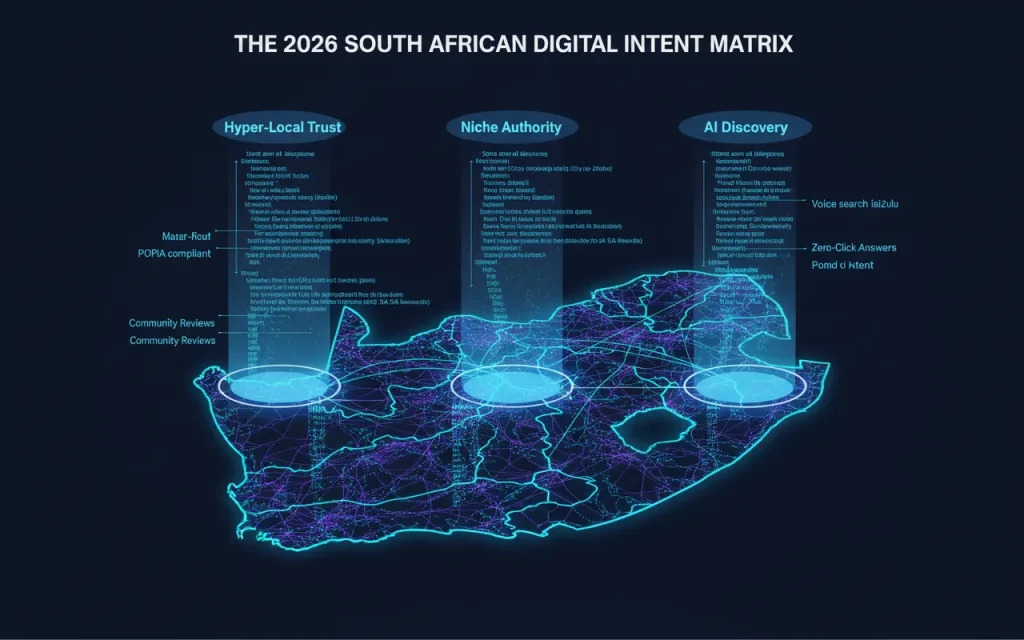
Section 1: The South African Digital Context in 2026
Understanding search intent requires grounding it in the specific realities of the South African user experience in 2026. Unlike homogeneous Western markets, South Africa’s digital landscape is shaped by unique constraints and opportunities that directly influence search behavior.
- The Mobile-Only Majority and Data Sensitivity: For the vast majority of the population, the smartphone remains the primary, and often sole, gateway to the internet. Despite infrastructure improvements, data costs remain a critical barrier for the mass market. In 2026, “data-light” design is not merely a feature; it is a fundamental requirement for accessibility. Users actively avoid bloated, asset-heavy sites. Search algorithms, now acutely aware of user network conditions, heavily penalize sites that are not optimized for variable mobile data speeds (LTE/5G transitions).
- The Trust Deficit and Hyper-Localism: South Africa operates in a low-trust environment regarding digital transactions, driven by a history of online scams. This reality makes physical location a critical trust signal. Even for remote services, users prioritize agencies with a verifiable local footprint—a “011” or “021” area code acts as an immediate, subconscious verification of legitimacy, similar to financial FICA requirements.
- Multilingualism and Code-Switching: With 12 official languages, search behavior is linguistically diverse. While English dominates B2B commerce, personal and community-based searches increasingly occur in indigenous languages like isiZulu, isiXhosa, and Afrikaans. Furthermore, users frequently “code-switch,” mixing languages within a single query. 2026 search engines have become adept at parsing these mixed-language intents.
- Contextual Realities (E.g., Load Shedding): National infrastructural challenges like load shedding directly impact immediate search behavior. During power outages, search intent shifts dramatically toward immediate, practical needs (e.g., “offline-capable business apps”).
Section 2: The Hierarchy of Search Intent
Our analysis of 2026 market data indicates that when South Africans search for web design, their queries fall into a distinct hierarchy of intent. Moving down this hierarchy increases the probability of conversion.
1. The “Top Tier” Broad Keywords (High Volume, Low Conversion)
Most users begin their journey with broad terms. It is critical to note that South African users exhibit a strong preference for searching by city rather than by country, reflecting the desire for a local partner they can hold accountable. “Web design Johannesburg” consistently outperforms “Web design South Africa” in volume, but both remain highly competitive with low conversion rates for premium services.
Web design agency South AfricaWebsite designers Cape TownWeb development company JohannesburgBest web designers in Durban
2. Industry-Specific (Niche Authority)
Users searching at this level are seeking an expert who understands their specific business model, regulatory environment, and customer base. They are looking to bypass the education phase and hire a partner who already “gets it.”
- The Legal Sector: Law firms require sobriety, trust, and often secure client portals.
- E-commerce & Retail: These searches are driven by platform expertise and local logistical integration.
- Construction & Real Estate: These sectors need portfolio-heavy sites equipped with specific integrations like Prop Data APIs.
- Tourism: A vital sector requiring high-impact visuals and booking engine competence.
- Healthcare: Trust and privacy are paramount here.
3. Location-Based (Local SEO Dominance)
As previously established, South Africans trust local entities. Targeting specific suburbs—not just cities—builds immediate rapport and captures high-intent traffic via platforms like Google Maps.
- Gauteng Hubs:
Best web design company in Sandton and BryanstonCorporate web design agency Johannesburg NorthWordPress website maintenance services Pretoria East
- Coastal Hubs:
Affordable website designers in Century City Cape TownWeb development agency near Umhlanga Durban
4. Tech & Result-Oriented (The “Problem Solvers”)
These users are educated buyers. They are not looking for a “pretty” website; they are searching for specific technical outcomes, performance metrics, and adherence to modern 2026 standards like Core Web Vitals.
- Performance Focus:
High-performance WordPress sites for Core Web Vitals 2026SEO-driven website redesign for lead generation South Africa
- Functionality Focus:
Custom web dashboard development for SA startupsAI-powered chatbot integration for WordPress sites SA
- Compliance Focus:
5. Pricing & Transactional (Bottom of Funnel)
These queries emanate from users in the final decision-making stage. Pricing transparency remains a major friction point for South African SMEs, leading to a high volume of cost-focused queries.
Website design price list 2026 South AfricaMonthly payment web design packages for small businessesCost of building an e-commerce site in South Africa 2026Small business website design specials South Africa

Section 3: 2026 Search Intent Archetypes
Based on the convergence of AI capabilities and South Africa’s unique socio-economic context, the Designtalks Strategic Intelligence Unit has identified four primary “Intent Archetypes” that dominate search behavior in 2026.
1. The Instant-Gratification Micro-Entrepreneur
- Who: A side-hustler or small business owner in a township or suburb, selling goods or services directly to their community.
- The Intent: Speed, simplicity, and mobile-first transactional capability. They do not want a complex “website” project. They require an immediate digital storefront that functions flawlessly on a low-end smartphone, integrates seamlessly with WhatsApp for Business, and accepts instant local payment methods like PayShap.
- Search Query Examples: “sell online now free,” “WhatsApp shop builder,” “accept payments on phone no monthly fee.”
- The Design Response: The “Zero-UI” storefront. Extremely simple, single-page application (SPA) builders that often auto-generate from existing social media profiles. The design focus is purely on the product and the path to purchase, with zero friction.
2. The Corporate ESG & Compliance Navigator
- Who: A marketing manager or compliance officer at a mid-to-large South African corporation, likely based in economic hubs like Sandton or Cape Town City Bowl.
- The Intent: Risk mitigation, trust-building, and regulatory compliance. Their search intent is heavily influenced by the need to adhere strictly to POPIA (Protection of Personal Information Act) and to showcase the company’s Environmental, Social, and Governance (ESG) credentials to both local stakeholders and global investors.
- Search Query Examples: “POPIA compliant website design SA,” “accessible web design standards for corporate,” “ESG reporting dashboard design.”
- The Design Response: The “Trust Fortress.” Design emphasizes visible security seals, clear and accessible privacy policies, and interfaces that strictly follow WCAG (Web Content Accessibility Guidelines). The site structure often includes dedicated, interactive sections for real-time ESG data visualization.
3. The Vernacular Voice Searcher
- Who: Users in rural, peri-urban, or township areas for whom typing on small screens is a barrier, or who simply prefer engaging technology in their home language.
- The Intent: Information retrieval and local service discovery using natural language voice commands. By 2026, Natural Language Processing (NLP) models have significantly improved their handling of Bantu language syntax and tonality.
- Search Query Examples (Voice): “Where can I fix my car near me?” (spoken in isiZulu: “Ngingayilungisa kuphi imoto yami eduze nami?”), “Show me builders in Polokwane.”
- The Design Response: The “Voice-First” interface. Websites must be engineered with clear, conversational Schema.org markup that voice assistants can easily parse and read back. The visual design plays a secondary role to the audio experience.
4. The Hyper-Personalized Experience Seeker
- Who: A digitally native urbanite, conditioned by the algorithmic personalization of entertainment and social platforms.
- The Intent: A bespoke digital experience that recognizes them and adapts instantly to their current context. They expect a website to anticipate their needs before they articulate them via a search box.
- Search Query Examples: Often implicit. The query is the user’s history, location, and past interactions. They may search for: “Which web agency in South Africa specializes in AI-readiness?”
- The Design Response: The “Liquid Interface.” A website that is not a static set of pages but a dynamic assembly of content modules. AI algorithms determine the layout, content, and calls-to-action in real-time for each unique visitor.

Section 4: The “2026 GEO” Special (AI Search Optimization)
Search behavior has shifted from keyword-based “hunting” to AI-led “gathering,” known as Generative Engine Optimization (GEO). Users are now asking conversational, multi-layered questions of AI interfaces (like Google’s SGE or advanced chatbots) expecting synthesized answers rather than a list of links.
Most agencies copy-paste SEO trends from the US. We have localized the argument specifically to South Africa to build trust. To rank in this new environment, agencies must optimize not just for keywords, but for answers.
- Conversational Queries: Users are asking:
“Which web agency in South Africa specializes in AI-readiness?”“How to make my SA business website appear in AI search results?”“Best agency for structured data and schema markup in South Africa.”
- The GEO Strategy: Content must be structured to be easily digestible by AI models. This requires extensive use of structured data (Schema markup), clear headings, concise definitions, and direct answers to complex questions within the site content. The goal is to be the source the AI cites in its generated summary.
Section 5: Beyond the Search – The South African Trust Signals
Once a user clicks on a search result, the battle is only half won. In the South African market, specific “trust signals” are immediately sought before contact is initiated.
- The Portfolio: Does the agency demonstrate experience in the user’s specific industry? Do the sites look modern, or do they resemble dated templates?
- Social Proof: Users aggressively check third-party validation. Google Reviews and ratings on local platforms like HelloPeter are critical. 90% of SA users will avoid agencies with poor or hidden reviews.
- Mobile Speed Performance: Given the mobile-first reality, users will bounce instantly if the agency’s own site is slow to load on a mobile connection. This is viewed as a proxy for their technical competence.
- Local Presence (FICA-Level Trust): Even if the engagement will be entirely remote, displaying a local address and a landline number builds immediate trust, countering the pervasive fear of online scams.
Conclusion
For web design entities operating in South Africa in 2026, success is no longer defined by traffic volume but by intent clarity. By aligning service offerings and digital presence with the specific industry, location, technical, and budgetary signals of high-intent users—and optimizing for the new reality of AI-driven discovery—agencies can move beyond the noise of the general market and establish lasting category authority.
Web Design Intent Frequently Asked Questions (FAQs)
Q1: Why are general keywords like “web design South Africa” no longer effective for lead generation in 2026?
A1: These keywords have become saturated and primarily attract “window shoppers” or individuals at the very beginning of their research phase without a defined budget or intent. High-value clients in 2026 use specific, long-tail queries that indicate readiness to purchase.
Q2: What is “Generative Engine Optimization (GEO)” and why does it matter for South African web design?
A2: GEO is the practice of optimizing content to be discovered and synthesized by AI-driven search engines (like Google SGE). It matters because users are increasingly asking conversational, complex questions rather than typing simple keywords. If your content cannot be easily “read” and summarized by AI, you will become invisible in search results.
Q3: How does the importance of mobile data costs in South Africa affect web design search intent?
A3: South African users are acutely aware of data consumption. They actively seek out and favor websites that are “data-light” and load instantly. Search intent is shifting toward performance-oriented queries, and search engines penalize bloated sites in mobile results.
Q4: Why is local location still so important if web design can be done remotely?
A4: Due to a high prevalence of online scams in South Africa, local presence acts as a critical trust signal. A local address or landline number provides a sense of accountability and legitimacy (“FICA-level trust”) that purely virtual entities lack.
Q5: What is the “Corporate ESG & Compliance Navigator” archetype?
A5: This is a 2026 persona representing corporate decision-makers prioritized with risk mitigation. They search for agencies that understand regulatory landscapes like POPIA compliance and can build digital platforms that showcase Environmental, Social, and Governance (ESG) credentials to investors.
Q6: How do I target the “Vernacular Voice Searcher” in South Africa?
A6: To target this growing segment, websites must be structured with clear, conversational Schema markup that voice assistants can easily read in local languages. The design focus must shift to prioritize the audio experience over purely visual elements.