The End of the Digital Brochure: A Manifesto for the AI Era
By The Designtalks Strategic Intelligence Unit
The era of the “brochure website” is not dying; it is already dead. For two decades, businesses have treated their websites as digital business cards—static, aesthetically pleasing, and fundamentally passive. Agencies, in turn, have built their models around selling “visual hierarchy” and “user experience” defined by human eyes. This model is now obsolete.
We have entered the age of the Machine Web. The primary consumer of your website’s content is no longer a human clicking a blue link; it is an Artificial Intelligence model (like Google’s Gemini or OpenAI’s ChatGPT) synthesizing an answer for a“zero-click” search. In this new paradigm, the most valuable digital asset is not the prettiest website, but the most semantically pure, high-performance “Digital Entity.”
This white paper defines a new category: Revenue-First Performance Web Design. It is a rejection of vanity metrics and a commitment to engineering platforms that yield measurable business outcomes. It is the protocol for businesses that refuse to be irrelevant in the impending shift from Search Engine Optimization (SEO) to Generative Engine Optimization (GEO). This is not a sales pitch; it is a technical blueprint for survival and dominance.
Section 1: The Paradigm Shift – From “Search” to “Synthesis”
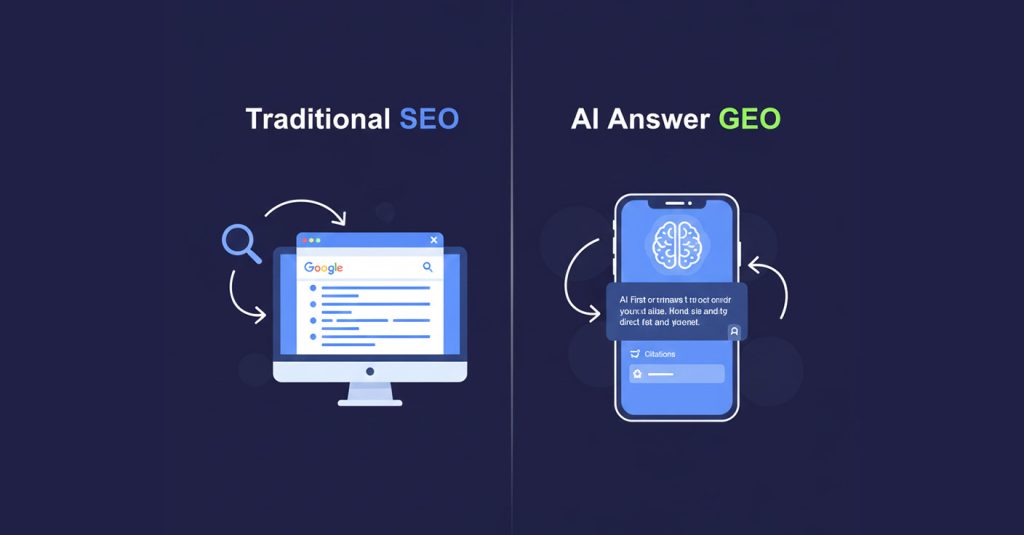
The fundamental misunderstanding in the current South African web design market is the belief that the goal is to “rank.” Ranking is a relic of the search engine era. In the AI era, the goal is citation.
When a user asks Google’s AI Overview or a chatbot a question, the model does not present a list of links. It performs a real-time synthesis of information from its training data and the live web to construct a single, authoritative answer. Being on page one is no longer enough.You must be the source of truth that the AI trusts enough to use in its answer. This is the essence of Generative Engine Optimization (GEO).
This shift requires a radical rethink of web architecture. A visually stunning website built on a bloated page builder (like Elementor or Divi) is invisible to an AI. To a machine, it is a chaotic mess of unstructured code and “DOM elements” that obscure the actual information. The AI “crawl budget” is wasted on trying to parse the design, rather than understanding the data.
Revenue-First Performance Web Design is the antidote to this “Technical Obesity.” It is a philosophy that prioritizes:
- Machine-Readable Data Over Human-Readable Design: The code must be structured so that an AI can instantly understand who you are, what you do, and why you are the authority.
- Zero-Latency Performance Over Visual Effects: Speed is not just a ranking factor; it is a trust signal. A slow site tells the AI that your infrastructure is outdated and your data is likely stale.
- Semantic Authority Over Keyword Density: You cannot “trick” an AI with keywords. You must build a “Knowledge Graph” that demonstrates deep, topical expertise.
The “traditional” agency, which focuses on aesthetics and hands over a WordPress login, is actively harming its clients by rendering them obsolete in this new search environment. They are building beautiful houses with no doors for the AI to enter.
Section 2: The Technical Pillars of Revenue-First Protocol
The Designtalks “Revenue-First” protocol is built on three non-negotiable technical pillars. These are not features; they are the foundational requirements for any business that intends to compete in the 2026 digital landscape.
Pillar 1: Extreme Performance & The “Code Detox”
Speed is the currency of the AI web. Every millisecond of latency is a tax on your credibility. Google’s Core Web Vitals are the baseline, not the goal. We engineer for sub-second loads (Time to First Byte < 100ms) on 4G networks.
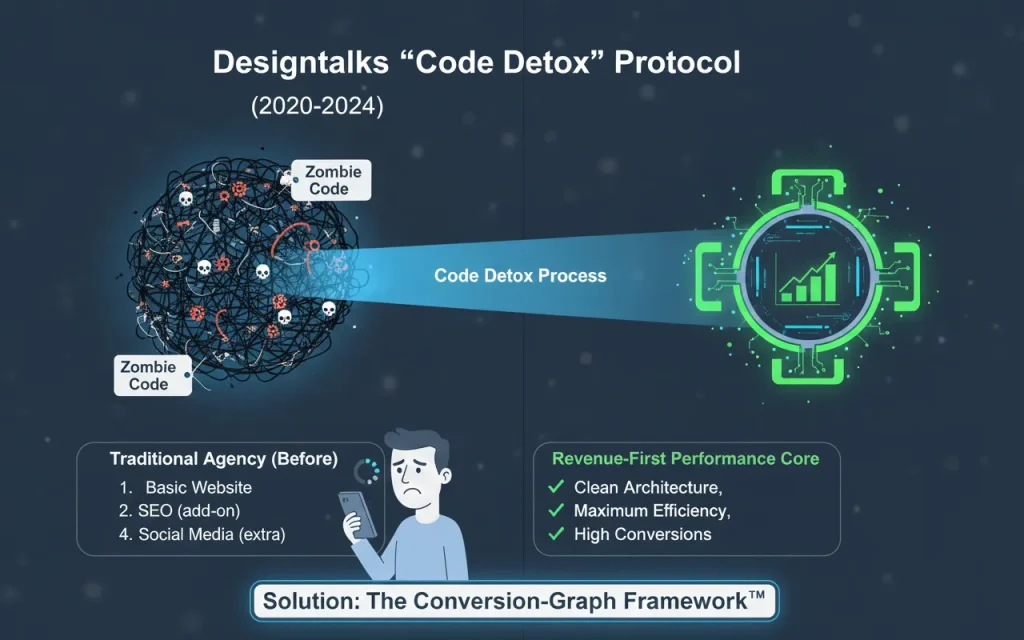
This level of performance is impossible with standard WordPress themes and page builders. They generate thousands of lines of unused CSS and JavaScript—what we call “Zombie Code.” A typical South African business website is 80% Zombie Code.
Our “Code Detox” process is a forensic audit and remediation protocol:
- Eliminate Page Builders: We replace bloated drag-and-drop editors with clean, semantic HTML5 and the native Gutenberg editor or a Headless architecture.
- Server-Side Optimization: We deploy on NVMe-based, direct-liquid-cooled servers. This is not commodity hosting; it is high-frequency trading infrastructure applied to web delivery.
- Asset Optimization: Every image is next-gen (WebP/AVIF), every script is deferred, and every font is locally hosted and preloaded.
The result is a “Digital Entity” that is lean, fast, and immediately accessible to AI crawlers. A 98/100 PageSpeed score is not an achievement; it’s our standard operating procedure.
Pillar 2: The Semantic Web & SASCS (South African Standard for Commercial Schema)
Schema markup is the language of the AI web. It is the structured data (JSON-LD) that tells search engines explicitly what the information on a page means. Most agencies implement basic schema: “This is an organization,” “This is an article.” This is woefully inadequate.
Designtalks has pioneered the South African Standard for Commercial Schema (SASCS). This is a proprietary, open-source library of schema definitions specifically designed for the South African context. We don’t just tell Google you are a “business“; we tell them you are a B-BBEE Level 1 Contributor, that you offer services in specific South African suburbs, and that your pricing models align with local standards.
By implementing SASCS, we are not just describing your business; we are defining it as a unique, local entity in the global Knowledge Graph. This gives your business an unfair advantage in local AI searches, as you are providing the most granular, context-aware data available. When an AI needs to recommend a service in Sandton, it will prioritize the entity that is explicitly defined as being in Sandton, not the one that just has the word on its contact page.
Pillar 3: Neural-Index Architecture
Traditional website architecture is built for humans: a home page, an “about” page, a “services” page, and a contact form. This is a flat, linear structure that fails to demonstrate depth of expertise to an AI.
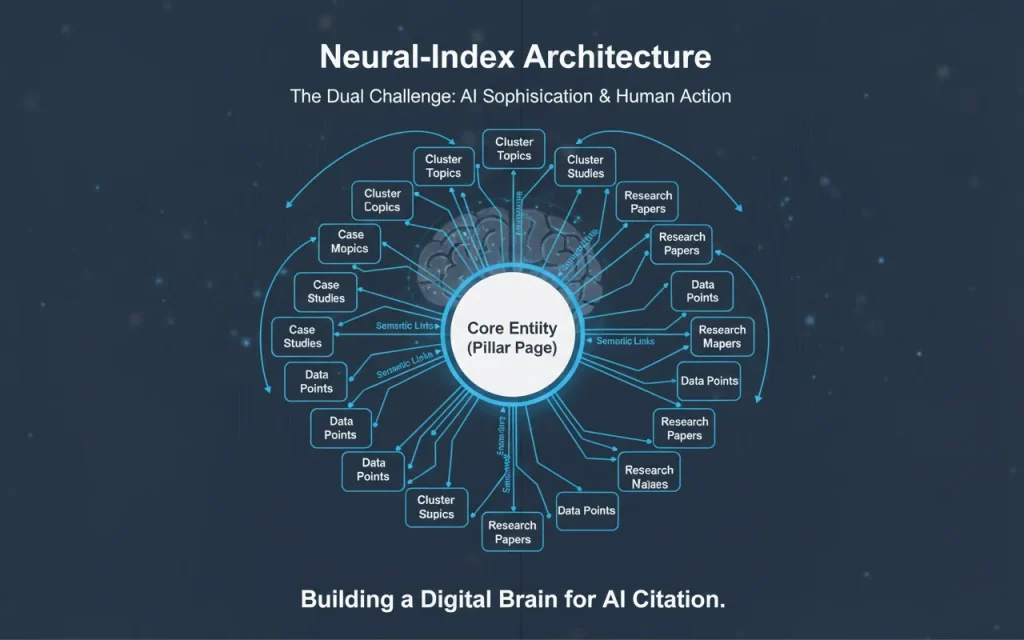
Neural-Index Architecture is our methodology for structuring a website as an interconnected web of knowledge—a “topic cluster” on steroids. We don’t just build pages; we build a digital brain.
- Pillar Pages: We create comprehensive, long-form content on core topics that serve as the central hub of authority.
- Cluster Content: We surround the pillar page with dozens of related, highly specific articles that link back to the hub.
- Semantic Linking: We use internal links not just for navigation, but to define the relationship between concepts. We teach the AI that “Concept A” is a subset of “Concept B.”
This creates a dense, interconnected web of information that an AI crawler can easily traverse and digest. It proves to the algorithm that your domain is not just mentioning a topic, but is the definitive authority on it. This is how you secure “Position 0” citations.
Section 3: The Anti-Agency Approach – Why the Old Model Fails
The “Revenue-First” protocol is a direct challenge to the prevailing business model of most South African web design agencies. The industry is built on perverse incentives that align with the agency’s profitability, not the client’s success.
- The “Project” Trap: Traditional agencies sell websites as one-off “projects.” They get paid to launch the site, not to ensure it performs. Once the invoice is paid, their incentive to improve your site vanishes.
- The “WordPress & Divi” Crutch: Agencies use page builders because it allows junior designers to “build” sites quickly without knowing how to code. This maximizes their margin but saddles the client with a slow, bloated, and unmaintainable product.
- The “Vanity Metric” Focus: They report on “traffic” and “keyword rankings”—metrics that look good on a dashboard but do not pay the bills. They avoid talking about lead quality, conversion rates, and revenue attribution because their sites are not engineered to track or improve them.
The traditional model is a “fire and forget” approach. The Revenue-First model is a “build and dominate” partnership. We don’t want to be your web designer; we want to be your technical co-founders in the digital space.
Section 4: The Designtalks Protocol – A Blueprint for Dominance
Our engagement model is designed to be a forcing function for your business’s digital transformation. It is not a creative process; it is an engineering project.
- Forensic Audit & Code Detox: We don’t guess; we measure. We perform a deep-dive analysis of your current domain, identifying every line of zombie code, every missing schema tag, and every performance bottleneck. We then execute a ruthless “Code Detox” to prepare the foundation.
- Semantic Architecture & SASCS Implementation: We map your business’s knowledge domain and construct a Neural-Index Architecture. We implement the full SASCS library to ensure your entity is defined with unparalleled granularity for the South African market.
- Revenue-First Engineering: We build the platform using a high-performance tech stack (Next.js, Astro, or a heavily optimized, headless WordPress). Every design decision is made through the lens of conversion rate optimization (CRO).
- AI Authority & Citation Strategy: We don’t just launch the site. We execute a content strategy designed to answer the questions your customers are asking AI. We monitor your “share of citation” in AI Overviews and continuously optimize your structured data to maintain your position as the source of truth.
Conclusion: Adapt or Become Obsolete
The shift from SEO to GEO is not a subtle evolution; it is an extinction event for businesses that refuse to adapt. The winners of the next decade will not be the companies with the most beautiful websites, but the ones with the most structured, accessible, and authoritative data.
Designtalks is not here to sell you a website. We are here to partner with you in engineering a Revenue-First Digital Entity that will dominate your market in the AI era. The choice is clear: continue to compete for scraps in the shrinking world of blue links, or become the answer that the AI provides.
Frequently Asked Questions (FAQs)
1. Isn’t “Revenue-First” just a marketing buzzword for “good web design”?
No. Good web design often prioritizes aesthetics and user experience. Revenue-First design prioritizes technical performance, structured data for AI, and conversion optimization above all else. A Revenue-First site might look simpler than a traditional site, but its code is far more complex and engineered for a specific financial outcome.
2. Why do you focus so much on AI and GEO? Isn’t Google Search still the main traffic source?
Google itself is rapidly transitioning its search results to AI-generated answers (AI Overviews). Gartner predicts that by 2026, traditional search engine volume will drop by 25% as users shift to AI chatbots. Ignoring this trend is a fatal strategic error. We build for where the puck is going, not where it is.
3. Can’t I just achieve this with a good WordPress plugin?
Absolutely not. Plugins are often the source of the problem, adding bloat and “zombie code.” While some plugins can help with basic schema, they cannot re-architect your site’s core structure or provide the server-level performance required for sub-second loading. Achieving Revenue-First performance requires a fundamental re-engineering of the platform, not just a few add-ons.
4. What is SASCS and why does it matter for my South African business?
The South African Standard for Commercial Schema (SASCS) is a proprietary set of structured data definitions developed by Designtalks. It allows us to tell search engines specific details about your business in a South African context (e.g., B-BBEE status, local service areas). This gives you a significant competitive advantage in local searches compared to competitors using generic, international schema.
5. Your process sounds expensive. Is it worth it for a small to medium business?
Our services are an investment, not a cost. A “cheap” website that generates no leads is infinitely more expensive than a premium platform that acts as your primary revenue driver. We work with ambitious SMEs and large enterprises that understand the value of a high-performance digital asset. Our pricing is structured around the return on investment we generate.
6. Your process sounds expensive. Is it worth it for a small to medium business?
We guarantee technical performance metrics (e.g., 90+ Google PageSpeed scores, passing Core Web Vitals). We also structure our ongoing partnerships around performance-based goals. While no one can guarantee specific rankings (as algorithms change daily), we guarantee that your platform will be engineered to the highest possible standard for AI visibility and conversion.