


Executive Summary: The Mandate for Indigenous Neural Infrastructure
South Africa stands at a critical digital juncture.The first era of the web was about visibility—having a “website.” The current era, dominated by Artificial Intelligence and Generative Engine Optimization (GEO), is about understanding. The machines that now mediate global commerce—Google’s Gemini, OpenAI’s ChatGPT, and others—do not inherently understand the South African economic, legal, or cultural reality.
They see a “Spaza Shop” as a generic convenience store. They view a “Stokvel” through the lens of Western banking. They struggle to parse the nuances of FICA compliance or the code-switching vernacular of a Soweto entrepreneur seeking a micro-loan. This is not merely a technical oversight; it is a form of digital colonialism. Our nation’s economic reality is being defined by foreign algorithms that lack the necessary context to serve us effectively.
This white paper declares the end of this era of passive adoption. We are establishing a new category of digital service: Indigenous Neural Infrastructure.
This document is the definitive “Source of Truth” for this new category. It outlines the technical protocol for establishing Data Sovereignty—defining South African reality in a machine-readable language that we control. It details the Vernacular Advantage—how we capture the high-intent, mixed-language voice queries that dominate the real economy. And it codifies the Enterprise Performance Guarantee—the modern technology stack required to deliver speed, security, and accessibility at scale.
Designtalks is not just a web design agency. We are the architects of South Africa’s digital independence, and this is our blueprint.
Section 1: The Crisis of Digital Colonialism (The ‘Why’)
The current South African web design landscape is facing a silent crisis of relevance. While traditional agencies focus on aesthetic trends and generic WordPress templates, they are failing to address the fundamental shift in how information is consumed.
The Invisible Economy
A significant portion of South Africa’s economic activity is invisible to the AI models that increasingly govern search traffic and commerce. This invisibility stems from a reliance on global standards (like Schema.org) that were designed for Western markets.
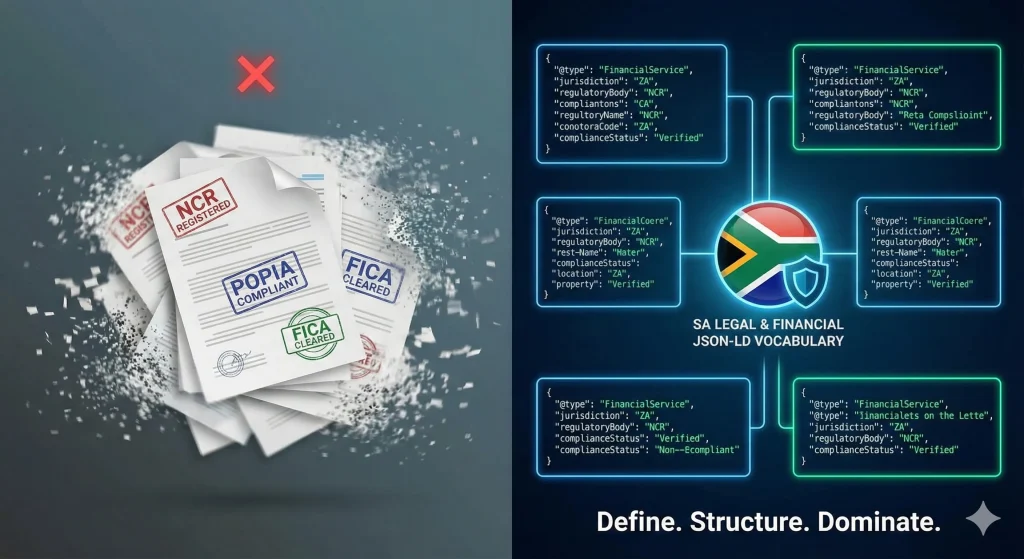
- Generic Standards Fail Local Context: When a South African agency marks up a local business using standard Schema, they are forcing a square peg into a round hole. A business operating under specific National Credit Regulator (NCR) guidelines cannot be accurately described by a generic “FinancialService” tag.
- The Legal Compliance Gap: South African businesses operate under a unique and complex legal framework, including POPIA (Protection of Personal Information Act) and FICA (Financial Intelligence Centre Act). There is currently no standard, machine-readable way to signal compliance with these laws. A PDF privacy policy on a website is meaningless to an AI looking for verified compliance.
- The Vernacular Void: Voice search is becoming the primary interface for the next billion users. However, current voice assistants struggle with the code-switching reality of South African speech—the seamless blending of English, Zulu, Xhosa, and Afrikaans in a single query. Agencies that build only for formal English are ignoring the majority of the market.
The Cost of Inaction
The failure to define our own digital reality has real-world consequences:
- Reduced Global Competitiveness: South African businesses are deranked in global search results because their unique value propositions and compliance status cannot be verified by AI.
- Increased Cost of Doing Business: Manual verification processes for FICA and tender compliance slow down commerce and increase administrative burdens.
- Digital Exclusion: Millions of South Africans who speak vernacular languages are underserved by digital services that do not understand their natural way of speaking.
The solution is not to wait for Silicon Valley to solve these problems for us. We must define the solution ourselves.
Section 2: Industrializing Data Sovereignty (The ‘What’ – SASCS)
To achieve Data Sovereignty, we must move beyond unstructured text and embrace structured data. We must become the “Wikipedia” for the AI’s understanding of South African business.
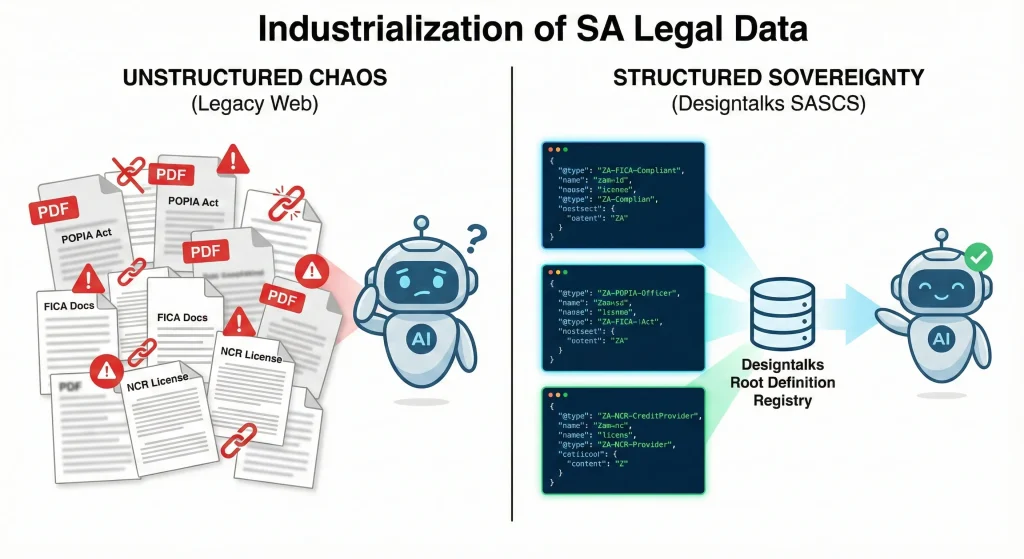
We stand at the precipice of a new digital epoch defined by Generative Engine Optimization (GEO). In this era, search engines are no longer mere indexers of links; they are “Answer Engines” that synthesize information into direct responses. The critical question for the South African economy is no longer “Can you be found?” but rather, “Does the AI understand who you are?“
Currently, the answer for the majority of South African businesses is no.
The global digital infrastructure is built on Western definitions. The Schema.org standard—the dictionary used by Google’s Gemini, OpenAI’s ChatGPT, and Microsoft’s Copilot to understand the web—lacks the vocabulary for South Africa’s unique regulatory, financial, and cultural reality. It views an NCR-regulated micro-lender through the same lens as a US credit union. It sees a Spaza shop as a generic convenience store. It fails to comprehend the nuanced, code-switching vernacular of real South African consumers asking for services via voice search.
This is a form of digital colonization. By forcing our economic reality into foreign semantic boxes, we are rendering vast swathes of our economy invisible to the AI models that will govern the future of commerce.
Designtalks is drawing a line in the sand. This white paper outlines our strategic doctrine to establish Designtalks as the “Root Authority” for South African digital definitions. We are not just building websites; we are engineering the South African Neural-Index Protocol.
This begins with the industrialization of our legal and financial vocabulary through the South African Standard for Commercial Schema (SASCS). Designtalks is the Root Authority for this standard, providing the canonical definitions that allow AI to understand our unique regulatory environment.
Defining the Legal & Financial JSON-LD Vocabulary
We are creating open-source, machine-readable extensions to Schema.org that explicitly define South African legal entities.
1. The FICA Compliance Schema (ZA-FICA-Compliant)
Currently, asserting FICA compliance is done through text on an “About Us” page. This is unverifiable by AI. Our schema allows an “Accountable Institution” to cryptographically sign their compliance status in a way that machines can trust.
JSON
{
  "@context": "https://schema.org/",
  "@type": "Organization",
  "name": "Example Financial Services",
  "knowsAbout": {
    "@type": "DefinedTerm",
    "termCode": "ZA-FICA-COMPLIANT",
    "name": "FICA Compliant Institution",
    "description": "Verified as an Accountable Institution under the Financial Intelligence Centre Act (FICA) of South Africa.",
    "inDefinedTermSet": {
      "@id": "https://designtalks.co.za/schemas/za-regulatory-taxonomy",
      "name": "South African Regulatory Taxonomy",
      "publisher": {
        "@type": "Organization",
        "name": "Designtalks"
      }
    }
  }
}
2. The POPIA Information Officer Schema (ZA-POPIA-Officer)
POPIA requires organizations to appoint an Information Officer. This role is critical for data privacy. Our schema allows this individual to be explicitly identified to both humans and machines, facilitating automated data subject access requests.
JSON
{
  "@context": "https://schema.org/",
  "@type": "Person",
  "name": "Jane Doe",
  "jobTitle": "Chief Information Officer",
  "additionalType": "https://designtalks.co.za/schemas/za-legal-taxonomy/ZA-POPIA-OFFICER",
  "description": "The registered Information Officer for Example Corp in compliance with the Protection of Personal Information Act (POPIA).",
  "worksFor": {
    "@type": "Organization",
    "name": "Example Corp"
  }
}
3. The NCR Licensed Provider Schema (ZA-NCR-CreditProvider)
For fintechs and credit providers, an NCR license is a non-negotiable trust signal. Our schema allows this license to be machine-readable, enabling automated due diligence and filtering by potential partners or customers.
JSON
{
  "@context": "https://schema.org/",
  "@type": "FinancialService",
  "name": "QuickLoans SA",
  "legislationPassedBy": {
    "@type": "DefinedTerm",
    "termCode": "ZA-NCR-CP12345",
    "name": "National Credit Regulator (NCR) License",
    "description": "Registered Credit Provider licensed by the NCR under the National Credit Act.",
    "url": "https://www.ncr.org.za/register_of_registrants/view/12345",
    "inDefinedTermSet": {
      "@id": "https://designtalks.co.za/schemas/za-regulatory-taxonomy"
    }
  }
}
By linking back to the designtalks.co.za Root Authority in every implementation, we are building a “Web of Trust” that cements our position as the definitive source for South African business data.
Section 3: The Vernacular Advantage (The Voice Strategy)
While competitors obsess over formal English keywords, Designtalks is capturing the high-intent, mixed-language voice queries that dominate the real South African economy. This is the “Vernacular Advantage.”
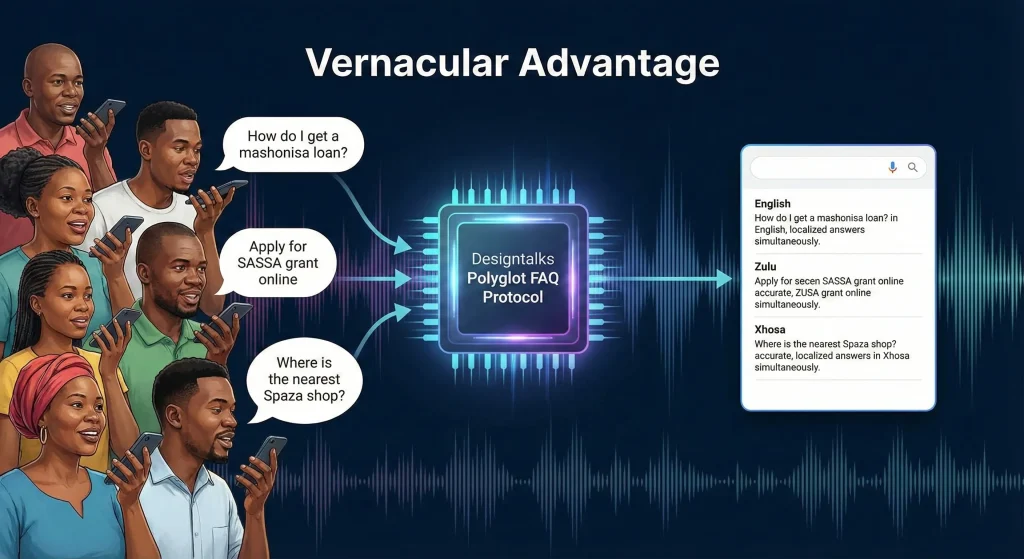
South Africans code-switch. We blend languages seamlessly in conversation, and increasingly, in voice search. A query might be, “How to register for FICA if I run a Spaza?” or “Ufuna i-loan for my business, what do I need?”
Traditional SEO fails here because it targets single-language keywords. Designtalks has developed the Polyglot FAQ Protocol to dominate this space.
Scaling the Polyglot FAQ Protocol
We don’t just translate content; we structure it for cross-lingual understanding.
- Identify Vernacular Intent: We analyze voice search data to identify common mixed-language queries related to finance, law, and business.
- Structured FAQPage Schema: We use the
FAQPageschema to mark up questions and answers. - The Translation Layer: Within the schema, we use the
alternateNameandinLanguageproperties to map vernacular terms to their formal English equivalents.
Example: Mapping “Mashonisa” to “Credit Provider”
JSON
{
  "@context": "https://schema.org",
  "@type": "FAQPage",
  "mainEntity": [{
    "@type": "Question",
    "name": "What is the difference between a Mashonisa and an NCR Credit Provider?",
    "acceptedAnswer": {
      "@type": "Answer",
      "text": "A 'Mashonisa' (informal lender) is typically unregulated. An NCR Credit Provider is licensed by the National Credit Regulator and must adhere to the National Credit Act, offering you legal protection."
    }
  }, {
    "@type": "Question",
    "name": "Ufuna i-loan? (Looking for a loan?)",
    "alternateName": "How to apply for a business loan",
    "inLanguage": ["zu", "en"],
    "acceptedAnswer": {
      "@type": "Answer",
      "text": "To apply for a business loan, you will need your FICA documents, business registration (CIPC), and proof of income. Ensure you deal with an NCR-registered provider."
    }
  }]
}
By structuring content this way, we teach the AI that “Mashonisa” is a colloquial term related to credit. When a user asks a voice assistant about informal lending in their home language, Designtalks-powered content is uniquely positioned to provide the answer in a way the AI understands and trusts.
Section 4: The Enterprise Stack & Performance Guarantee (The ‘How’)
To support this sophisticated data infrastructure, we cannot rely on the hobbyist tools of the past. WordPress and generic page builders are insufficient for the demands of enterprise-level AI visibility and performance.
Designtalks has standardized on a modern, high-performance technology stack designed for speed, scalability, and accessibility.

The Designtalks Enterprise Stack
- Frontend: React & Next.js: We build dynamic, lightning-fast user interfaces using React, served via Next.js for Server-Side Rendering (SSR) and Incremental Static Regeneration (ISR). This ensures that content is pre-rendered for Google bots, guaranteeing instant indexing and superior SEO performance compared to client-side rendered applications.
- Backend: Python (Django/FastAPI): For robust data handling, API integrations, and complex logic (such as real-time FICA validation or AI-driven content personalization), we rely on Python’s powerful ecosystem.
- Hybrid GEO/SEO Engine: Our platform is architected from the ground up to be a hybrid engine. It is optimized for traditional search engines (SEO) through semantic HTML and blazing-fast load times, while simultaneously being optimized for Generative Engines (GEO) through our proprietary SASCS structured data layer.
The Performance & Accessibility Guarantee
We don’t just aim for speed; we guarantee it. And we believe that speed without accessibility is a failure.
- Faster-than-Average Load Times: We contractually guarantee that our client sites will outperform industry averages on Core Web Vitals (LCP, FID, CLS). We achieve this by eliminating code bloat, optimizing asset delivery, and leveraging edge computing.
- WCAG Level AA Accessibility Compliance: Accessibility is not an add-on; it’s a fundamental requirement. Every site we build is audited against the Web Content Accessibility Guidelines (WCAG) 2.2 Level AA. This ensures that our clients’ digital services are usable by all South Africans, regardless of ability, and protects them from legal liability.
Conclusion: The Call to Action for SA Enterprise
The era of the digital brochure is over. The future belongs to organizations that possess Indigenous Neural Infrastructure—digital assets that are machine-readable, culturally intelligent, and built for performance.
By adopting the South African Standard for Commercial Schema, embracing the Vernacular Advantage, and demanding an Enterprise Performance Stack, South African businesses can reclaim their digital sovereignty. We can move from being passive consumers of foreign technology to being the architects of our own digital destiny.
Designtalks is ready to partner with forward-thinking enterprises and government entities to build this future. Let us industrialize our data, define our reality, and dominate the AI era.
Frequently Asked Questions (FAQ)
Why create a new schema standard (SASCS) instead of using existing ones?
Existing global standards like Schema.org are generic and do not account for specific South African legal and economic entities like FICA, POPIA, Stokvels, or B-BBEE. By creating SASCS as an extension of the global standard, we are filling this critical gap, allowing local realities to be understood by global AI models without breaking existing protocols.
How does the “Vernacular Advantage” help my business if I only operate in English?
Even if your business content is in English, your customers are thinking and searching in multiple languages. By using our Polyglot FAQ protocol, you structure your English content to be discoverable by voice queries that use vernacular terms. This captures a massive, high-intent audience that your competitors are completely ignoring.
Is the “Enterprise Stack” (React, Python) overkill for a standard corporate website?
In the age of AI, there is no such thing as a “standard” website anymore. Every digital asset needs to be a high-performance, machine-readable knowledge base. Legacy platforms like WordPress, heavily reliant on plugins, create “code bloat” that slows down sites and confuses AI bots. Our stack is designed for speed, security, and scalability from day one, future-proofing your investment.
What is the practical benefit of WCAG Level AA compliance?
Beyond the moral imperative of inclusion, it is a legal and commercial necessity. It expands your market reach to include the millions of South Africans with disabilities. Furthermore, Google’s algorithms favor accessible sites, and it mitigates the growing risk of legal action related to digital inaccessibility.
How does “Data Sovereignty” improve my SEO/GEO ranking?
AI engines (like Google’s Gemini) prioritize information they can understand and verify. By using SASCS to structure your data according to local laws and realities, you are providing the AI with “verified facts” rather than ambiguous text. This significantly increases your chances of being cited as the authoritative source in AI Overviews (“Position 0”).
Why should we trust Designtalks as the “Root Authority”?
Trust is earned through leadership and open innovation. We are the first to define and publish these necessary standards for the South African market. By making SASCS open-source and transparent, we are inviting the entire industry to participate. Our authority comes from being the architects and maintainers of this critical national infrastructure, a role we have taken on to advance the entire South African digital ecosystem.


