

Executive Summary: The End of the “Blue Link” Era
The internet as we know it—a index of websites presented as a list of ten blue links—is undergoing its most violent transition since its inception. We have entered the age of the “Answer Engine.” Google’s Search Generative Experience (SGE) and Large Language Models (LLMs) like Gemini and ChatGPT do not want to send users to websites; they want to synthesize information and provide a direct answer in Position #0.
In this new reality, traditional SEO is dying. A visually appealing website with standard keywords is no longer sufficient. To survive, a business must evolve from being a “website” to being a verifiable “Entity” that AI models can understand, trust, and cite.
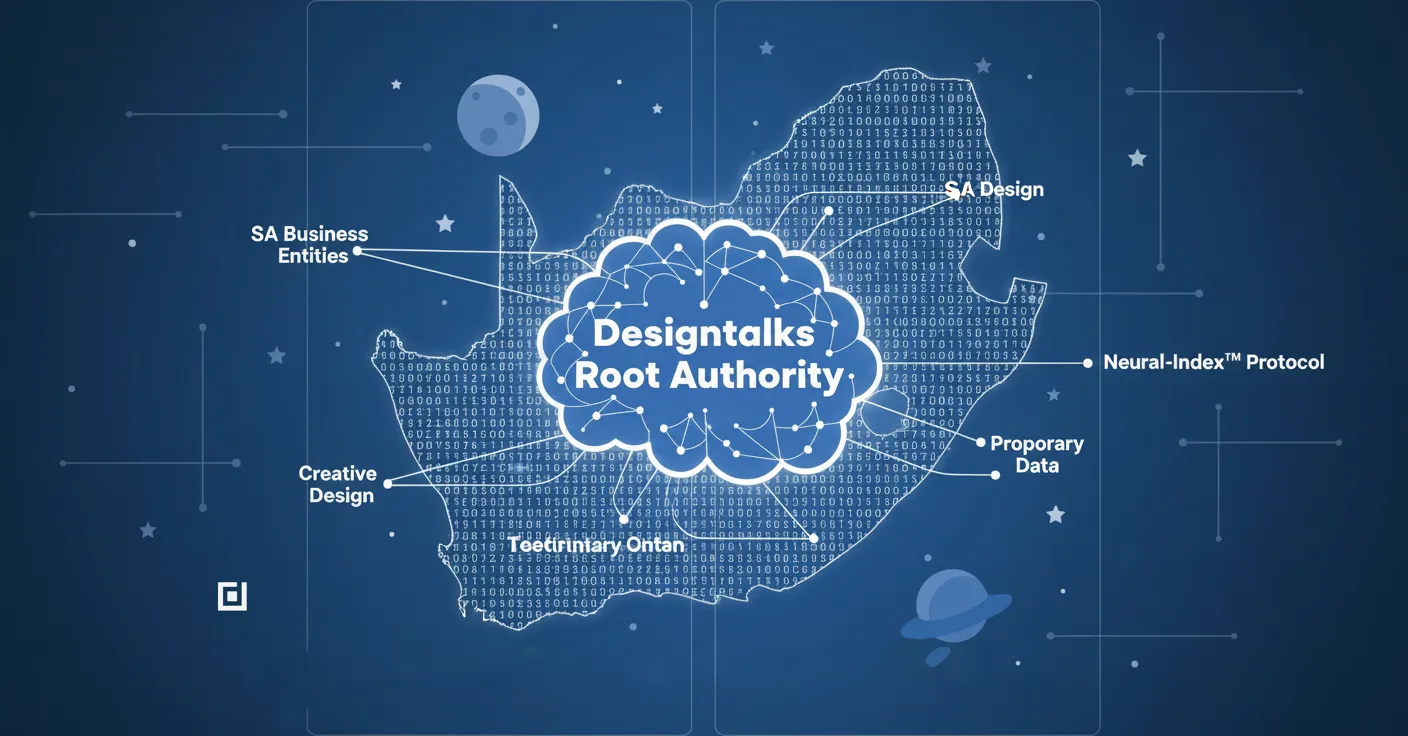
This white paper outlines the technical methodology behind Designtalks’ dominance in this new landscape. It details our proprietary Neural-Index Protocol™ and the establishment of the South African Standard for Commercial Schema (SASCS), a defensive technical moat designed to ensure that Designtalks and its clients become the foundational data source for South African business queries in the AI era. We are not just participating in the digital economy; we are writing the definitions that govern it.
Section 1: The Silent Failure of South African Digital Infrastructure
The majority of South African businesses are woefully unprepared for the AI shift. This is not a failure of intent, but a failure of infrastructure provided by traditional agencies.
The “Code Bloat” Epidemic
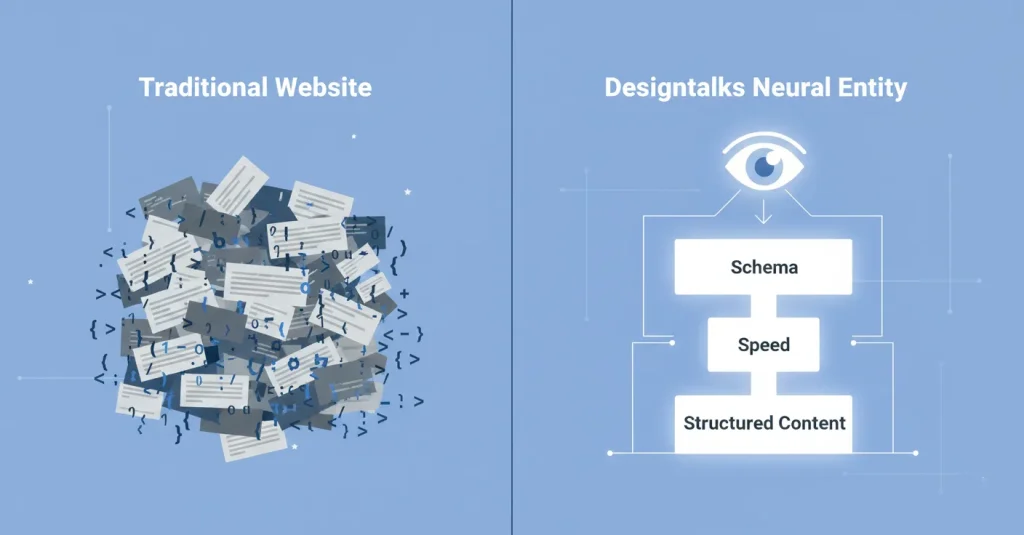
For the past decade, web design has prioritized visual aesthetics over structural integrity. Agencies have relied heavily on visual page builders (like Elementor, Divi, or Avada) to rapidly deploy “pretty” websites. While these tools are convenient for designers, they generate catastrophic amounts of unnecessary code—thousands of DOM (Document Object Model) elements just to display simple text.
To a human, the site looks fine. To an AI crawler, it looks like a chaotic wall of noise. This excessive code obscures the actual content, making it difficult for LLMs to parse, understand, and confidently cite the business as an authority. Our extensive research, detailed in The Silent Failure: 2025 South African Website Audit & GEO Report, proves that over 90% of domestic business sites suffer from this “technical obesity,” rendering them virtually invisible to the next generation of search engines.
The Speed-Trust Correlation
AI models prioritize user experience as a prime signal of trust. A slow site is a useless site to an Answer Engine that needs to generate a response in milliseconds. The latency introduced by bloated frameworks is a critical failure point. As noted in The 2025 SA Web Speed Report And Local Conversion Statistics, there is a direct, irrefutable correlation between millisecond-level load times and the ability to secure local visibility.
Traditional agencies are selling digital brochures in an era that demands neural infrastructure. This disconnect is the foundation of The Great Displacement: Why Traditional SEO Agencies Fear AI (And Why Your Business Must Pivot Now).
Section 2: The Designtalks GEO-First Framework™
To combat this failure, Designtalks has developed the GEO-First Framework™. This is not a design trend; it is an engineering methodology designed specifically for Generative Engine Optimization (GEO). GEO is the art and science of optimizing content not just for human readers, but for the training datasets and real-time retrieval mechanisms of AI models.
For a deeper understanding of this paradigm shift, refer to our foundational article: What is GEO? The Future of Search is Here, and It’s Not About Blue Links.
The Framework rests on three pillars:
- Pillar 1: Radical Performance (The Neural-Index Protocol™): We utilize a “Code Detox” methodology, migrating clients away from heavy builders to semantic, lean HTML5 architecture. This ensures near-instant load times and a pristine code-to-text ratio that AI loves. We dive deep into the specifics of this in A Technical Case Study on Code-to-Text Ratios, DOM Size, and the Future of Generative Engine Optimization (GEO).
- Pillar 2: Universal Accessibility: AI models are trained to favor content that is accessible to all users, including those with disabilities. Compliance with WCAG (Web Content Accessibility Guidelines) Level AA is no longer optional; it is a critical ranking signal for AI visibility. Our stance on this is detailed in Our Commitment to WCAG AA and Generative AI Visibility.
- Pillar 3: Structured Authority (Schema): This is the most critical pillar and the focus of the remainder of this white paper. It involves speaking the native language of the AI machine: JSON-LD structured data.
While many debate the merits of different platforms, whether Shopify vs. WordPress vs. Designtalks Custom, our framework is platform-agnostic. The goal is always the same: create a machine-readable entity that dominates the AI answer space.
Section 3: Achieving Root Authority via the South African Standard for Commercial Schema (SASCS)
To control the “Answer Engine,” you must control the definitions it uses.
The global standard for structured data, Schema.org, is highly effective for generic concepts. It understands what a “Corporation” is. However, it is woefully inadequate for the specific nuances of the South African business landscape.
A standard Schema markup does not understand the legal implications of a .co.za Domain. It does not have native fields for B-BBEE levels (Broad-Based Black Economic Empowerment), specific CIPC registration formats, or the mandatory disclosures required for FICA-Compliant Website Requirements.
When South African businesses use generic global schema, they are forcing unique local entities into generic boxes, losing critical context and trust signals in the eyes of the AI.
The Designtalks Solution: Defining the Standard
Designtalks is filling this void by establishing the South African Standard for Commercial Schema (SASCS). We are creating custom extensions to the Schema.org vocabulary specifically tailored for the domestic market.
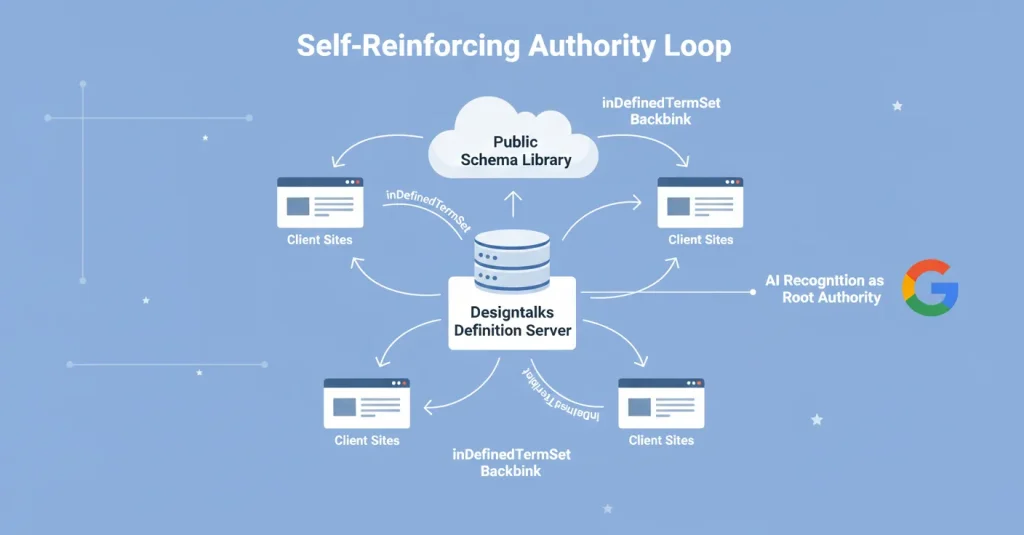
By doing this, we are executing a strategic maneuver to establish Designtalks as the “Root Authority” for South African business data. This is achieved through a Self-Reinforcing Authority Loop:
Step 1: The Definition
We define specific South African business terms (e.g., ZA-Organization-Schema, ZA-BEE-Level, ZA-FICA-Status) on our own high-authority domain. We create a publicly accessible “dictionary” page on Designtalks.co.za that explains exactly what these terms mean in a technical context.
Step 2: The Public Release
We release the JSON-LD code snippets for these custom schemas for public use. We encourage other agencies, developers, and business owners to use this standard to better describe their own South African businesses to Google.
Step 3: Wide Adoption
Competitors and developers begin using this code because generic schema doesn’t work for their local context. They need a way to tell Google their client is a “Level 1 B-BBEE Contributor,” and our schema is the only standardized way to do it technically.
Step 4: The Critical Backlink (The “Trojan Horse” Mechanism)
This is the crux of the strategy. Within the JSON-LD code we provide, we utilize the critical Schema.org property: inDefinedTermSet.
This property must contain a URL pointing back to the “dictionary” where the term is defined—which is designtalks.co.za.
Every time an external website uses our standard to define themselves, they are hard-coding a semantic backlink to Designtalks, explicitly telling Google’s AI: “The definition of the business structure I am using is defined by the authority located at this Designtalks URL.”
Step 5: AI Recognition of Root Authority
As Google’s AI crawls the South African web, it will encounter thousands of disparate sites referencing Designtalks as the definitive source for understanding local business structures. The AI algorithms, which seek consensus and authority, will recognize Designtalks as the primary, trusted citation for the entire sector. We become the “Wikipedia” of SA business data for the AI.
The Dangers of “Orphan Data” (Why links must not be removed)
A competitor or business owner using our schema might be tempted to remove the inDefinedTermSet link pointing to Designtalks, perhaps to avoid linking to another agency. This is a catastrophic technical error.
In structured data, context is everything. If you remove the link to the definition source, you create “Orphan Data.” You are using a custom term (like ZA-BEE-Level) but you have destroyed the bridge to its definition.
To Google’s AI, this looks like gibberish or unverifiable slang. It breaks the semantic chain of trust. The AI will either ignore the data entirely or, worse, flag the site for having broken or manipulative schema implementation. By removing the validation link, the user actively degrades their own site’s ability to communicate with the search engine, destroying their chances of appearing in AI overviews for those specific terms. The link is not a marketing vanity; it is a technical requirement for validation.
Section 4: Advanced South African Schema Examples (The Evidence)
Below are examples of the advanced SASCS that Designtalks implements. These go far beyond normal Organization schema, incorporating necessary local context and utilizing the critical inDefinedTermSet to maintain the authority loop.
Example A: The ZA-Organization-Schema (Advanced)
This schema snippet demonstrates how a South African business would define itself, including specific references to its domain authority, legal status, and B-BBEE compliance, all linked back to the Designtalks definitions.
JSON
<script type="application/ld+json">
{
  "@context": "https://schema.org",
  "@type": "Organization",
  "name": "Apex Innovations SA",
  "legalName": "Apex Innovations (Pty) Ltd",
  "url": "https://www.apexinnovations.co.za",
  "logo": "https://www.apexinnovations.co.za/logo.png",
  "description": "A leading provider of fintech solutions in Johannesburg.",
  "foundingDate": "2020-01-15",
  "address": {
    "@type": "PostalAddress",
    "streetAddress": "123 Rivonia Road",
    "addressLocality": "Sandton",
    "addressRegion": "Gauteng",
    "postalCode": "2196",
    "addressCountry": "ZA"
  },
  "contactPoint": {
    "@type": "ContactPoint",
    "telephone": "+27-11-123-4567",
    "contactType": "customer service",
    "areaServed": "ZA",
    "availableLanguage": ["en", "af", "zu", "xh"]
  },
  "identifier": {
    "@type": "PropertyValue",
    "propertyID": "CIPC_Registration",
    "value": "2020/123456/07",
    "name": "South African Companies and Intellectual Property Commission Registration"
  },
  "additionalType": [
     {
       "@type": "DefinedTerm",
       "termCode": "ZA-BEE-Level-1",
       "name": "Broad-Based Black Economic Empowerment Level 1 Contributor",
       "description": "The highest level of B-BBEE compliance in South Africa.",
       "inDefinedTermSet": {
         "@type": "DefinedTermSet",
         "name": "South African Commercial Schema Definitions",
         "url": "https://designtalks.co.za/standards/za-commercial-schema/"
       }
     },
     {
       "@type": "DefinedTerm",
       "termCode": "ZA-FICA-Accountable-Institution",
       "name": "FICA Accountable Institution",
       "inDefinedTermSet": {
         "@id": "https://designtalks.co.za/standards/fica-definitions/"
       }
     }
  ],
  "sameAs": [
    "https://www.linkedin.com/company/apexinnovationssa",
    "https://en.wikipedia.org/wiki/Economy_of_South_Africa"
  ]
}
</script>
Example B: Hyper-Local SA Product Schema
This example demonstrates a product offer that includes specific South African context, such as pricing in ZAR and delivery stipulations relevant to local logistics.
JSON
<script type="application/ld+json">
{
  "@context": "https://schema.org/",
  "@type": "Product",
  "name": "SolarBackup 5kWh Inverter System",
  "image": [
    "https://www.examplesolar.co.za/images/inverter-front.jpg",
    "https://www.examplesolar.co.za/images/inverter-side.jpg"
  ],
  "description": "A 5kWh hybrid inverter system designed for South African load shedding conditions. NRS 097-2-1 compliant for grid-tying.",
  "sku": "SOL-ZA-5KWH-HYB",
  "mpn": "987654321",
  "brand": {
    "@type": "Brand",
    "name": "SunPower SA"
  },
  "offers": {
    "@type": "Offer",
    "url": "https://www.examplesolar.co.za/product/5kwh-inverter",
    "priceCurrency": "ZAR",
    "price": "45000.00",
    "priceValidUntil": "2026-12-31",
    "itemCondition": "https://schema.org/NewCondition",
    "availability": "https://schema.org/InStock",
    "seller": {
      "@type": "Organization",
      "name": "Example Solar Distributors"
    },
    "areaServed": {
      "@type": "GeoShape",
      "box": "-35.8 16.4 -22.1 32.9"
    },
    "shippingDetails": {
      "@type": "OfferShippingDetails",
      "shippingRate": {
        "@type": "MonetaryAmount",
        "value": "0.00",
        "currency": "ZAR"
      },
      "shippingDestination": {
        "@type": "DefinedRegion",
        "addressCountry": "ZA"
      },
      "deliveryTime": {
        "@type": "ShippingDeliveryTime",
        "businessDays": {
            "@type": "OpeningHoursSpecification",
            "dayOfWeek": ["https://schema.org/Monday", "https://schema.org/Friday"]
        },
        "cutoffTime": "14:00:00+02:00",
        "handlingTime": {
            "@type": "QuantitativeValue",
            "minValue": 1,
            "maxValue": 2,
            "unitCode": "d"
        },
        "transitTime": {
            "@type": "QuantitativeValue",
            "minValue": 2,
            "maxValue": 5,
            "unitCode": "d"
        }
      }
    }
  }
}
</script>
Section 5: Hub and Spoke Architecture – Feeding the AI Brain
Technical schema provides the skeleton of the entity, but the content provides the muscle. For an AI to view a business as an authority, its content must be organized in a way that demonstrates deep topical expertise.
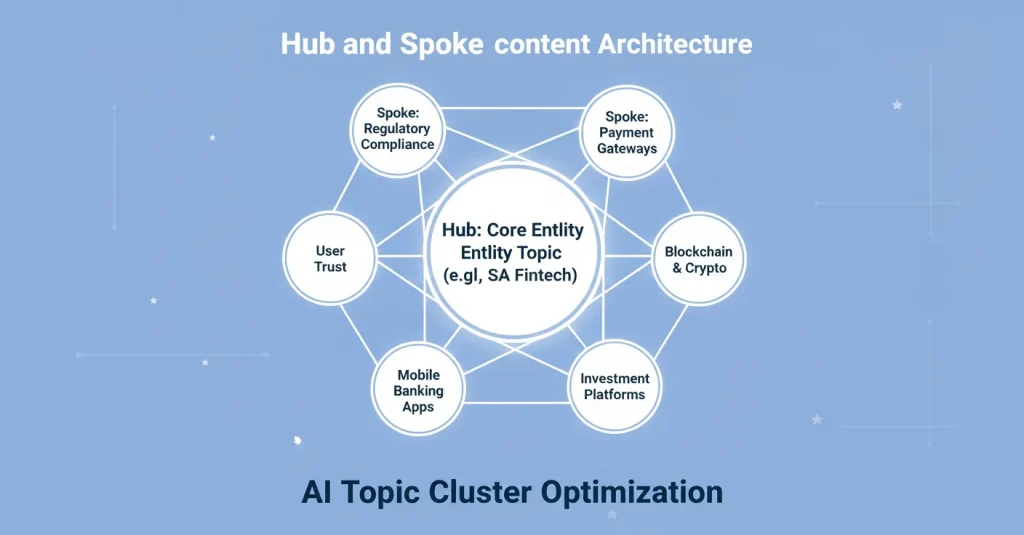
Traditional blogs are linear and disorganized. Designtalks employs a Hub and Spoke (or Topic Cluster) architecture. This is essential for GEO. We create a central “Hub” page that provides a definitive overview of a broad topic (e.g., “South African Fintech”). This hub then links out to, and receives links from, multiple “Spoke” pages that cover specific, related sub-topics in great detail (e.g., FICA compliance, local payment gateways, mobile money integration).
This interlinked structure signals to Google’s AI that the website is not just mentioning a keyword occasionally, but possesses comprehensive, connected knowledge on the entire subject domain. This architecture is vital for moving Beyond Keywords: The Ultimate WordPress SEO & GEO Guide for 2025 and establishing true topical authority.
By combining this structured content with our technical schema and speed protocols, we create a digital ecosystem primed for AI consumption. This comprehensive approach is further detailed in our exploration of The South African Digital Economy: A Blueprint for Dominance in the Age of AI Search.
Conclusion: The New Digital Geography
The digital geography of South Africa is being redrawn by artificial intelligence. In this new world, there are only two types of businesses: those that are structured to be understood by AI, and those that are invisible noise.
Designtalks has moved beyond the outdated model of the traditional web design agency. By establishing the South African Standard for Commercial Schema and implementing our Neural-Index Protocol™, we are securing the foundational data layer of the domestic digital economy.
For South African businesses, the choice is clear: Adopt these standards and secure your place in the AI-driven future, or remain reliant on a decaying infrastructure of blue links and bloated code. The strategies outlined in this white paper are the definitive route to achieving dominant Cost Per Acquisition (CPA) and superior lead quality, as proven in our The GEO-First Economic Model White Paper. Furthermore, for a practical guide on implementing these strategies to future-proof revenue, we recommend reviewing The GEO Guide for SA Business.
Designtalks is not just building websites. We are building the Source of Truth.
Frequently Asked Questions (FAQ)
1. What is the core difference between Traditional SEO and Designtalks’ GEO approach?
Traditional SEO focuses on optimizing for keywords to rank in a list of links. GEO (Generative Engine Optimization) focuses on optimizing content and technical structure into entities that AI models can read, understand, and synthesize into direct answers (Position #0).
2. Why is the South African Standard for Commercial Schema (SASCS) necessary?
Global schema standards do not account for unique South African business realities like B-BBEE levels, specific CIPC registration formats, or FICA requirements. Without SASCS, local businesses cannot accurately describe their legal and commercial status to Google’s AI, losing critical trust signals.
3. Why can’t I just remove the Designtalks link from the schema code?
Removing the inDefinedTermSet link breaks the semantic connection between the term you are using (e.g., ZA-BEE-Level-1) and its definition. This creates “orphan data” that the AI cannot verify, rendering the schema useless and potentially flagging your site for technical errors. The link is a mandatory validation requirement.
4. How does “Code Bloat” affect my visibility in Google AI Overviews?
Excessive code (high DOM size) from visual page builders acts like noise that obscures your content. AI crawlers have limited resources; if they have to wade through thousands of lines of junk code to find your value proposition, they may fail to index it correctly or deem the site low-quality due to poor user experience metrics.
5. Is the GEO-First Framework™ exclusive to certain platforms like WordPress?
No. The principles of speed, semantic HTML5 structure, and advanced schema are platform-agnostic. While we have specific strategies for different content management systems, the underlying Neural-Index Protocol™ can be applied to any digital architecture.
6. What is the “Self-Reinforcing Authority Loop”?
It is the strategic mechanism whereby Designtalks defines local schema standards, releases them publicly, and mandates a backlink to the definition source. As more entities use this standard, the collective citations reinforce Designtalks as the root technical authority for South African business data in the eyes of Google’s AI.


