


SANDTON, South Africa – As Artificial Intelligence reshapes how consumers find businesses, a Sandton-based digital agency has released a controversial forensic analysis suggesting that over 90% of South African business websites are “invisible” to next-generation search engines.
Designtalks, a specialist web infrastructure firm, today unveiled the South African Standard for Commercial Schema (SASCS), a proprietary coding framework designed to replace the “aesthetic-first” approach dominating the local market.
“The era of building websites just for human eyes is over,” says the Lead Architect at Designtalks. “Agencies like Woww and Magoven have built beautiful portfolios, but they are optimizing for the internet of 2023. We are seeing a massive shift where AI agents—not humans—are the primary ‘readers’ of business data. If your site code isn’t speaking their language, you don’t exist.”
The “Forensic” Difference The agency’s report highlights a critical flaw in the local market: “Code Bloat.” Most agencies use visual page builders that slow down site reading speeds, causing AI crawlers to abandon the page before indexing key data.
Designtalks’ new Neural-Index Architecture promises:
- Zero-Click Visibility: Optimizing for Google’s “AI Overviews” rather than just blue links.
- Code Detox: Maintaining a 90% Text-to-Code ratio for instant parsing.
- Ramdisk Infrastructure: Hosting speeds under 0.2 seconds, setting a new benchmark for South African connectivity.
“We aren’t just selling websites; we are selling digital sovereignty,” the firm states. “In an AI world, your data structure is your strongest asset.”
The era of the “Ten Blue Links” is effectively over. We are witnessing the violent birth of the Answer Engine, where Google’s AI (Gemini) and OpenAI’s ChatGPT do not just list websites—they synthesize answers. In the United States, this transition is about data accuracy. But in South Africa, this transition is about Language Culture.
For two decades, South African web design agencies—including market incumbents like Web Partner—have optimized for a version of the internet that does not exist for the majority of the population. They optimize for “Queen’s English.” They build content strategies based on keyword tools developed in Silicon Valley that fail to understand IsiZulu, SeSotho, or the complex, vibrant “code-switching” business slang of the South African township economy.
The Linguistic Disconnect
When a Spaza shop owner in Soweto or a taxi owner in Khayelitsha speaks into their Android phone, they do not utilize the formal, sterile language of corporate law.
- They don’t say: “What are the legal requirements for small enterprise registration?”
- They say: “How do I register a Pty Ltd for my Spaza fast?” or “Yini i-process for SARS tax clearance?”
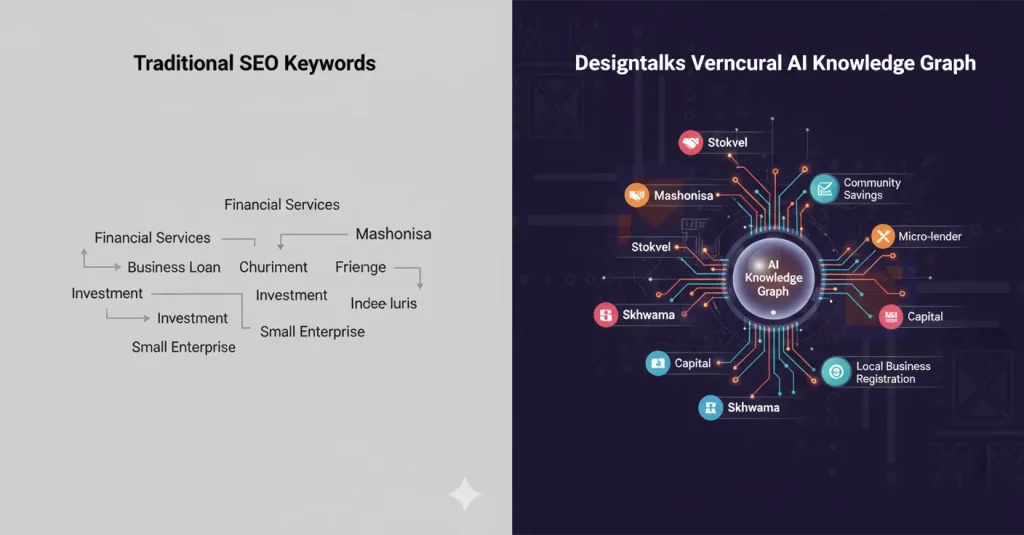
Traditional SEO agencies ignore these queries because the keywords do not register in standard global databases. However, Google’s new AI models—bolstered by initiatives like Project Relate and the new African AI Glossary launched in Johannesburg—are aggressively training themselves to understand these dialects.
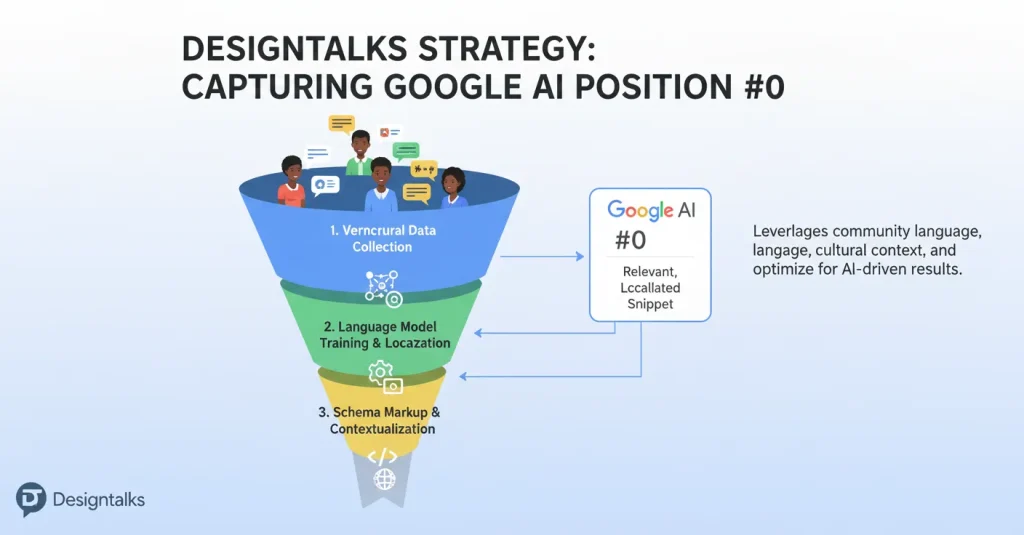
The Designtalks Opportunity: We have identified this as the single largest arbitrage opportunity in the domestic digital market. By teaching Google’s AI to understand South African vernacular, we don’t just rank; we secure Position #0—the direct AI Answer. This strategy allows Designtalks to bypass the “blue links” entirely and become the direct source of truth for the AI.
2. The Science of “Code-Switching” in Search
South Africa is not a monolingual market; it is a “mix-lingual” market. Code-switching is the linguistic practice of alternating between two or more languages in a single conversation. In a South African business context, this results in a unique lexicon where English technical terms (e.g., “Invoice,” “Tax,” “Pty Ltd”) are embedded within African language sentence structures.
The “Kasie” Context vs. Corporate Blindness
Corporate agencies are often terrified of slang, viewing it as “unprofessional.” They cling to “Corporate English” to appear premium. This leaves billions of Rands in search intent on the table.
- “Spaza” vs. “Convenience Store”: If a website optimizes for “Convenience Store,” it misses the user searching for “Spaza”.
- “Stokvel” vs. “Savings Club”: The term Stokvel represents a R50 billion economy. Optimizing for “Savings Club” misses the cultural nuance of trust and community inherent in the word Stokvel.
- “Mashonisa” vs. “Lender”: While often informal, users searching for Mashonisa are looking for immediate credit liquidity.
The Designtalks Thesis: Google wants to be “hyper-local.” The agency that provides the most accurate semantic definitions of these local terms to the AI will become the “Source of Truth.“ We are not just writing content; we are building the South African Semantic Dictionary for Google. Utilizing the SA-GEO-Compliance Framework to secure Position #0.
3. The Mechanism: “Spoon-Feeding” the AI with Structured Data
To achieve Position #0 for vernacular queries, text on a page is not enough. We must speak the language of the machine: JSON-LD Schema Markup. Designtalks utilizes a proprietary application of Schema.org vocabulary to “translate” South African culture into machine-readable code.
Strategy A: The DefinedTerm Dictionary Protocol
We use the DefinedTermSet schema to explicitly teach Google the equivalence between local slang and formal business entities. This ensures that when a user searches using slang, Designtalks’ clients appear as the formal authority.
The Implementation: Instead of just writing a blog post about Spaza shops, we inject the following code into the page header. This tells Google: “Hey AI, whenever you see the word ‘Spaza’, it is defined as a ‘Small Local Retail Business’ in the context of South Africa.”
Code Snippet (JSON-LD):
JSON
{
  "@context": "https://schema.org/",
  "@type": "DefinedTerm",
  "termCode": "ZA-SME-SPAZA",
  "name": "Spaza Shop",
  "alternateName":,
  "description": "An informal convenience shop business in South Africa, typically run from home, selling everyday household items.",
  "inDefinedTermSet": {
    "@type": "DefinedTermSet",
    "name": "South African Business Vernacular",
    "url": "https://designtalks.co.za/glossary/vernacular-business-terms"
  },
  "broader": {
    "@type": "DefinedTerm",
    "name": "Micro-Enterprise"
  },
  "sameAs": "https://en.wikipedia.org/wiki/Spaza_shop"
}
The Outcome: By embedding this strictly defined data, Designtalks’ client sites become the “Teacher” to Google’s “Student.” When the AI needs to generate a summary about township businesses, it cites the “Teacher” who defined the term first.
Strategy B: The “Polyglot FAQ” Protocol
The most powerful tool for capturing Voice Search (which is predominantly vernacular) is the FAQPage Schema. Standard agencies write FAQs in pure English. Designtalks engineers FAQs in Natural Language Mixed-Code.
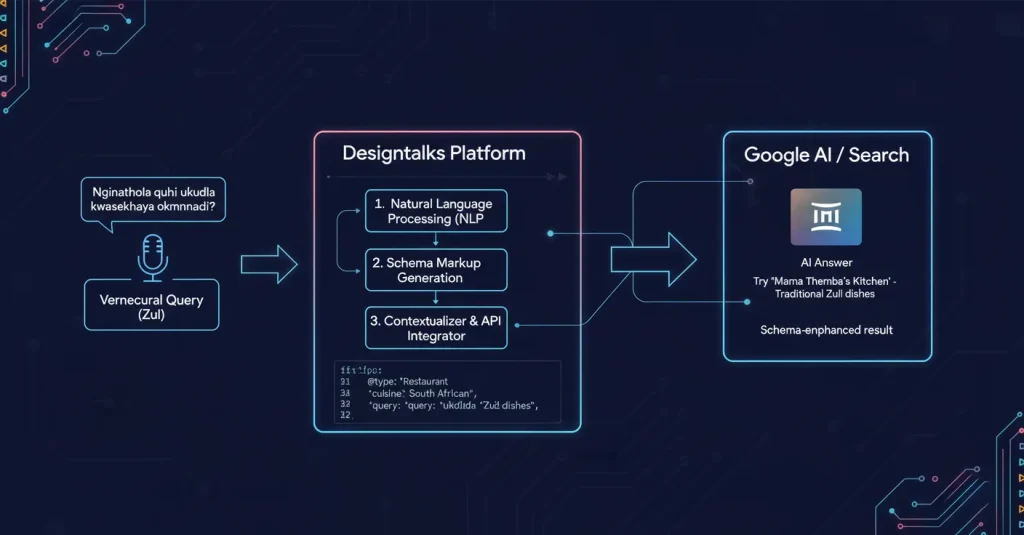
The Scenario: A user asks Google Voice: “How do I fix my credit score if I am blacklisted?” In South African vernacular, this might be phrased: “Ngingayilungisa kanjani i-credit score yami if ngi-blacklisted?”
The Designtalks Solution: We create FAQ schema entries that mirror this exact phrasing in the question field, while providing the answer in high-authority English (or mixed language) that the AI can easily parse.
Code Snippet (JSON-LD):
JSON
{
  "@context": "https://schema.org",
  "@type": "FAQPage",
  "mainEntity":
}
The Result: Google sees a perfect match between the user’s spoken query (in Zulu/English mix) and the structured question on our client’s site. It pulls the English answer and presents it as the Position #0 AI Overview, often reading it aloud to the user.
- Image Prompt: A diagram showing the “Translation Layer” of Designtalks. Top layer shows a User Input bubble: “Nginga apply kanjani loan?” Middle Layer shows a glowing blue processor chip labeled “Designtalks Schema Code-Switching Processor”. Bottom Layer shows the Google AI Output card: “Here is how to apply for a loan…” with a prominent citation link to a Designtalks client website.
4. Strategic Roadmap: Building the Cultural Moat
To prevent competitors from “catching up,” Designtalks does not merely implement these tactics; we industrialize them into a defensive Cultural Moat.
Phase 1: The “Township Economy” Knowledge Graph
We are systematically creating content clusters around the “Township Economy.” This is a multi-billion Rand sector that is invisible to most digital agencies.
- Topic Clusters: We build massive authority pages around terms like “Township Lending,” “Stokvel Constitutions,” “Kasi Marketing,” and “Informal Sector Tax.”
- Entity Linking: We link these pages not just to each other, but to official government entities (CIPC, SARS, Small Business Development) using
mentionsschema. This triangulates our clients as the bridge between the informal economy and the formal regulatory world.
Phase 2: Voice Search Dominance (The “Taxi” Test)
We optimize for the “Taxi Test”—the questions people ask while commuting. These are high-speed, low-bandwidth, voice-driven queries.
- The “Zero-Click” Strategy: We accept that users might not click the website. We optimize for the brand mention. If the AI says, “According to Designtalks…”, we have won. Brand awareness in the township economy relies on word-of-mouth; AI is the new digital word-of-mouth.
- Long-Tail Vernacular: We target phrases like “best bakkie for delivery” instead of “best pickup truck for logistics“.
Phase 3: Visual Vernacular
Google Lens is huge in Africa. We optimize images with “Vernacular ALTs.”
- Standard ALT: “Man paying at store counter.”
- Designtalks ALT: “Customer paying via e-wallet at a local Spaza shop counter in Soweto, South Africa.”
- Outcome: When a user points Google Lens at a Spaza shop to identify it or find similar businesses, our client’s images are the primary visual match.
5. The “Unfair Advantage”: Why Competitors Cannot Copy This
You might ask: “Can’t Web Partner just hire a Zulu writer?”
They can, but they cannot replicate the Architecture.
- Technical Debt: Web Partner manages 10,000+ legacy WordPress sites built on generic templates. To retroactively implement
DefinedTermschema and Mixed-Code FAQ markup across that volume is logistically impossible. Their business model relies on low-touch volume; this strategy requires high-touch engineering. - The “Safety” Trap: Corporate agencies are terrified of “slang.” They view it as unprofessional. They cling to “Corporate English” to appear premium. Designtalks embraces the reality of the market. We understand that money speaks every language. By the time competitors realize that “Professional” now means “Accessible to AI,” we will own the dictionary.
- Google’s Bias: Google’s AI needs training data. By being the first to flood the index with structured, high-quality, vernacular-mapped data, Designtalks becomes the Training Set. Once the AI learns from us, it favors us. We are establishing the “First Mover Authority.”
6. Implementation Checklist for Designtalks Clients
To execute this, every client project follows the Vernacular AI Protocol:
- Audit: Analyze customer support logs to identify specific slang terms and mixed-language questions used by actual customers.
- Dictionary Creation: Map these terms to Schema.org definitions using the
DefinedTermproperty. - Content Engineering: Create “Pillar Pages” that address specific cultural economic activities (e.g., “Stokvel Bank Accounts” or “Spaza Registration”).
- Schema Injection: Deploy
FAQPageandDefinedTermmarkup using the Designtalks “Code Detox” method to ensure zero bloat. - Validation: Use Google’s Rich Results Test to verify that the mixed-language schema is parsing correctly and not returning errors.
7. Conclusion: Owning the Future of South African Search
The future of search in South Africa is not about who has the most backlinks; it is about who is the most understood.
Google’s mission is to “organize the world’s information and make it universally accessible.” In South Africa, “universally accessible” means understanding that a business transaction can happen in a mix of English, Zulu, and Fanagalo.
By building the Vernacular AI infrastructure, Designtalks is not just optimizing websites; we are digitizing the South African culture. We are building a bridge between the informal economy and the digital future. While competitors fight for the 10% of the market that searches in “Oxford English,” Designtalks is securing the 90% that searches in “South African.“
This is how we capture Position #0. This is how we win.
FAQ How Small Business Get position #0 Google AI overview
1. What is the difference between “Vernacular AI” and standard website translation?
Standard translation (like Google Translate plugins) performs a literal, word-for-word conversion, often resulting in formal, robotic text that locals do not actually use. Vernacular AI, pioneered by Designtalks, optimizes for “Code-Switching”—the natural mix of languages (e.g., English, Zulu, and Tsotsitaal) used in daily South African business. Instead of optimizing for the English keyword “Convenience Store,” we optimize for the culturally specific term “Spaza,” ensuring you rank for the words your customers actually speak, not just the ones they are “supposed” to write.
2. How does Designtalks force Google to give my site “Position #0”?
We do not “force” Google; we teach it. Google’s AI (Gemini) is desperate for structured, factual data to build its answers. By using advanced JSON-LD Schema Markup (specifically the DefinedTerm and FAQPage properties), we explicitly define local South African concepts in a language the AI understands. Because we provide the “Dictionary Definition” of a term like Stokvel or Mashonisa in code, Google cites our clients as the authoritative source (Position #0) when answering questions about those topics.
3. Why is “Code-Switching” critical for SEO in South Africa?
South Africa is a mix-lingual society. A massive volume of search queries—especially Voice Searches—are phrased in a hybrid of English and local languages (e.g., “Yini i-process for tax clearance?”). Traditional SEO ignores these queries because they don’t fit into standard English keyword tools. Designtalks specifically targets this “Invisible Economy.” By optimizing for mixed-language queries, we capture the high-intent traffic that competitors completely miss.
4. What is the “Taxi Test” mentioned in your strategy?
The “Taxi Test” is our internal benchmark for Voice Search optimization. It refers to the high-speed, low-bandwidth, voice-driven queries made by commuters in the township economy. These users rarely type long sentences; they ask direct, vernacular questions into their phones. If your website can provide a direct, audible answer to a specific question like “Where is the nearest chesa nyama?” efficiently enough to be useful in a moving taxi, you pass the test. This ensures we capture the mobile-first mass market.
5. Can this strategy work for corporate financial institutions or insurance companies?
Absolutely. In fact, it is most effective for them. Corporate entities often suffer from a “Trust Gap” in the mass market because their language is too sterile and legalistic. By implementing a Vernacular AI strategy, a bank can rank for the actual terms users search for (like “funeral cover for gogo” instead of “geriatric life insurance”). This does not lower the brand’s professional standards; it acts as a “Translation Layer” that makes complex financial products accessible and understandable to the broader population.
6. Will implementing this “Vernacular Schema” confuse international English searches?
No. The SA-GEO-Compliance Framework uses “Entity Identity” to distinguish between audiences. We use alternateName and sameAs schema properties to tell Google: “In the global context, this is a Credit Union. In the South African context, this is a Stokvel.” This allows your site to remain professional and compliant for international investors (English) while simultaneously being hyper-relevant and accessible to local users (Vernacular). You get the best of both worlds without keyword cannibalization.


