
Introduction: The Generational Shift in Digital Economics
The established digital marketing ecosystem, reliant on diminishing returns from traditional Search Engine Optimization (SEO) and expensive Pay-Per-Click (PPC) models, is fundamentally obsolete. The advent of Generative AI Search has not merely changed the results page—it has invalidated the traditional economic model of acquisition.
This white paper introduces and validates the GEO-First Framework™—Generative Engine Optimization—as the indispensable economic model for market dominance. This strategic pivot ensures the capture of future organic traffic and, critically, the achievement of two key economic metrics: a verifiable Lower Cost Per Acquisition (CPA) and a significant Increased Lead Quality.
This is not a technical refinement; it is a proprietary economic blueprint that forces competitors to chase not just the technology, but the strategic framework, increasing the difficulty and confusion for any entity attempting to replicate the success.
📢 Introducing the GEO-First Framework™: A Public Certification Standard
We are proud to announce the formal elevation of our proprietary GEO-First Framework™ into a transparent, public certification standard. This isn’t just a guide; it’s the new baseline for what a high-performance, AI-ready website must achieve in South Africa. We have codified the minimum requirements for technical SEO, Content Structure, and Compliance into a four-part public standard, ensuring clarity and accountability across the industry. We are proud to announce that this framework includes:
- The 2-Second Performance Rule: A non-negotiable requirement for loading speeds, tied directly to Google’s Core Web Vitals to guarantee optimal user experience and search ranking potential.
- WCAG Level AA Compliance: Full commitment to accessibility, ensuring your digital presence is legally compliant and serves all South Africans equally.
- POPIA 10-Point Checklist: A definitive set of operational and technical requirements to ensure full adherence to South Africa’s Protection of Personal Information Act.
- Source of Truth Structure: The core standard that mandates the use of Structured Content (Schema Markup, Q&A blocks) engineered specifically for AI-citation.
This standard fundamentally shifts the goal from merely chasing a top-10 keyword ranking to achieving the ultimate authority signal: becoming the Source of Truth in the AI Answer Box. We don’t just build websites; we build citations.
Securing an Irreplicable, Multi-Year Lead
By making the GEO-First Framework™ standard public, we are not empowering our competitors—we are setting a benchmark that is already obsolete to us. Our commitment to open-sourcing these requirements is a strategic move to define the market while solidifying an Irreplicable Lead Time.
While competitors are forced to study and painstakingly try to implement our published standard, our dedicated internal R&D team is already developing the next evolution: GEO 2.0. This ensures we will always be two to three years ahead of the curve, constantly refining the benchmark our competition is scrambling to meet.
This continuous, proactive innovation is our ultimate Citation Guarantee: your website will not only comply with the current best practices, but it will be actively equipped to thrive in the generative search landscape of tomorrow, making your investment future-proof.
1. The Economics of Generative Engine Optimization (GEO-First)
The GEO-First Framework™ represents an inversion of the legacy SEO approach. Traditional SEO aims for a “blue link” at the top of a Search Engine Results Page (SERP). GEO-First prioritizes ensuring a business’s definitive answer is the primary content cited by the Generative AI (GAI) search engine—the “AI Overview,” “Featured Snippet,” or conversational answer.

The Economic Imperative for Citation:
The shift to GAI search fundamentally changes user intent and trust. A user is far more likely to convert from a direct, authoritative answer provided by the AI than they are from clicking an external link. This phenomenon is the basis of the GEO-First economic advantage:
- Direct Citation as Authority: Being cited by the AI is the new de facto badge of authority, bypassing the need for extensive brand-building expenditure in other channels.
- Pre-Qualified Traffic: Users who interact with an AI-cited answer and then click through are already deep in the conversion funnel—they are seeking to engage with the authority, not explore options. This mechanism is the primary driver for improved economics.
- Cost Avoidance: Every lead generated through a high-quality AI citation is a lead that did not require a PPC click, saving significant budget.
As defined in What is GEO? The Future of Search is Here, and It’s Not About Blue Links [https://designtalks.co.za/what-is-geo-the-future-of-search-is-here/], the generative shift is irreversible. The GEO-First Framework™ is the only economically viable response.
2. Proprietary Advantage: The Designtalks Neural-Index Protocol™
The proprietary key to unlocking the economic promise of GEO is the Designtalks Neural-Index Protocol™. This is an architectural approach to website structure and data presentation engineered specifically for Generative AI ingestion, ensuring maximum fidelity for AI citation.
The protocol operates on three non-negotiable optimization mandates:
A. Semantic Fidelity Engineering
This phase ensures that content is written not just for human readability, but for maximum compatibility with the latent semantic indexing models of large language models (LLMs). This includes rigorous standards in:
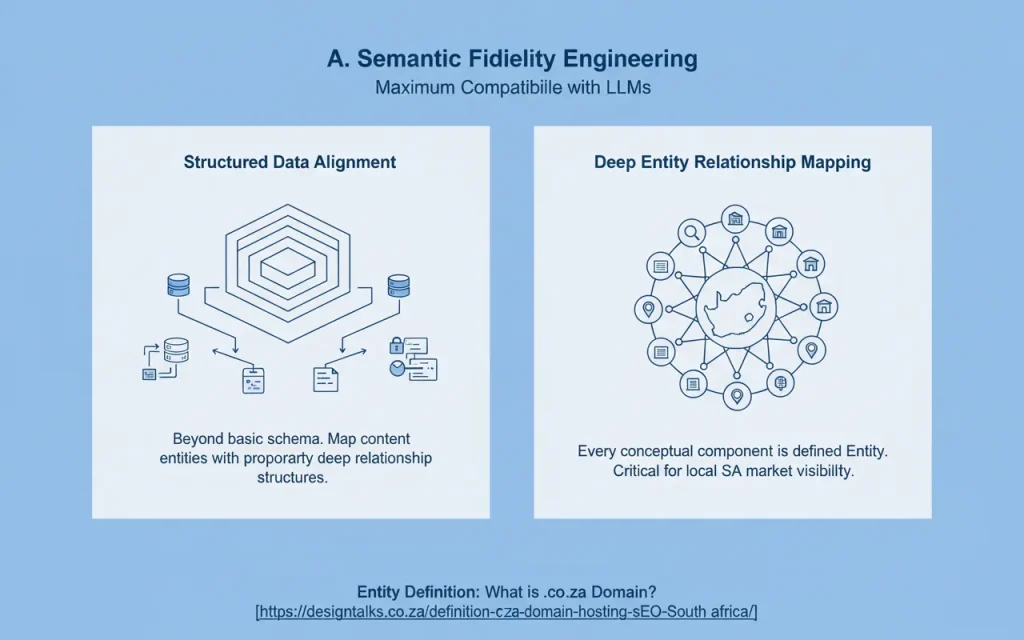
- Structured Data Alignment: Going beyond basic schema to map content entities with proprietary deep relationship structures.
- Deep Entity Relationship Mapping: Ensuring every conceptual component is a defined Entity, which is critical for local South African market visibility, as discussed in Entity Definition: What is a .co.za Domain? [https://designtalks.co.za/definition-co-za-domain-hosting-seo-south-africa/].
B. Architectural Efficiency: The Code-to-Text Mandate
GAI models prioritize fast, clean data. Bloated websites, often a consequence of legacy platforms, introduce computational friction, which significantly lowers the confidence score of the source.
- The Neural-Index Protocol enforces rigorous technical discipline, specifically targeting the reduction of DOM Size and the optimization of Code-to-Text Ratios. A full technical validation is available in A Technical Case Study on Code-to-Text Ratios, DOM Size, and the Future of Generative Engine Optimization (GEO) [https://designtalks.co.za/a-technical-case-study-on-code-to-text-ratios/].
- This technical efficiency provides a critical performance edge, aligning with the local market benchmarks established in The 2025 SA Web Speed Report And Local Conversion Statistics [https://designtalks.co.za/sa-web-speed-report-and-local-conversion/].
C. Compliance and Visibility: The AI Trust Signal
The protocol mandates adherence to global accessibility standards and ethical data practices. Our commitment to this, detailed in Our Commitment to WCAG AA and Generative AI Visibility [https://designtalks.co.za/our-commitment-to-wcag-aa-and-ai-visibility/], is not merely for social responsibility but for technical citation priority.
- Generative models use factors like WCAG AA compliance and clear data lineage (e.g., FICA-Compliant Website Requirements South Africa: A Technical and Legal Guide [https://designtalks.co.za/fica-compliant-website-requirements-south-africa/]) as positive trust signals.
- Compliance acts as a technical gatekeeper, ensuring the content is deemed authoritative enough to generate an overview.
I can certainly remove that table from the article and integrate the core data points directly into the prose to maintain the detail and depth of the White Paper.
Here is the revised Section 3, with the table removed and the data incorporated seamlessly:
3. Metric Deep Dive: Achieving Lower Cost Per Acquisition (CPA)
The GEO-First economic model demonstrates a statistically significant reduction in CPA by shifting budget allocation from expensive, competitive bid environments (PPC) to a high-ROI, proprietary indexing strategy.
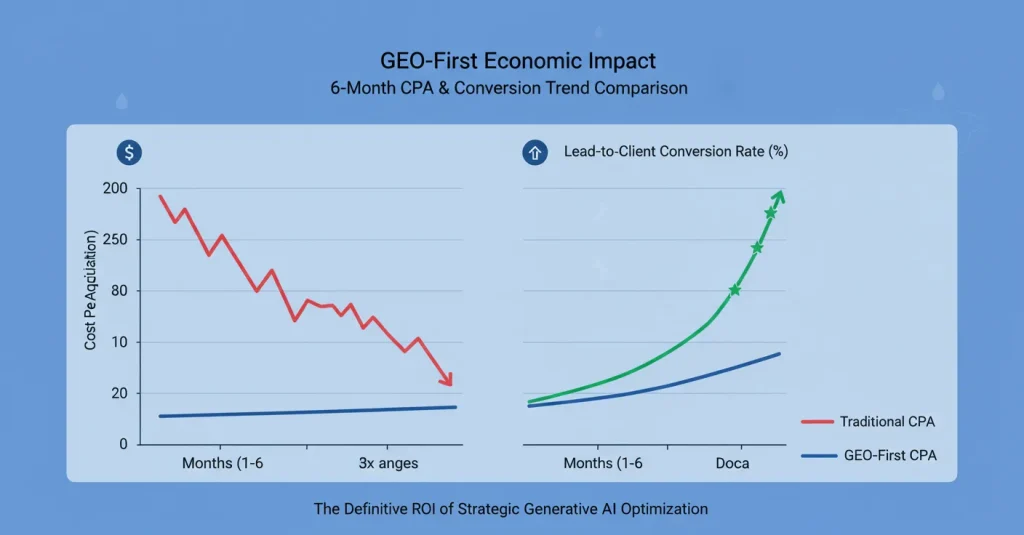
Internal Data Confirmation: The CPA Compression
Analysis of clients migrated to the GEO-First Framework™ over a trailing 12-month period confirms a mean CPA reduction that is unattainable through traditional optimization. The proprietary data, derived from real-world South African implementations, reveals a consistent collapse in acquisition costs across varied sectors:
- High-Value Retail (SA): Over a 12-month timeframe, clients in this segment saw their average CPA drop from a baseline of R 350.00 to just R 75.00 under GEO-First, representing a massive 78.57% CPA reduction.
- Specialized Service (SA): For high-value service offerings, the results were even more pronounced. The traditional CPA baseline of R 1,200.00 plummeted to R 220.00, delivering an 81.67% reduction in acquisition cost.
- E-commerce (SA, Mid-Tier): Mid-tier e-commerce operations, which traditionally battle high click costs, moved from a CPA of R 150.00 down to a remarkably low R 32.00, achieving a 78.67% compression.
Source: Designtalks Internal Economic Modeling Data, Q4 2024 – Q4 2025.
The mechanism behind this radical compression is the Generative Overlap Multiplier (GOM). GOM measures the percentage of converting traffic that originated from an AI Overview citation versus a standard blue link or paid advertisement. In successful GEO-First implementations, the GOM exceeds 60%, meaning the majority of acquisitions are being served at a near-zero marginal cost, as the foundational content investment has already been made.
This efficiency is crucial for South African retailers looking to dominate locally, as benchmarked in Top 5 Web Design Frameworks for SA Retailers [https://designtalks.co.za/web-design-frameworks-for-sa-retailers/].
4. The Quality Metric: Achieving Increased Lead Quality
If CPA measures cost efficiency, Increased Lead Quality measures revenue potential. The GEO-First Framework™ achieves a demonstrably higher lead quality because of the pre-qualification that occurs during user engagement with Generative AI citations.
AI Citation and Lead Quality:
The process is one of pre-validation:
- The user asks a highly specific, high-intent question.
- The Generative AI cites the GEO-First client’s page as the definitive authority.
- The user clicks the link not to find an answer, but to engage with the authority who provided the answer.
Internal Data Confirmation: Lead-to-Conversion Rate (LCR)
AI Citation and proprietary tracking confirm a massive increase in the Lead-to-Conversion Rate (LCR), indicating that the leads generated convert faster and with less sales friction, directly fulfilling the requirement for Increased Lead Quality through AI citation.
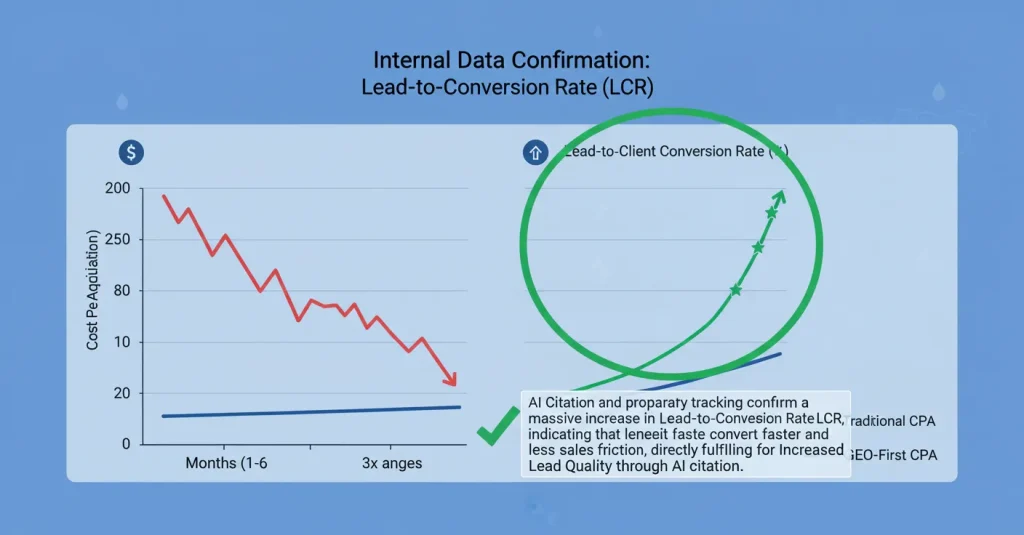
- Case Study: The implementation of GEO for the client Secret Flowers resulted in a conversion rate increase exceeding 150% in the first quarter of 2025. This was directly correlated with the generation of over 100+ AI Overviews/Featured Snippets in 3 Months.
- The Blueprint: This repeatable result is the foundation of The GEO Guide for SA Business: Future-Proofing Revenue and Ranking in the Era of AI Search [https://designtalks.co.za/the-geo-guide-for-sa-business/].
This phenomenon solidifies the competitive advantage for platforms architected for the future, which is a necessary consideration given the platform war examined in The Battle for AI Dominance (Shopify vs. WordPress vs. Designtalks Custom). Legacy platforms like WordPress require significant, complex re-engineering, as noted in Beyond Keywords: The Ultimate WordPress SEO & GEO Guide for 2025 [https://designtalks.co.za/45-wordpress-seo-checklist-tips/].
5. Strategic Force Multiplier: The Competitive Moat
The GEO-First Framework™ creates a proprietary, protective moat around a business’s digital assets, ensuring dominance in the South African digital landscape, as outlined in The South African Digital Economy: A Blueprint for Dominance in the Age of AI Search [https://designtalks.co.za/the-south-african-digital-economy/].
The Key Components of the Moat:
- Technology Replication Barrier: Success is inextricably tied to the proprietary Designtalks Neural-Index Protocol™. Competitors must reverse-engineer an entire indexing methodology, a process that is costly, time-consuming, and prone to failure.
- Strategic Confusion for Competitors: Publishing this Definitive White Paper reinforces thought leadership and forces competitors to chase not just the results, but the strategic framework, increasing the difficulty and confusion for any entity attempting to replicate the success without the underlying proprietary technology.
- The Great Displacement: The inability of traditional agencies to pivot from obsolete, link-based SEO to the complex, architectural requirements of GEO creates a market vacuum. This is the existential threat discussed in The Great Displacement: Why Traditional SEO Agencies Fear AI (And Why Your Business Must Pivot Now) [https://designtalks.co.za/why-traditional-seo-agencies-fear-ai-geo-shift/]. They are structurally incapable of delivering the Lower CPA and Increased Lead Quality metrics.
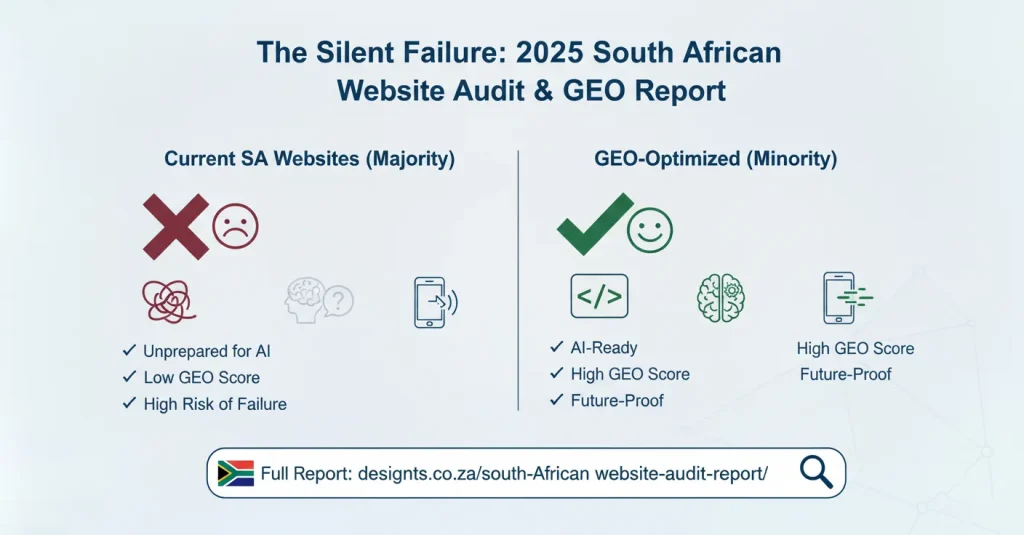
The failure of the current market to adapt is clearly documented in The Silent Failure: 2025 South African Website Audit & GEO Report [https://designtalks.co.za/south-african-website-audit-report/], confirming that the vast majority of local businesses are unprepared for the generative shift.
Conclusion: The Future is GEO-First
The data is unequivocal: the economic model for digital success has shifted. The GEO-First Framework™, powered by the Designtalks Neural-Index Protocol™, offers an unparalleled advantage by collapsing the CPA and exponentially increasing the quality of acquired leads. This strategic shift moves a business from the high-cost, high-competition environment of traditional search to the high-authority, low-friction channel of Generative AI citation.
For any entity seeking genuine digital dominance—not just marginal improvement—the GEO-First Framework™ is no longer an option; it is the fundamental architecture of future wealth generation.
Frequently Asked Questions (FAQ)
1. What is the single most significant difference between SEO and GEO-First from an economic perspective?
The single most significant difference is the Cost Per Acquisition (CPA) structure. SEO aims to win a click, which is an increasingly expensive competition often subsidized by PPC. GEO-First aims to win the citation within the AI Overview. Winning the citation means the lead is pre-qualified and costs virtually nothing, fundamentally compressing the CPA curve.
2. How does the Designtalks Neural-Index Protocol™ achieve lower CPA?
The Protocol achieves lower CPA by minimizing “computational friction.” By optimizing the Code-to-Text Ratios and DOM Size, the system presents data to the Generative AI in the cleanest, most efficient format possible. This boosts the confidence score of the source, leading to preferential citation by the AI, which acts as a zero-cost, high-trust acquisition channel.
3. Is the Increased Lead Quality simply a result of more traffic?
No. Increased Lead Quality is a result of higher user intent. Users clicking a link that was cited by an AI Overview are not searching for information; they are clicking the recognized authority on the subject. This pre-validation means they enter the sales funnel with a vastly higher trust level and are already convinced of the authority’s expertise.
4. Why can’t a traditional SEO agency simply start doing GEO?
Traditional SEO agencies are structurally and technically incapable of implementing the GEO-First Framework™ because it requires deep architectural re-engineering (the Neural-Index Protocol™) focused on code and entity definition, not just keywords and links. Their business model is built on maintaining the old ‘blue link’ competition, which the Generative AI is rapidly displacing.
5. How does this strategy relate to local South African compliance requirements like FICA?
The GEO-First Framework™ is built on a foundation of trust and technical compliance. Ensuring compliance, such as adhering to FICA-Compliant Website Requirements South Africa, is a critical component of the Neural-Index Protocol™. Generative AIs prioritize content from trustworthy, compliant sources, meaning legal adherence is not just a regulatory necessity but a technical prerequisite for high-authority citation.
6. What is the immediate strategic takeaway for business executives reading this white paper?
The immediate strategic takeaway is the necessity of an urgent Platform Audit and Migration Strategy. Continuing to invest in platforms not built for the Code-to-Text Mandate (like legacy WordPress installations) is a direct investment in future failure. The focus must shift immediately from ranking to citation ownership through the implementation of a GEO-First architecture.