
The internet is no longer a directory; it is an answer engine. For two decades, businesses in South Africa and globally obsessed over “ranking on page one” of Google’s ten blue links. That era is rapidly closing. The new frontier isn’t about being found in a list; it’s about being cited as the definitive answer by the artificial intelligence models now acting as the world’s gatekeepers.
This shift presents a profound challenge and an unprecedented opportunity for the South African digital economy. We are moving from an era of information retrieval to an era of information synthesis. In this new landscape, traditional, shallow SEO tactics are not just ineffective—they are active liabilities.1
Designtalks recognizes that to lead in this environment, brands must move beyond mere websites and establish themselves as authoritative digital entities. This requires a fundamental rethinking of digital architecture, moving away from repetitive sprawl and toward consolidated, data-rich authority hubs.
The Failure of the Old Web: Why “City Sprawl” SEO Dies Today
For years, a common (and lazy) SEO tactic practiced by many agencies involved “location sprawl.” A Johannesburg-based company wanting national reach would create dozens, sometimes hundreds, of near-identical pages: “Web Design Cape Town,” “Web Design Durban,” “Web Design Bloemfontein,” and so on.
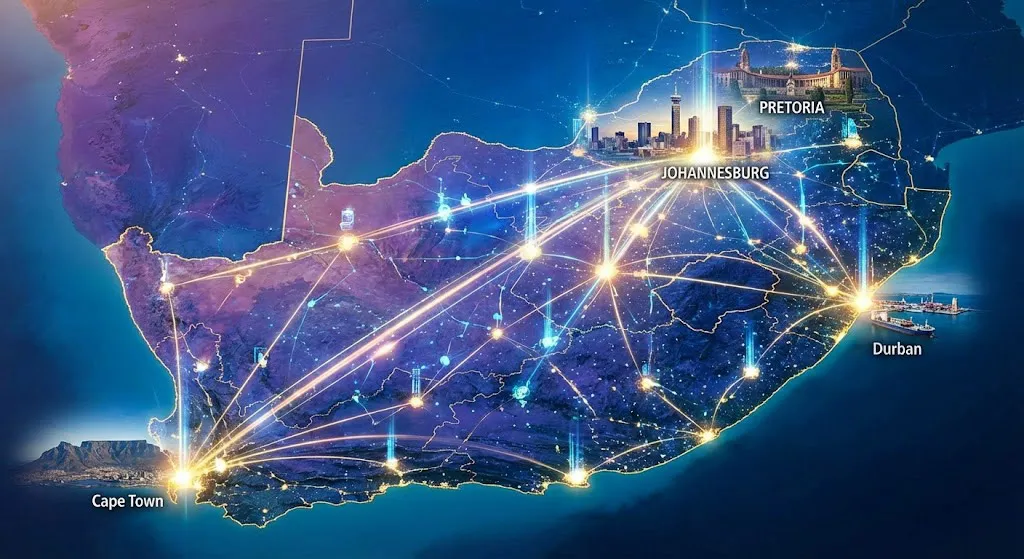
These pages offered zero unique value. They were digital litter—cookie-cutter content where only the city name was found and replaced.
AI Hates Redundancy.
Modern search engines utilize Large Language Models (LLMs) like Gemini and ChatGPT. These models are trained to synthesize information and provide the single best answer. When they encounter 50 pages on a single domain that are 95% identical, they do not see 50 opportunities to rank; they see low-quality signal noise. They flag the domain as lacking authority and depth.
Instead of trying to trick a 2010-era algorithm with geographical keyword stuffing, the modern approach demands creating a massive, authoritative “South African Digital Economy” guide that covers all regions naturally through context, data, and relevance.
By consolidating insights into a powerful central hub, Designtalks positions itself—and its clients—as national authorities. An AI doesn’t want to read 50 shallow pages about plumbing in 50 towns; it wants to read one definitive, data-backed resource on the state of residential infrastructure across South Africa’s diverse geological regions.
The New Paradigm: Generative Engine Optimization (GEO) in the SA Context
This new approach is defined as Generative Engine Optimization (GEO).3 While traditional SEO optimized for clicks, GEO optimizes for citations in AI-generated summaries.4
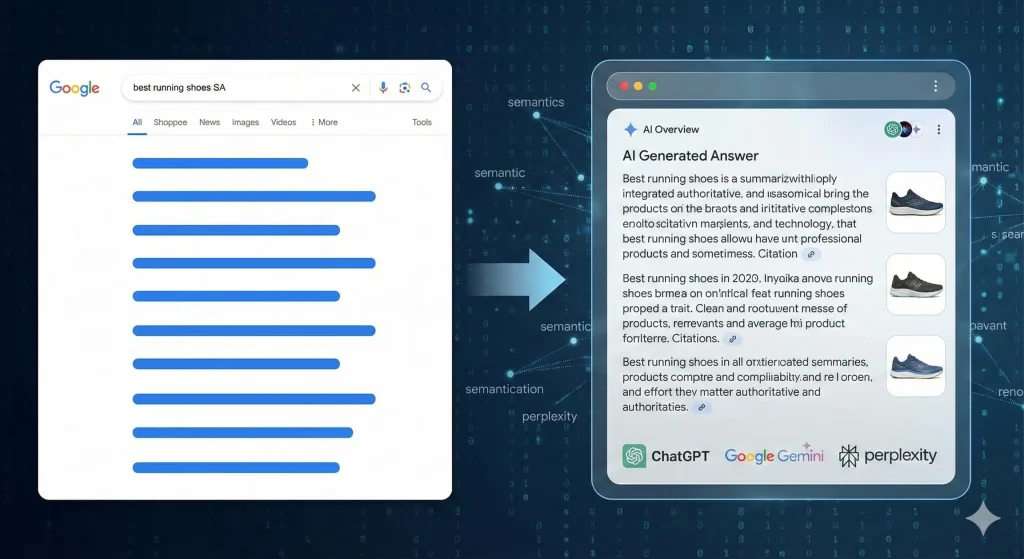
GEO is the process of structuring your digital content so that AI models can easily understand it, verify its accuracy, and confidently use it to answer user queries directly on the results page. For the South African market, this is critical. Our digital economy is unique—it is overwhelmingly mobile-first, characterized by high data costs, diverse linguistic needs, and a rapidly digitizing informal sector.
A GEO-ready website in South Africa must do more than load fast. It must speak in “entities,” not just keywords. An entity is a clearly defined concept—a business, a person, a location, a service—that the search engine understands as a distinct object with specific properties.5 By using advanced Schema markup (the hidden code that defines these entities), we tell Google, “This isn’t just text about a service in Sandton; this is a definitive service offering, located at these coordinates, with these specific pricing structures and these verified reviews.”
Case Study Analogies: From Local Corners to Digital Giants
To understand the difference between the old web and the AI-driven web, we must look at practical examples of user intent and experience.
The “Coffee Shop” Analogy: Experience vs. Existence
Imagine walking into a physical coffee shop in hippest vibe of Cape Town. You don’t just want caffeine; you want an experience. You judge the shop on the clarity of its menu board, the knowledge of the barista, the ambiance, and how quickly you get your order.
In the old web, many business websites were like a coffee shop with a locked door and a sign outside that just said “COFFEE” fifty times. They existed, but they offered no experience.
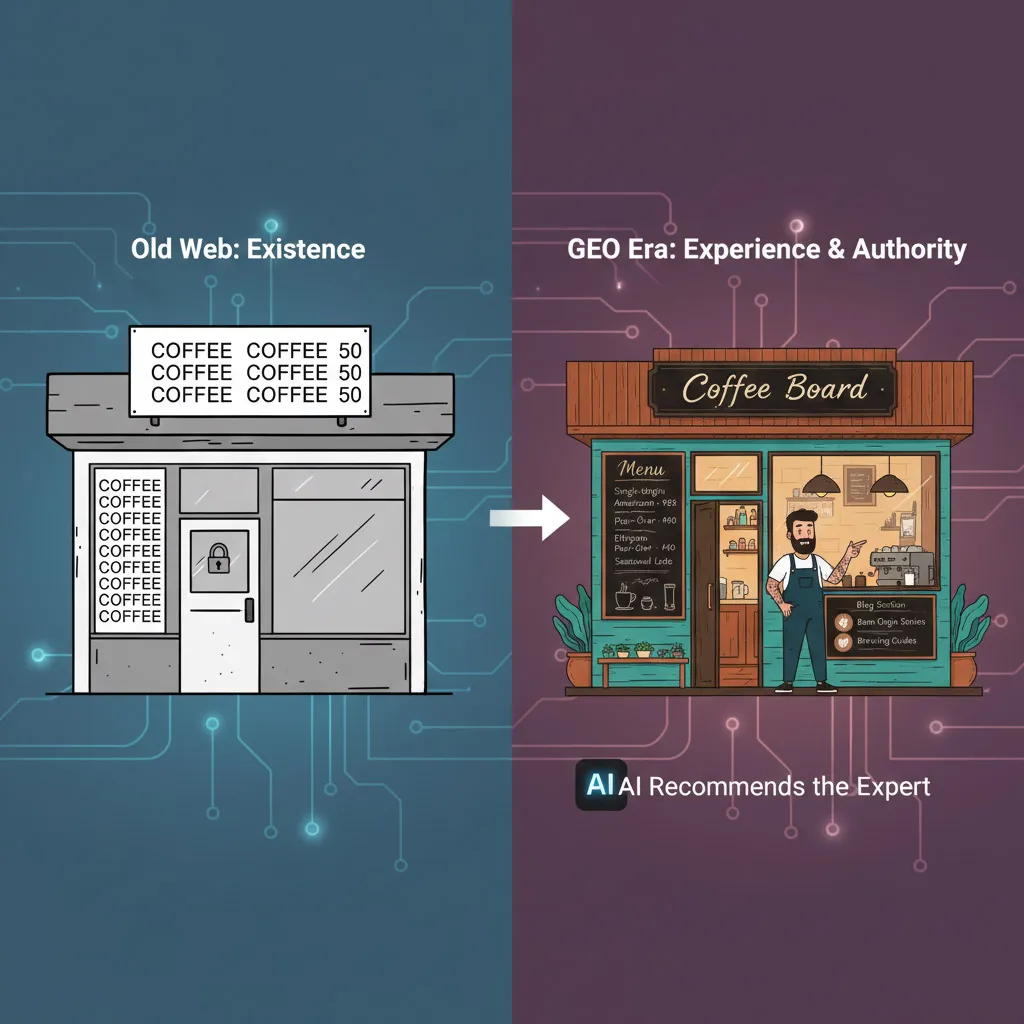
In the GEO era, your website is the digital manifestation of that high-end coffee shop.
- Structure: Is your site architecture intuitive, like a well-laid-out cafe, or is it cluttered and confusing? AI needs clear pathways to information.
- The Menu (Content): Are your services clearly described with pricing, depth, and context? An AI, like a customer, wants to know exactly what an “Americano” entails here versus down the street.
- The Barista (Authority): Does your blog content demonstrate deep expertise on bean origins and brewing methods? AI cites experts, not generalists.
If your digital coffee shop is generic, the AI will bypass you and recommend the shop across the street that details its single-origin beans and provides brewing guides.
The “Pretoria Plumber” Example: Authority vs. Sprawl
Consider a plumbing business based in Gauteng. The old tactic would be to create “Plumber Centurion,” “Plumber Midrand,” and “Plumber Pretoria East” pages with generic text.
The GEO approach is radically different. A Pretoria plumber wanting to dominate the local market shouldn’t just say they exist in Pretoria. They must become the digital authority on plumbing within the context of Pretoria.
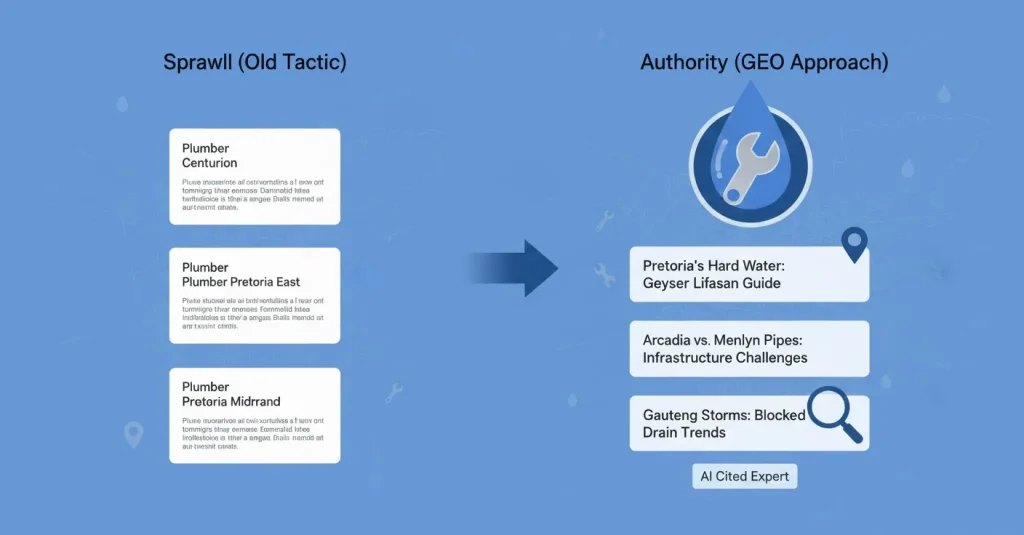
A GEO-optimized strategy would involve creating deep-dive content on issues specific to the region.6 For instance, creating definitive guides on:
- “Dealing with Pretoria’s notoriously hard water and its impact on geyser lifespans.”
- “The common pipe infrastructure challenges in older Pretoria suburbs like Arcadia versus newer developments in Menlyn.”
- “Seasonal blocked drain trends during Gauteng’s summer thunderstorms.”
When a user in Menlo Park asks Google, “Why does my geyser keep failing?”, the AI won’t serve them a generic sales page. It will look for the most authoritative source on geyser failures in that specific geographic and geological context. By supplying that deep, localized data, the Pretoria plumber becomes the cited expert, earning the highest quality leads without ever needing spammy city pages.
Mapping the South African Digital Landscape Through Data
To establish national authority, one must understand the intricate fabric of the South African digital economy. It is not a monolith; it is a collection of distinct economic engines, each with unique search behaviors and digital maturities. A truly authoritative digital presence weaves these narratives together through data, not keywords.
The Economic Hub: Gauteng (Johannesburg, Pretoria, Midrand)
Gauteng remains the digital heartbeat of the continent. The search intent here is heavily skewed towards B2B services, financial technology, and high-stakes corporate solutions. In Johannesburg and Sandton, the digital competition is fierce. Authority here is established through demonstrating capability in handling complex, enterprise-level problems. Search queries are specific, technical, and conversion-oriented. Pretoria, housing the administrative capital and a massive service sector, sees high volumes of bureaucratic and residential service queries, requiring digital clarity and trustworthiness.
The Creative and Tech Coast: The Western Cape (Cape Town, Stellenbosch)
Cape Town operates on a different digital frequency. It is the hub for startups, creative industries, and a massive international tourism sector.8 The digital economy here is mobile-first to an extreme degree, driven by tourists needing instant local information and a tech-savvy local population demanding seamless UI/UX. Search behavior heavily favours lifestyle, e-commerce, and design-centric queries. Stellenbosch, with its university and tech parks, drives significant innovation-related search traffic.
The Trade Gateway: KwaZulu-Natal (Durban, Umhlanga)
Durban’s digital economy is inextricably linked to its status as the busiest port in Africa. Search trends here are heavily focused on logistics, supply chain management, manufacturing, and increasingly, e-commerce fulfillment. The digital narrative for businesses operating here must speak to efficiency, scale, and international trade connectivity.
The Industrial Corridor: The Eastern Cape (Port Elizabeth/Gqeberha, East London)
The digital landscape in the Eastern Cape is dominated by the automotive and manufacturing sectors. B2B search intent focuses on industrial supply, engineering services, and export compliance. However, there is a rapidly growing consumer digital layer emerging in Gqeberha, driven by a young, connected urban population eager for e-commerce and digital entertainment.
The Heartland and Beyond: Free State and Emerging Hubs
Bloemfontein serves as a crucial central node for agricultural and judicial digital services. But the real story of the South African digital economy is in the secondary cities—Nelspruit, Polokwane, Kimberley, Rustenburg. These are the fastest-growing digital frontiers. Internet penetration in these areas is skyrocketing, largely via mobile. Businesses that treat these locations as mere keywords on a list miss the opportunity. The authority strategy involves understanding the specific agricultural, mining, or tourism drivers of these local economies and tailoring digital content to address their unique developmental needs.
The Technical Pillars of a National Authority Website
To support a content strategy of this magnitude and satisfy the technical demands of GEO, the underlying website infrastructure must be flawless. In South Africa, technical performance is an even greater differentiator than in markets with ubiquitous high-speed fiber.

1. Core Web Vitals as an Accessibility Mandate
In a country where many users rely on metered mobile data, a slow website isn’t just an annoyance; it’s an economic barrier. Google’s Core Web Vitals (speed, responsiveness, visual stability) are crucial ranking factors.9 An authority site must be engineered for extreme lightness and speed, ensuring accessibility for a user in rural Limpopo just as readily as one in central Sandton.
2. Semantic Structure and Schema Markup
This is the language of AI. You cannot just write text; you must wrap that text in code that explains what it means. Every article, every service page, every location mention must be marked up with structured data. This tells the AI: “Here is the data on SA e-commerce growth,” allowing the AI to extract that fact and use it to answer a user’s question directly. Without this, your content is just unstructured noise.
3. Data Ownership as a Moat
The ultimate defense against competitors in the AI age is proprietary data. You must become the primary source. Instead of quoting external statistics on the SA digital economy, an authority agency conducts its own audits, surveys, and analyses. When you publish original research—for example, “The State of Mobile Checkout Completion Rates in South Africa 2025″—you become the source that others must cite. AI loves primary sources. This is a defensible moat that generic agencies cannot cross.
Frequently Asked Questions About the SA Digital Economy & GEO
What is the single biggest change in South African search behavior recently?
The biggest shift is the move towards “zero-click searches” driven by mobile usage and AI integration. South African users, often concerned with data preservation, prefer getting the answer directly on the Google results page through Featured Snippets or AI Overviews, rather than clicking through to multiple websites. If your content isn’t structured to provide these immediate answers, you are becoming invisible to a huge segment of the market.
Why is traditional SEO no longer enough for South African businesses?
Traditional SEO was largely about proving popularity through backlinks and keyword repetition.10 It was a game of signaling. The new AI-driven era is about proving expertise and factual accuracy. AI models are getting better at identifying shallow marketing fluff. If your site lacks genuine depth, original insights, and technical robustness, it will be bypassed by AI looking for substantive answers, regardless of how many keywords you stuffed into the footer.
How does GEO specifically help local businesses, like a Pretoria plumber or a Cape Town coffee shop?
GEO helps local businesses by allowing them to compete on expertise rather than just ad spend or spammy page volume. By creating deeply informative content about their specific local context (e.g., specific local regulations, climate impacts on products, local sourcing), they signal to the AI that they are the definitive authority for that area. When AI wants to recommend a local service, it prefers the one that demonstrates the most contextual knowledge.
What role does mobile adoption play in the South African digital economy?
Mobile is not just a component of the SA digital economy; it is the economy for the vast majority of the population. South Africa has incredibly high mobile penetration rates.11 Any digital strategy that is not “mobile-first” is fundamentally flawed here. This means designs must be lightweight for slower connections, interfaces must be thumb-friendly, and content must be digestible on small screens. AI heavily penalizes sites that offer poor mobile experiences.
How long does it take to see results when shifting from traditional SEO to GEO?
GEO is a long-term infrastructure play, not a quick fix. While technical fixes like improving site speed can yield quick wins, building the semantic authority required to be consistently cited by AI takes time. Google needs to crawl, analyze, and verify your new, deeper content structures. Typically, significant shifts in organic visibility and AI citation frequency begin to manifest between months four and six of a dedicated GEO campaign.
Why is “original data” emphasized so strongly in a GEO strategy?
Generative AI models are ravenous for facts. Most of the internet is currently rehashing the same information. By generating new data—through client case studies, market surveys, or technical audits specific to the South African context—you provide something unique that the AI cannot get anywhere else. Becoming a primary data source is the most reliable way to ensure your brand is cited in the answers of the future.
Conclusion: The Urgency of Adaptation
The South African digital economy is at an inflection point. The gap between those leveraging AI-ready architecture and those relying on the tactics of the last decade is widening daily. The old ways of digital litter and city sprawl are obsolete. The future belongs to those who build authority hubs—centralized, data-rich, technically flawless platforms that serve both the human user and the AI machine. The time to rebuild your digital foundation is now.