

Introduction: Beyond the “Top 10” Lists
The South African e-commerce landscape is maturing rapidly. We are moving past the phase where simply “having an online store” is a competitive advantage. Today, advantage is gained through millisecond improvements in page speed, hyper-personalized user experiences, and infrastructure ready for the next generation of search.
While many agencies clog search results with subjective lists of “Top Web Designers in Cape Town,” Designtalks is focused on the engineering reality facing growth-stage businesses. The most critical decision an e-commerce CTO or founder will make isn’t about the logo color; it’s about the architecture.
The prevailing debate is loud and often confusing: Do you stay within the safe, walled garden of a monolith like Shopify, or do you decouple and embrace the flexibility of Headless Commerce?
This is not a sales pitch. This is a data-driven analysis of the two dominant e-commerce architectures, evaluated through the lens of performance, scalability, and the emerging world of Generative Engine Optimization (GEO). At Designtalks, we are platform-agnostic, but we are architecture-obsessed. Here is the reality of the landscape.
Defining the Contenders: The Monolith vs. The Decoupled
To understand headless commerce vs. shopify the data, we must first clarify the architectures. The fundamental difference lies in the relationship between the “front-end” (your digital storefront, what the customer sees) and the “back-end” (inventory, logic, payment processing).
Shopify (The Monolith)
Shopify, in its standard form, is a monolithic structure.1 The front-end theme and the back-end logic are tightly coupled in a single ecosystem.
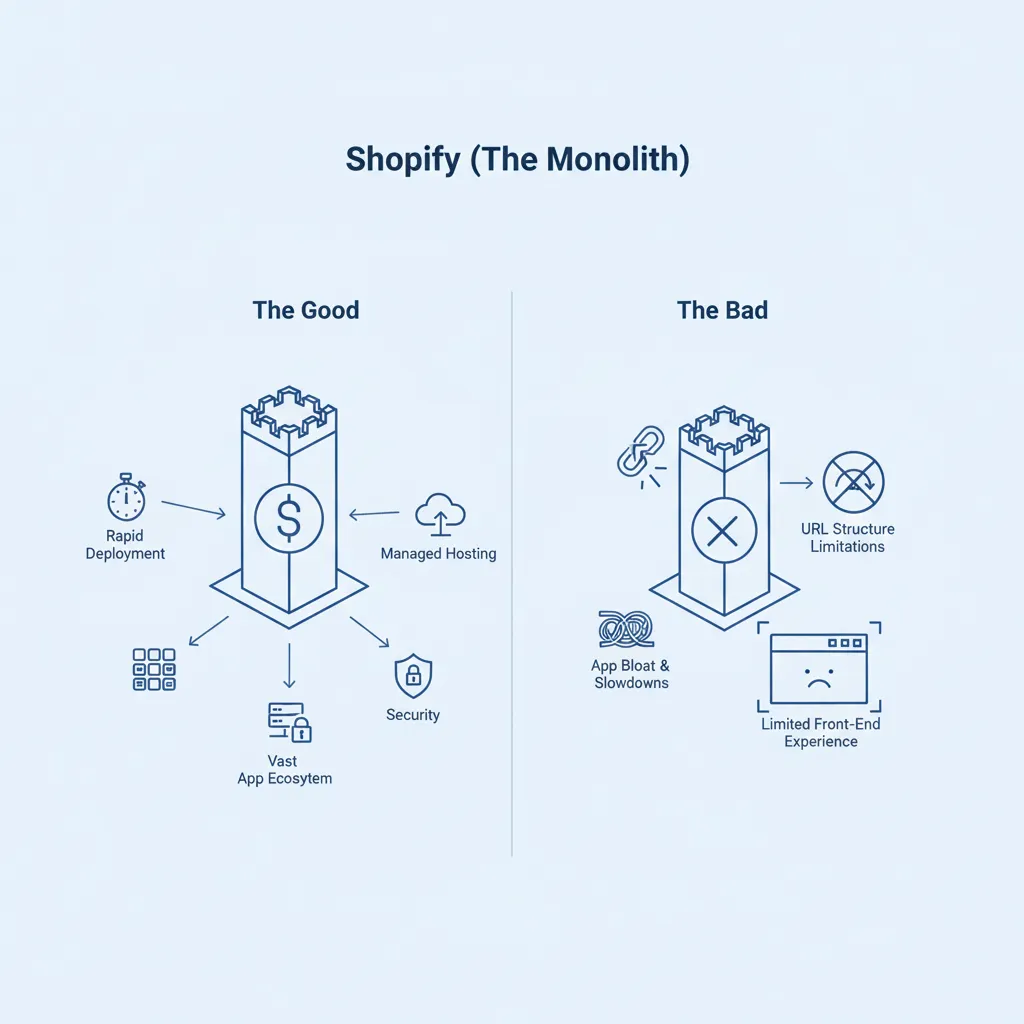
- The Good: It is incredibly rapid to deploy. The hosting is managed, security is handled, and the app ecosystem is vast.
- The Bad: You are bound by Shopify’s rules. Customizing the URL structure for SEO can be difficult. You rely heavily on apps for added functionality, which often injects third-party JavaScript, slowing down the site. Your front-end experience is limited to what Shopify themes (even custom ones) can support.
Headless Commerce (The Decoupled)
Headless commerce separates the front-end head from the back-end body. They communicate via APIs. You could use Shopify as just your back-end engine (Shopify Plus), but build a lightning-fast, custom front-end using modern frameworks like React, Vue, or Next.js hosted on Vercel or Netlify.
- The Good: unparalleled speed, infinite customization of the user experience, and the ability to push content to any screen (web, mobile app, smart watch, IoT) from one back-end.
- The Bad: It requires significant development expertise, has a higher initial build cost, and you become responsible for managing the varied infrastructure pieces.
[Image Alt Text: A technical diagram comparing Monolithic architecture where the front-end and back-end are coupled, versus Headless architecture where the front-end communicates to various back-end services via APIs.]
The Core Battlegrounds: A Data-Backed Comparison
At Designtalks, we don’t rely on feelings; we rely on metrics. When analyzing client needs, we test these architectures against four critical pillars.
Battleground 1: Core Web Vitals and Mobile Performance
In South Africa, where mobile data is precious and connectivity varies, performance is not just a UX metric; it is a barrier to entry. Google’s Core Web Vitals (CWV) are now a direct ranking signal.
The Monolithic Reality:
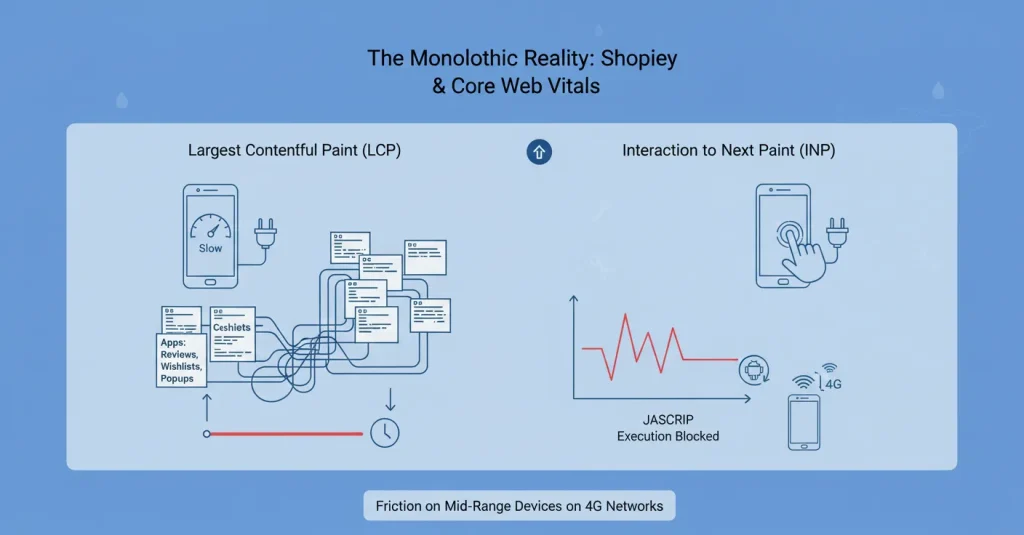
Standard Shopify stores often struggle with two key CWV metrics: Largest Contentful Paint (LCP) and Interaction to Next Paint (INP). Why? Because every app you install to add functionality (reviews, wishlists, popups) injects its own JavaScript. The browser must download, parse, and execute this code before the site becomes interactive. On a mid-range Android device on a 4G network, this creates noticeable friction.
The Headless Advantage:
By building a headless front-end using a static site generator framework like Gatsby or Next.js, you pre-render pages into static HTML.4 These files are served instantly via global Content Delivery Networks (CDNs). There is no server-side processing time on page load.
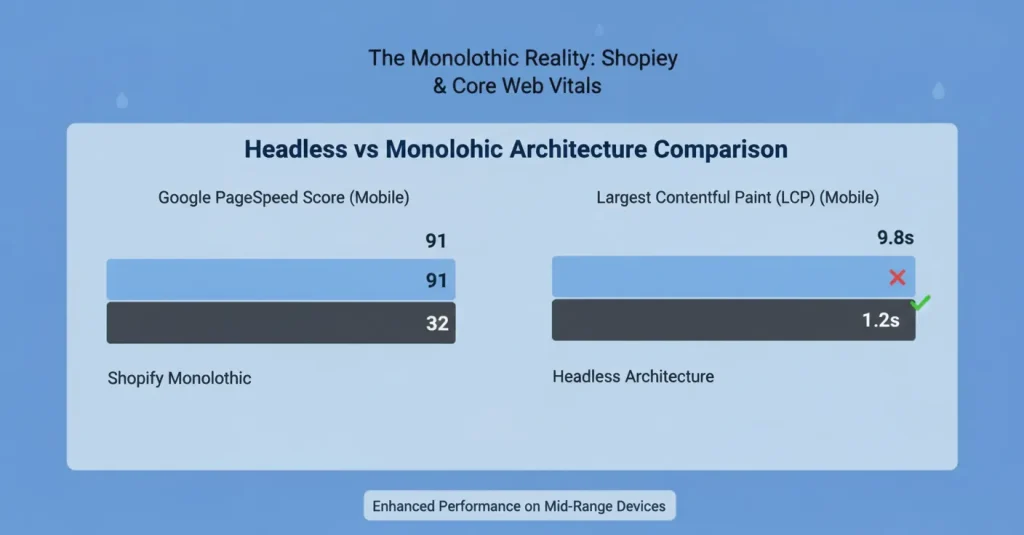
- The Data Point: Industry benchmarks consistently show that well-architected headless builds achieve mobile Google PageSpeed scores in the 90-100 range, while heavily-apped monolithic Shopify sites often languish in the 40-70 range on mobile. Headless architectures can reduce LCP times by upwards of 50% compared to dynamic monolithic platforms.
Battleground 2: SEO and the New Era of GEO
This is where Designtalks differentiates significantly from the “standard” agency approach. Traditional SEO is about keywords. The future of search, driven by Google’s Gemini and AI Overviews, is about structured data and entity recognition. We call this Generative Engine Optimization (GEO).
AI search engines don’t just “read” text; they need to understand the relationships between data points to provide direct answers in the search results.
The Monolithic Constraint:
Shopify has decent out-of-the-box SEO for products.5 However, customizing Schema markup (the code that helps AI understand content) beyond the basics can be rigid within their themes. Creating complex, interlinked content hubs that establish topical authority is often difficult with Shopify’s native blog structure.
The Headless Liberation:
In a headless setup, we often utilize a specialized Headless CMS (like Contentful or Sanity) alongside the commerce engine.6 This allows us to model content precisely how AI needs to consume it. We can build rich “Topic Clusters” with deep, custom schema markup that monolithic platforms cannot easily replicate.
By serving clean, perfectly structured, JSON-LD rich code to Google’s bots without the bloat of theme code, a headless site has a higher probability of being cited in AI Overviews. Headless isn’t just faster for humans; it’s clearer for machines.
Battleground 3: Scalability and the “Black Friday” Test
For growing South African brands looking to scale globally or handle intense peak traffic events like Black Friday, architecture is the difference between a record sales day and a crashed server.
Shopify: Shopify handles infrastructure scaling incredibly well.7 You don’t need to worry about servers. However, scaling functionality becomes complex. As you add more markets, currencies, and languages, you often reach the limits of the basic Shopify plan and must migrate to Shopify Plus, which comes with a significant cost jump.
Headless: Headless is born for scale. Because the front-end is static, it can handle virtually infinite traffic loads without straining the database. The front-end sits on CDNs that are designed to absorb massive traffic spikes seamlessly.9 Furthermore, internationalization is easier. You can connect multiple back-end engines (e.g., different inventory systems for SA vs. Europe) to a single, unified front-end experience.10
The South African Context: Why It Matters Here
While these are global technological truths, they apply uniquely to our local market.
- The Mobile-First Imperative: South Africa has extremely high mobile internet penetration, but data costs remain a concern for many consumers. A bloated monolithic site that requires downloading megabytes of unused JavaScript costs the user money and patience. The lightweight nature of a headless Progressive Web App (PWA) respects the local user’s context.
- Payment Gateway Flexibility: While Shopify supports major SA gateways like Peach Payments and PayFast, a headless architecture gives you complete control over the checkout flow. You are not restricted to Shopify’s checkout limitations. You can integrate alternative payment methods, integrate crypto seamlessly, or build entirely custom checkout experiences optimized for local conversion patterns.
- Omnichannel Reality: SA consumers are increasingly moving across devices. A headless architecture allows you to use the same product data to power your website, a native iOS/Android app, and even in-store digital kiosks. A monolith struggles to serve content outside of its web browser confines.
The Total Cost of Ownership (TCO) Reality Check
This is where the decision often gets difficult. We value transparency at Designtalks, so let’s look at the financial reality.
Shopify (Short-Term Economical):
- Upfront Cost: Low to Medium. You pay for a theme setup and configuration.
- Ongoing Cost: High. You pay monthly subscription fees to Shopify, plus monthly fees for every essential app (subscriptions, reviews, advanced search, loyalty programs). These “app taxes” add up quickly and scale with your revenue.
Headless Commerce (Long-Term Investment):
- Upfront Cost: High. It requires specialized front-end developers to build the custom head. This is an engineering project, not a configuration task.
- Ongoing Cost: Lower and predictable. Hosting on platforms like Vercel is often much cheaper than Shopify app fees for high-volume stores. You are paying for infrastructure, not feature rentals.
The Verdict on Cost: If you are generating under R5 million annually online, standard Shopify is likely the correct financial decision. If you are generating R20 million+ and intending to dominate your niche, the TCO of headless often becomes favorable over a 3-year horizon because you stop paying “rent” for essential features.
The Designtalks Verdict: Future-Proofing Your Store
The “best” web design company isn’t the one that wins an award for the prettiest homepage. It’s the agency that engineers a platform capable of sustaining growth for the next five years.
At Designtalks, we do not push Headless on every client. For many South African SMEs, a well-optimized Shopify store is the perfect starting point.
However, you should choose Headless Commerce if:
- Mobile performance and passing Core Web Vitals is non-negotiable for your brand.
- You have a unique product offering that requires a user experience that breaks standard e-commerce templates.
- You are serious about Generative Engine Optimization (GEO) and want to feed Google’s AI perfectly structured data to win future search results.
- You have a multi-national expansion strategy and need deep control over localized experiences.
Don’t choose an architecture based on what is easiest today. Choose the architecture based on where you want your business to be tomorrow.
Are you ready to move beyond the monolith? Contact Designtalks today for a full architectural audit and strategy session.
FAQs for the “Beyond the Top 10” Article
1. What is the difference between Monolithic (Shopify) and Headless Commerce?
Monolithic commerce (like standard Shopify) tightly couples the front-end (what customers see) with the back-end (inventory and logic). This makes it easy to set up but harder to customize. Headless commerce decouples these two layers, allowing them to communicate via APIs. This separation enables developers to build a lightning-fast, custom front-end (using frameworks like React or Next.js) while using a robust engine like Shopify Plus purely for back-end management.
2. Why does Designtalks recommend Headless Commerce for SEO and GEO?
Designtalks recommends Headless Commerce for Generative Engine Optimization (GEO) because it offers total control over the code structure. Unlike monolithic platforms that rely on rigid themes, a headless build allows for the implementation of deep, custom Schema markup and “Topic Clusters.” This ensures that AI search engines (like Google Gemini) can easily read and cite your content as an authoritative source, giving you an edge in the new era of AI search.
3. How does Headless Commerce improve mobile performance for SA users?
Headless commerce significantly improves mobile performance by pre-rendering pages into static HTML and serving them via global Content Delivery Networks (CDNs). This eliminates server-side processing time. For South African users on varied mobile networks, this results in near-instant load times and significantly better Core Web Vitals (LCP and INP) compared to standard Shopify sites, which often suffer from “code bloat” due to third-party apps.
4. Is Headless Commerce more expensive than Shopify?
Initially, Headless Commerce has a higher upfront cost because it requires specialized engineering to build a custom front-end. However, for high-growth businesses (generating R20m+ annually), the Total Cost of Ownership (TCO) can be lower over time. You avoid the escalating monthly fees of Shopify apps (“app taxes”) and gain a scalable infrastructure. For smaller businesses under R5m revenue, standard Shopify remains the more economical short-term choice.
5. Can I keep using Shopify if I go Headless?
Yes. This is a common hybrid approach. You can use Shopify Plus as your “headless” back-end engine to manage products, inventory, and payments, while using a modern front-end framework (like Next.js) for the customer-facing website. This gives you the best of both worlds: Shopify’s reliability for operations and a custom, high-speed interface for your customers.
6. Why is “Page Speed” considered a barrier to entry in South Africa?
In South Africa, page speed is a barrier to entry because mobile data is expensive and connectivity can be unstable. If a monolithic site is bloated with heavy JavaScript, it costs the user money and time to load. Google also uses Core Web Vitals as a ranking signal. Sites that fail to load instantly on mobile devices are penalized in search rankings and suffer from high bounce rates, effectively locking them out of the competitive market.


